

 Account


Crepey skin doesn’t creep in gradually. It shows up almost overnight, usually somewhere between 48 and 55, and most women I talk to blame themselves. They tell me they should have used more sunscreen. They say they shouldn’t have lost the weight so fast.
The real culprit is quieter and more structural. Up to 30% of skin collagen disappears in the first five years post-menopause, with another 2% lost every year after. Skin thickness drops 1.13% per post-menopausal year. That’s not aging in the cosmetic sense. That’s an estrogen-dependent structural failure, and crepey skin responds to the right inputs once you stop treating it as a surface problem.
What follows is the protocol I’d give my own mother. Botanical, layered, and built around what actually rebuilds the dermal-epidermal junction. No miracle promises, no marketing language, only what works when you stack the right inputs consistently.
1. Understand the Menopause-Crepey Skin Connection First
I had a client tell me her skin changed in six weeks. Six weeks. She wasn’t imagining it.
Estrogen receptors live directly inside your skin’s fibroblasts, the cells that produce collagen. When estrogen drops, those cells get the message instantly. Production slows. Existing collagen breaks down faster than it’s replaced. The structural scaffolding that kept your skin firm starts to thin from the inside out.
This is why moisturizer alone doesn’t fix it. You’re not dehydrated. You’re missing the structural inputs that estrogen used to support, including the lipids and fatty acids your skin needs to hold itself together. Water escapes. The barrier collapses. Skin starts to fold and crinkle in ways it never did before. I wrote a longer piece on the eight ways menopause changes your skin for the deeper context.
The verdict: crepey skin is a structural problem, not a cosmetic one. Once you treat it as a rebuilding project rather than a smoothing project, everything that follows makes sense.
2. Make Sea Buckthorn Oil the Foundation of Your Routine
Your body makes a specific fatty acid called palmitoleic acid, also known as omega-7, and it drops 60% after age 60. There is exactly one plant rich enough to replace it. Sea buckthorn.
This is why I built Frøya's anti aging products around this berry. It’s not a marketing choice. Omega-7 is structurally irreplaceable for post-menopausal skin, and almost nothing else in the plant world delivers it in usable concentrations.
Sea buckthorn also delivers more than 200 bioactive compounds, all four fat-soluble vitamins (A, D, E, and K2), and roughly 15 times the vitamin C of oranges. It’s one of the few oils that actually feeds the skin instead of sitting on top of it.
One practical warning. Undiluted sea buckthorn stains everything orange, including pillowcases, light shirts, and bath towels. Dilute it 1:3 in castor oil for body use. On the face, dilute to roughly 10% in a lighter carrier. Apply morning and night on damp skin.
Best for: anyone with sudden post-menopausal thinning, especially on inner arms and décolletage. Skip if: you can’t commit to the dilution step. For the deeper science on this berry, my sea buckthorn oil benefits guide breaks it down.
3. Layer GLA-Rich Oils Like Borage and Evening Primrose
Borage oil contains 20 to 24% gamma-linolenic acid. That’s the richest plant source of GLA on the planet. GLA acts as a gentle estrogen-like signal at the fibroblast level, which is exactly the signal your skin stopped getting at menopause.
Evening primrose is the gentler cousin, sitting at 7 to 10% GLA. Both work. Borage works faster on severely thinning skin.
The way I layer GLA oils matters. Sea buckthorn goes on first because it’s heavier and addresses the omega-7 deficit. Borage goes on second, focused on the areas where thinning is most visible. Inner arms, jawline, décolletage. The GLA gets driven deeper by the lipid base of the sea buckthorn underneath it.
You can also take borage or evening primrose orally, and many of my clients do both. Topical for the visible areas, oral for whole-body skin support. Neither is a substitute for the other.
If you add one more oil to your routine after sea buckthorn, make it borage. Evening primrose is the gentler alternative if borage feels too rich for your skin type.
4. Add Rosehip Oil for Linoleic Acid and Gentle Cell Renewal
You’ve been moisturizing twice a day and your skin still looks parched by 3 p.m. The problem isn’t moisture. Your skin has stopped producing the specific fatty acids that let it hold moisture in the first place.
Linoleic acid is one of those fatty acids. It’s an omega-6 and a structural component of your skin’s lipid barrier. Aging and estrogen decline both reduce your skin’s ability to produce it. Rosehip oil is 45% linoleic acid, which makes it one of the densest topical sources you can apply.
What makes rosehip especially useful for crepey skin is what else it carries. A naturally occurring trans-retinoic acid analog supports cell turnover without the irritation of prescription retinol. Vitamin C in the oil supports collagen synthesis at the dermal level. You’re getting three benefits in one ingredient: barrier repair, gentle renewal, and collagen support.
A study published in Clinical Interventions in Aging in 2015 followed women over 45 using rosehip topically for eight weeks. Skin elasticity improved measurably, alongside hydration and roughness scores. Eight weeks is a reasonable timeline for visible change.
For the longer breakdown, my rosehip oil guide for mature skin walks through the chemistry.
5. Apply Oils on Damp Skin Within Five Minutes of Showering
This is the cheapest, fastest improvement you’ll make. Don’t dry off completely.
When your skin is damp, with roughly 10 to 20% residual surface water within two to five minutes of showering, the lipid bilayer is more permeable. Oils penetrate further instead of pooling on the surface. The water gets trapped underneath the lipid layer you’ve applied.
Warming the oil in your palms before application matters more than people think. Warmed oil absorbs up to 40% better than cold oil applied straight from the bottle. Pour a few drops into one palm, rub your hands together for five seconds, then press into damp skin.
Direction matters too. On limbs, use upward strokes against gravity to support tone. On the décolletage and neck, use pressing motions instead of dragging. The skin there is too thin to pull at, especially after 50.
6. Add Lactic Acid Once a Week to Thicken Skin from Within
Most acids exfoliate. Lactic acid at clinical strength does something else. It actually thickens the deeper layers of skin over time.
This is one of the more counterintuitive findings in dermatology, and it’s been demonstrated repeatedly. Ammonium lactate formulations at 12% or higher don’t only smooth surface texture. They stimulate glycosaminoglycan production and increase the density of the stratum corneum, which means the skin gets structurally thicker, not softer alone. Dr. Dray walked through the mechanism in a video with more than 672,000 views, and the underlying research backs it.
For crepey skin, this is the rare active that addresses the root structural problem. Most actives improve appearance. Lactic acid at clinical strength rebuilds.
A few rules I follow. Use it once a week, not more. On the body, especially arms and inner thighs, use the 12% ammonium lactate formulation. On the face, switch to a gentler 5 to 8% lactic acid serum because facial skin can’t tolerate the stronger version regularly. Apply to dry skin, leave on, and follow with your moisturizer or oil layer.
Best for: crepey arms and inner thighs where mechanical thickening matters most. Skip if: you have rosacea, broken skin, or you’re already using retinoids regularly. Stacking acids and retinoids on already-thinning post-menopausal skin is a fast track to a damaged barrier.
7. Try Dry Brushing Before Showers (With Real Limits)
Half the dry-brushing advice online is wrong. It won’t fix cellulite. It won’t rebuild collagen. But it does something genuinely useful, and it’s worth four minutes.
A Cleveland Clinic dermatologist rated dry brushing 4 out of 5 for skin glow. The mechanisms are real even if the marketing is overblown. Mechanical exfoliation removes dead-cell buildup. Brushing increases circulation to the skin’s surface. The motion supports lymphatic drainage in the areas where lymph nodes cluster.
What it doesn’t do: reduce cellulite long-term, rebuild collagen, or “detoxify” anything. The plumping effect you see immediately after brushing is temporary, lasting maybe an hour. I’d rather be honest about that than oversell it.
The technique that actually works: use a soft, natural-bristle brush on dry skin before your shower. Strokes go upward, toward the heart, in long sweeping motions. Three to five minutes is plenty. Then shower as normal and apply your oils to damp skin afterward.
For crepey skin specifically, the value is preparation. Dry brushing clears the desquamation buildup that thickens with age, which lets your oils penetrate more effectively after you shower.
Best for: arms, thighs, and back. Skip if: you have any inflammatory skin condition, broken skin, or you’re in a flare. Never use it on the face or décolletage. The skin in those areas is too thin to handle the friction.
8. Use Gua Sha to Boost Circulation on Face, Neck, and Décolletage
Three minutes a night. That’s the time investment. Gua sha is the only technique I’d recommend for the décolletage, the area where crepey skin shows up first and is hardest to treat.
Timing matters. Gua sha works best after you’ve applied your oils, not before. The tool needs to glide on lubricated skin, and the pressure also drives the oil’s active compounds deeper into the dermis. You’re getting two benefits from one technique.
Technique principles. Hold the stone at a 45-degree angle to the skin. Use light pressure, not the heavy scraping you sometimes see online. Strokes always move upward and outward on the face, downward toward the collarbone on the neck, which follows the lymphatic direction.
For the décolletage specifically: vertical strokes from the collarbone upward toward the chin, then horizontal sweeps from the sternum out toward each shoulder. Three to five passes per direction. Light pressure throughout. A drop of essential oil-infused facial oil under the stone makes the glide smoother and adds aromatherapeutic benefit.
If you only adopt one technique from this list, make it gua sha after your evening oils. The payoff for time invested is the highest of anything I’ve tested.
9. Treat Each Body Area Differently: Face, Neck, Décolletage, Arms, Inner Thighs
The skin on your inner arm is roughly half as thick as the skin on your forearm. Your neck has muscles actively pulling it downward all day. Your décolletage gets sun exposure your face never does. Treating them all the same is why your results are uneven.
Each area has its own structural reality, and the protocol should reflect that.
Inner arms have the thinnest skin on the body, almost no fat padding, and very low sebaceous gland density. They need the heaviest oil layering of any area. Sea buckthorn diluted in castor oil, layered with borage on top. Lactic acid weekly. Massage upward toward the armpit to support lymphatic flow.
Neck skin has muscles (the platysma) actively pulling it downward, and it’s often more sun-damaged than the face because most women apply less SPF here. Gua sha is the differentiator on the neck because the circulation boost addresses the muscular pull. Daily SPF is non-negotiable. Oils only, no acids, because the skin is too thin to handle even mild exfoliation regularly.
Décolletage combines thin skin, high sun exposure, and hormone-driven thinning. Sea buckthorn at the 10% dilution, gua sha with vertical strokes, and sleep on your back when possible to reduce the sleep-line creasing that becomes permanent in this area after 50.
Knees suffer from skin folds, sun exposure, and low circulation. Borage oil layered with a body cream works. Dry brushing before showers helps clear the buildup from constant friction.
Inner thighs combine thin skin, friction, and post-weight-loss laxity in many women. Heavy oil layering. Lactic acid weekly. Light upward massage.
After 70, desquamation slows by 50%, so weekly exfoliation becomes non-negotiable rather than optional across all of these areas.
Map your body before you map your routine. The same oils work on every area. The technique and frequency are what need to vary.
10. Cut the Habits That Are Quietly Making It Worse
Most of the women I talk to have the right products and the wrong habits. You can’t oil your way out of a 15-minute hot shower with sodium lauryl sulfate body wash.
The habits that quietly sabotage everything else you’re doing:
Hot showers strip oils, fats, and proteins from your barrier in minutes. Keep the water warm rather than hot, and limit showers to under 10 minutes.
SLS and SLES cleansers strip remaining sebum, which is already low post-menopause. Switch to a cream cleanser, oil cleanser, or syndet bar.
Drying alcohols (alcohol denat, ethanol, SD alcohol) create false surface tightness while dehydrating the deeper layers. Read the labels on every toner and lotion you own.
Synthetic fragrances cause low-level collagen breakdown over time and can sensitize already-fragile skin. Look for unscented or essential-oil-scented alternatives.
Over-exfoliation is one of the fastest ways to thin already-thinning skin. Maximum once weekly across all your acids and scrubs combined.
Skipping sunscreen is the biggest one. UV exposure is the number one external destroyer of collagen, full stop. SPF 30 or higher, every day, including the décolletage and the back of your hands.
Sleep under five hours correlates with 30% worse barrier recovery in a 60-woman study, and growth hormone (your primary collagen synthesis trigger) releases almost entirely during deep sleep. You can’t out-supplement bad sleep.
Chronic cortisol directly inhibits hyaluronic acid and collagen production at the fibroblast level. Stress shows up in skin within weeks. My piece on anti-aging foods for collagen and glowing skin covers dietary support for cortisol regulation alongside the topical work.
- Hot showers over 10 min
- SLS / SLES body wash
- Drying alcohols in serums
- Synthetic fragrances
- Over-exfoliating weekly
- Skipping daily SPF
- Under 5 hours of sleep
- Unmanaged chronic stress
- Sea buckthorn oil (diluted)
- Borage or evening primrose
- Rosehip oil (morning)
- Lactic acid 12% weekly
- Dry brushing before showers
- Gua sha after evening oils
- Damp-skin application
- Daily SPF 30+
The verdict: stop the strippers before you add the rebuilders. Otherwise you’re paying twice for half the result.
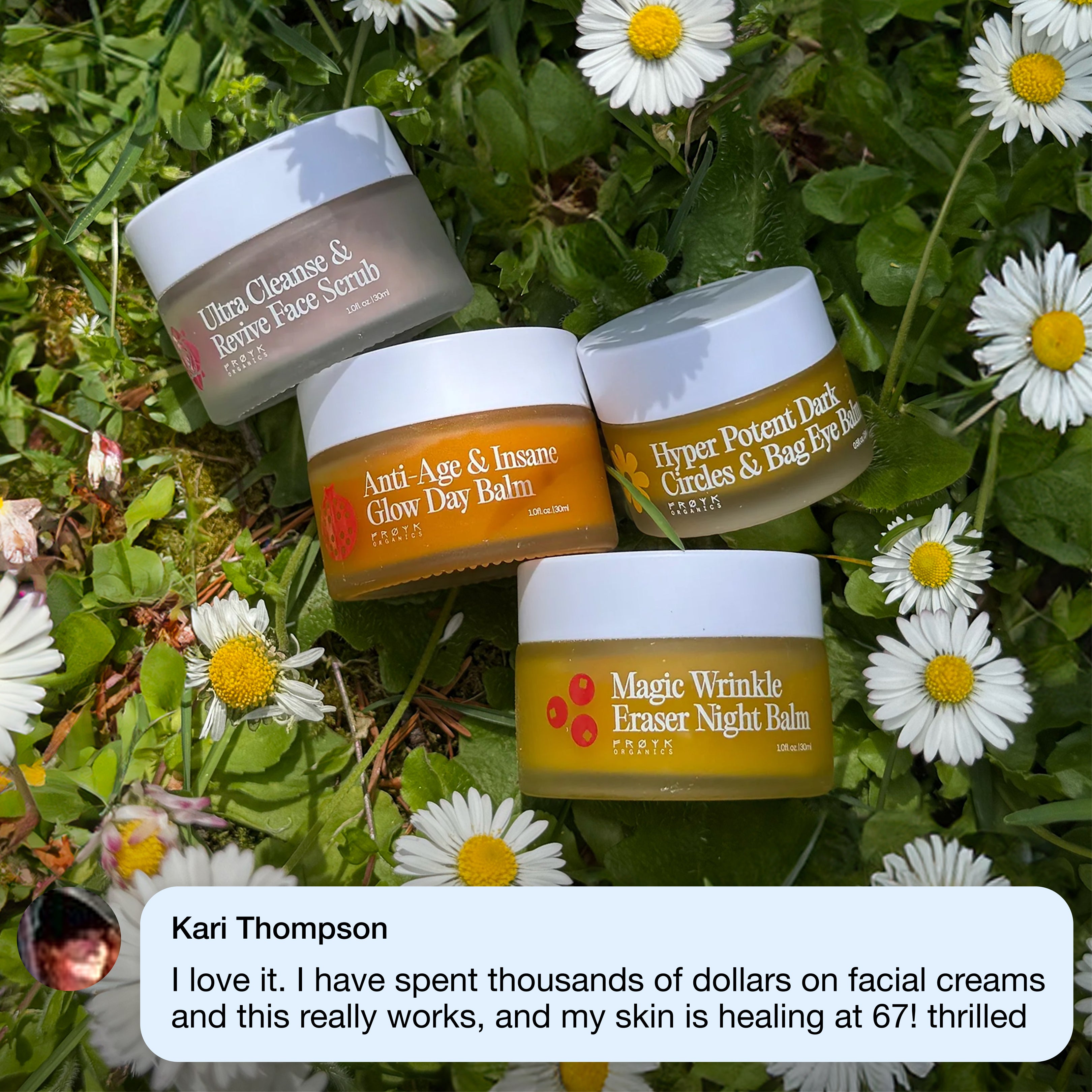
If you want to start with a formula already built around these principles, the Frøya Organics collection is designed specifically for post-menopausal skin, waterless and concentrated, with sea buckthorn and botanical oils at the foundation.
Shop the Collection


