

 Account


The Quiet Shelf Audit Every Woman Over 40 Needs
It starts with a serum you have used for a decade. One Tuesday morning, it stings. The next week, a moisturiser you have loved since your last birthday leaves a faint, blotchy rash along your jawline. Your skin, which handled almost anything in your 30s, is suddenly reactive. The products on your shelf have not changed. You have.
The average woman uses 12 products containing 168 different chemicals every day, and after 40, your skin processes every one of them differently. This is where the 15 toxic ingredients to avoid in skincare products stop being an abstract worry and start being a real conversation. Perimenopausal skin loses up to 30% of its collagen in the first five years, leaving a thinner, more permeable barrier that absorbs more of what you apply. Your estrogen is fluctuating, and many of the worst offenders happen to be endocrine disruptors.
This is not a fear list. The FDA has banned 33 chemicals in cosmetics. The EU has banned over 2,500. I have ranked 15 of the most concerning by priority tier, explained what each does to mature skin, and offered a safer swap for each. Start with the first nine. That is where the real damage lives.
1. Parabens HIGH Priority
Women aged 45 to 54 with the highest paraben exposure had FSH levels 10 to 14% higher, and 32 to 40% higher odds of experiencing hot flashes. That is from a published PMC pilot study, not a wellness blog.
Parabens are synthetic preservatives used to prevent microbial growth in creams and serums, which is one reason many women now look for organic skincare products that skip them. They mimic estrogen by binding directly to estrogen receptors in skin tissue. During perimenopause your own estrogen is already fluctuating, and adding xenoestrogens through your face cream creates hormonal noise on a system trying to find its new baseline.
2. Fragrance / Parfum HIGH Priority
One word on a label, “fragrance” or “parfum,” can legally hide as many as 3,100 different chemicals. You will never know which.
Fragrance is a blanket term protected as a “trade secret” under the Fair Packaging and Labeling Act. That single word covers synthetic scent compounds including phthalates, allergens, and known endocrine disruptors. No federal US law requires disclosure of what is inside it.
Fragrance reactivity climbs sharply with age. Your skin barrier thins and immune sensitisation accumulates. A 2025 study found women who avoided fragranced products for one week had less than half the urinary phthalate levels of women who kept using them.
3. Oxybenzone HIGH Priority
The Sunscreen Chemical in 97% of Americans
The CDC has detected oxybenzone in the urine of 97% of Americans tested. It bioaccumulates in fatty tissue and breast milk, and acts as an endocrine disruptor.
Oxybenzone is a chemical UV filter (benzophenone-3) used in traditional sunscreens to absorb UVB rays. It enters your bloodstream within hours of application, and volunteers continued excreting it days after the last use.
Daily sunscreen is the most important anti-aging habit for mature skin, which makes oxybenzone one of the highest-exposure leave-on ingredients in a 40+ routine. It mimics estrogen and accumulates in fat, and perimenopausal women already have shifting body composition that matters for fat-stored compounds.
4. Phthalates HIGH Priority
Researchers at Washington University in St. Louis tracked over 5,000 women and found those with the highest phthalate exposure entered menopause more than two years earlier.
Phthalates are plasticising chemicals used as solvents, fixatives, and flexibility agents. The most common cosmetic sources are synthetic fragrance, nail polish, and hair products. They are anti-androgenic and estrogenic, and they accelerate ovarian aging by multiple pathways.
Women who use cosmetics had 53% more monoethyl phthalate in their urine than non-users. Ongoing exposure during perimenopause is linked to earlier menopause and more disruptive transition symptoms.
5. Formaldehyde Releasers HIGH Priority
You will not find “formaldehyde” on a single skincare label in the United States. You will find the seven chemicals engineered to release it slowly into your product over months.
These preservatives release tiny amounts of formaldehyde, a known human carcinogen (IARC Group 1), to keep products microbially stable. The EU has banned them. The US has not.
Leave-on products containing formaldehyde releasers mean continuous low-level carcinogen exposure across thinner, more absorbent mature skin. The relevant metric is cumulative lifetime exposure, and at 40+ you already have decades of cosmetic use behind you.
6. PFAS / Forever Chemicals HIGH Priority
In December 2025 the FDA confirmed 51 different PFAS chemicals are intentionally added to 1,744 cosmetic products currently on shelves. Not as contaminants. As ingredients.
PFAS stands for per- and polyfluoroalkyl substances. They were engineered for water and oil resistance, which is why they appear in long-wear foundation, waterproof mascara, and “lasting” moisturisers.
PFAS earn their nickname honestly. They do not break down in your body. They are linked to thyroid dysfunction, immune suppression, fetal developmental harm, and certain cancers, all higher-stakes concerns in midlife.
7. 1,4-Dioxane HIGH Priority
1,4-dioxane has been detected in 97% of hair relaxers and 57% of baby soaps tested by the EWG. It never appears on a cosmetic label. It is a manufacturing byproduct hiding inside ingredients you assume are safe.
It is a probable human carcinogen by EPA classification, created during ethoxylation, the process used to soften harsh detergents. The byproduct is not gentle at all.
Mature skin has reduced detox enzyme activity and a thinner barrier. Cumulative low-dose exposure across a 40+ year skincare history is the relevant exposure curve, not any single application.
8. BHA and BHT HIGH Priority
The word “antioxidant” on a label can mean vitamin E. Or it can mean BHA, a chemical the EU classifies as a possible human carcinogen and the US lets you put on your face.
BHA (butylated hydroxyanisole) and BHT (butylated hydroxytoluene) are synthetic antioxidants used to stop oils from going rancid. Cheap, effective, regulated almost nowhere outside Europe.
Both are suspected endocrine disruptors with documented effects on the thyroid and reproductive system, the same systems already in flux during perimenopause. BHA and BHT live squarely inside the gap between EU and US cosmetic law.
9. Retinyl Palmitate HIGH Priority
Not all retinoids are equal. Retinyl palmitate, the cheapest and most common form, is the one the EWG and several independent toxicologists flag specifically in combination with sun exposure.
It is an ester form of vitamin A used widely in moisturisers, lip balms, and some daytime SPF products. The marketing says “vitamin A.” The chemistry behaves differently from prescription retinoids.
Retinyl palmitate has been associated with photo-induced free-radical activity when applied before sun exposure, which is the opposite of what a 40+ regimen should do. The EU restricted retinyl palmitate in leave-on products in 2024.
Ingredients 10 to 15
The following ingredients are rated MEDIUM priority. Most are rinse-off or lower-absorption, and the evidence against them is less direct than the first nine. Still worth reducing, but start there first.
10. Sodium Lauryl Sulfate / SLS MEDIUM Priority
If your cleanser leaves skin tight and squeaky after rinsing, that is not “clean.” That is barrier damage. SLS is usually the culprit.
Sodium lauryl sulfate is a harsh anionic surfactant used to generate foam and strip oil. It appears in cleansers, shampoos, body washes, and almost anything that bubbles.
Mature skin produces less sebum and has a weakened acid mantle thanks to declining estrogen. SLS strips what little lipid barrier you have left, worsening transepidermal water loss with every wash. Rinse-off keeps it MEDIUM priority, but daily use over decades compounds.
11. PEGs / Polyethylene Glycol MEDIUM Priority
PEGs are not toxic themselves. They do two problematic things. They let other ingredients absorb deeper than they otherwise would, and they often arrive contaminated with 1,4-dioxane from manufacturing.
Polyethylene glycols are synthetic polymer ingredients used as emulsifiers, thickeners, and texture agents. They smooth a formula and make it feel luxurious.
Thinner mature skin combined with a penetration-enhancing ingredient means anything else in the formula, including contaminants, reaches living layers faster. The penetration enhancement is the whole point. It also happens to be the whole problem.
12. Mineral Oil and Petrolatum MEDIUM Priority
Mineral oil feels luxuriously moisturising. It is also biologically inert, contributing nothing to the cellular machinery that produces collagen, ceramides, or barrier lipids.
It is a petroleum distillate used as an occlusive moisturiser in countless drugstore creams. Safe, technically. Useful, marginally.
Mature skin needs phytosterols, omega fatty acids, and bioactive lipids to maintain its barrier. Petrolatum-heavy products trap water on the surface without rebuilding anything underneath.
13. Silicones MEDIUM Priority
That “instantly smoother” feeling from a primer is silicone. A synthetic plastic film smoothing the surface while blocking everything underneath.
Silicones are synthetic polymers (the “-cones” family) used for slip, smoothness, and a temporary blurred-pore effect. Wonderful for a photograph. Less wonderful for what is happening underneath.
Layering a silicone-heavy product over actives like peptides, retinol, or hyaluronic acid blocks much of that active before it reaches living skin. Silicones also trap bacteria and dead cells against thinner mature skin, causing congestion and a dullness no exfoliant fixes.
14. Denatured Alcohol MEDIUM Priority
The toner you have used faithfully since 1998 might be what is making your skin reactive at 53.
Denatured alcohol is ethanol with poisonous additives that make it undrinkable. It is used as a solvent and astringent in toners and “quick-absorbing” lotions that feel feather-light because they evaporate off your face.
In your 20s, your skin compensated by ramping up sebum and lipid production. In your 50s, it cannot. Denatured alcohol dissolves the lipid components of an already-compromised barrier, leaving more redness, sensitivity, and visible fine lines.
15. Octinoxate and Homosalate MEDIUM Priority
If you swapped your oxybenzone sunscreen for one with octinoxate or homosalate, you may have switched the label without switching the underlying concern.
Both are chemical UV filters absorbed systemically through skin within hours of application, and both have been detected in plasma after a single use. Both are suspected endocrine disruptors. For a 40+ woman applying SPF daily on perimenopausal skin, the daily systemic dose adds up.
In June 2025, the EU’s Scientific Committee on Consumer Safety (SCCS) confirmed octinoxate exhibits estrogenic and anti-androgenic activity in its formal opinion.
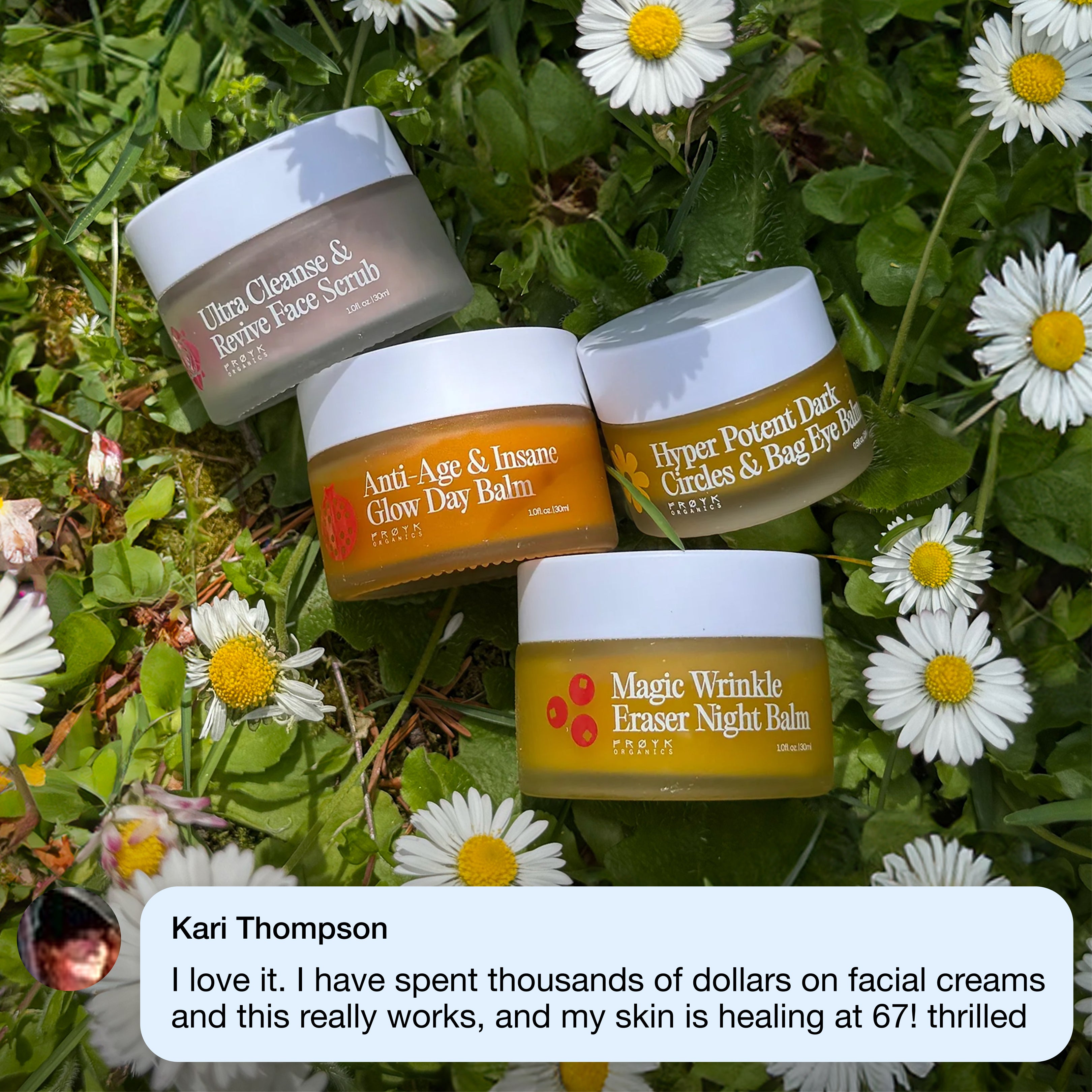
Wild Arctic botanicals and organic beeswax. Zero water, zero synthetic fragrance. Four concentrated balms that calm and nourish sensitive, reactive skin, backed by a 60-day money-back guarantee.
Shop the System TodayFrequently Asked Questions
Where should I start if my bathroom is full of these ingredients?+
Are leave-on products really more concerning than rinse-off?+
Why does the EU ban so many more ingredients than the US?+
Do I have to throw everything out today?+
What does a truly clean formulation look like?+


