

 Account


You wake up one morning, somewhere between 45 and 55, and the cream you’ve trusted for a decade stops working. Same jar. Same routine. Same face. An hour after you put it on, your skin feels tight again. The serum that calmed a red patch last week now stings on contact. You’ve added a mist, an oil, a thicker eye cream, and the bathroom shelf keeps growing while your skin keeps complaining. Dermatologists who treat menopausal skin point to one answer: a balm moisturizer.
This isn’t a product failure. It’s a biological one. The cream isn’t broken. The skin underneath it has changed, and the formula you’ve used since your late thirties was never designed for what’s happening now. Within five years of menopause, women lose roughly 30% of their dermal collagen, and sebum production keeps falling at 23% per decade.
Below, you’ll learn why your old cream stopped delivering, what a balm is at a formulation level, why waterless changes the absorption math, how to read a balm label in 10 seconds, the difference between a day balm and a night balm, and how to apply one without feeling greasy.
You don’t need more products. You need the right one, used correctly.
Why Your Moisturizer Stopped Working After 45
In the first five years after menopause, women lose roughly 30% of their dermal collagen (Brincat et al., 1987). That’s structural change, happening fast, often before anyone tells you it’s coming.
Estrogen receptors sit in every type of skin cell you have. They drive collagen synthesis, hyaluronic acid production, and ceramide production. When estrogen drops, all three drop together. Your skin isn’t aging on a smooth curve. It’s being structurally unbuilt in a short window, and most skincare routines were never calibrated for that.
Lower estrogen means lower ceramide production, which means a compromised barrier, which means elevated transepidermal water loss. In plain language: water is constantly evaporating out of your skin, and your skin has lost the lipid mortar that used to hold it in.
At the same time, sebum production falls roughly 23% per decade after age 20, and around 40% by your sixties. Sebum is your skin’s own occlusive layer. As it disappears, the natural seal on top of your barrier disappears with it. Over 60% of postmenopausal women report dryness, sensitivity, and thinning.
This is where the cream you’ve used for ten years runs out of road. A standard face cream is 60 to 95% water, with the actives you’re paying for sitting at 5 to 40% of the formula. It deposits a thin layer of water on a barrier that can no longer hold water in. The water evaporates within minutes. The actives are diluted before they can do much. You’re rehydrating a leaky bucket, and the bucket is the problem.
Estrogen-depleted skin needs something that supplies the lipids estrogen used to produce and seals what moisture remains. That isn’t a cream’s job description. It’s a balm’s.
What a Balm Moisturizer Actually Is (And Isn’t)
A balm doesn’t moisturize the way you think it does. It doesn’t add water to your skin at all. It prevents water from leaving.
The clinical mechanism is well documented. Occlusive agents form a hydrophobic film on the skin’s surface through which water cannot easily pass, allowing the stratum corneum to rehydrate from deeper skin layers below (StatPearls, NIH). The water that hydrates your skin doesn’t come from the jar. It comes from inside you. A balm’s job is to hold it there long enough for your skin to use it.
Three quick definitions, because this category gets muddled.
A balm is an anhydrous moisturizer. Anhydrous means waterless. The base is oils and waxes only, zero water content. Because there’s no water, there’s no microbial growth, so no preservative system is required.
Face balm vs cream comes down to one variable: water. A cream is a water-and-oil emulsion, typically 60 to 95% water, which requires emulsifiers to hold it together and preservatives to keep it stable. It feels lighter on application and disappears faster, which most of us read as “absorbing.” Much of it is actually evaporating. A balm is denser, sits longer, and works by occlusion rather than evaporation.
Balm vs oil is a related but different distinction. An oil is liquid lipids. A balm is lipids structured with waxes so the product stays solid in the jar and softens to a fluid only when warmed by your skin. The waxes give a balm staying power a pure oil doesn’t have. Oil slips. Balm seats in and holds.
The Waterless Advantage: Why No Water Means More Results
The average face cream is 60 to 95% water. The actives you’re paying for, the vitamins, the peptides, the plant oils, can make up as little as 5% of what’s in the bottle. The rest is water and the chemistry needed to hold water and oil together without separating.
Compare that to a waterless formula: zero added water, close to 100% functional material. Every drop is doing work. Think espresso versus a cup of hot water with a few coffee grounds floating in it. Same raw ingredient. Wildly different concentration.
Active stability changes too. Vitamin C and Vitamin E are two of the most studied antioxidant actives in skincare, and both maintain potency significantly better in waterless skincare environments. Water oxidizes them. Over the months a jar sits open on your counter, water-based formulas lose meaningful active strength. Waterless formulas don’t.
No water means no microbial growth, which means no preservatives are needed. For post-menopausal skin that’s suddenly reactive to products it used to tolerate, the hidden variable is often the preservative system. Dr. Brown’s observation applies here: the active ingredients usually haven’t changed. Your tolerance for the preservatives, fragrances, and emulsifiers required by water-based formulas has.
The lipids in a well-formulated balm match what aging skin has lost. Post-menopausal skin is short on sebum and ceramides. A waterless balm delivers concentrated plant lipids that biomimetically replace what estrogen used to produce. You’re not adding something foreign. You’re refilling a tank.
The objection I hear most often: “But I need hydration.” Yes, you do. The misunderstanding is where hydration comes from. True hydration happens at the dermal level, from inside out. Topical water mostly evaporates before it can be absorbed. What your skin needs is to hold the water your body produces, and to replenish the lipids that hold it.
How to Read a Balm Label: Ingredients That Earn Their Place
You can learn to assess any balm in any store within 10 seconds. Label literacy is the whole skill.
Start with the first three ingredients. INCI lists are ordered by concentration, highest to lowest. If a balm’s first three are petrolatum, mineral oil, or synthetic emollients like isopropyl myristate, you’re paying for an occlusive base with minimal biological activity. It will seal your skin. It won’t feed it. If the first three are cold-pressed plant oils and butters (shea, sea buckthorn, rosehip, jojoba), you’re looking at active lipids that mimic what your skin naturally produces.
Next, scan for biomimetic lipids, oils whose fatty acid profiles resemble human sebum and barrier lipids. Linoleic acid (sunflower seed, rosehip) supports the ceramide-building enzymes in your skin. Oleic acid (olive squalane, avocado) is deeply emollient and helps actives penetrate. Palmitoleic acid, also called omega-7, is one of the actual components of human sebum, and it declines with age. Very few plant sources contain meaningful amounts. The standout is sea buckthorn pulp oil, which contains 32 to 42% omega-7, one of the highest concentrations in the entire plant kingdom (PMC, 2012).
A 2024 randomized controlled trial on sea buckthorn showed measurable improvements in skin elasticity and collagen density after 12 weeks. The mechanism: omega-7 inhibits MMP-1, the enzyme that breaks collagen down. You’re replacing lipids you’ve lost and slowing the collagen loss curve from the previous section. The berries grow wild along the Norwegian coast, ripening in cold sun.
One note on color. Sea buckthorn is naturally deep orange. At therapeutic concentrations, a balm rich in it can leave a faint orange tint on very fair skin if you over-apply. That’s not a flaw. It’s the active being present in real amounts. The fix is dose, covered in the next section.
Avoid synthetic fragrance and parfum, among the top triggers for reactive mature skin, and avoid undiluted essential oils on a compromised barrier. Both can sting skin that used to tolerate them.
Day Balm vs Night Balm: Two Different Jobs
Your skin does two completely different things over a 24-hour cycle. A single balm can’t do both jobs well.
At night, your skin is in repair mode. Cell turnover accelerates after midnight, collagen synthesis peaks in the early morning hours, and the barrier rebuilds itself while you sleep. This is when repair-focused actives work hardest: retinoids, ceramides, peptides, concentrated plant antioxidants. Many of these actives cause photosensitivity, another reason they belong on a night routine and not under your morning SPF.
A well-designed night balm should be more concentrated, contain repair-supporting actives, and work occlusively for the full eight hours you’re asleep.

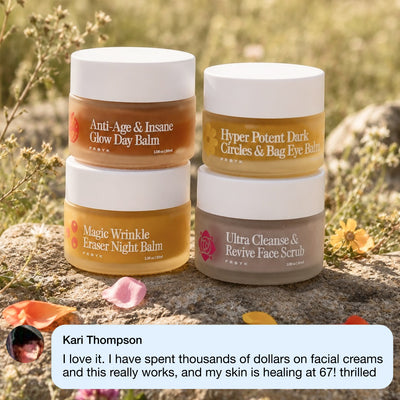
Built around overnight repair on barrier-compromised skin. Concentrated actives work during the barrier’s busiest repair window while you sleep.
Shop Night BalmIn the daytime your skin shifts to defense mode. UV, pollution, blue light, and oxidative stress are the workload. The actives you want during the day are protective: Vitamin E, Vitamin C, plant polyphenols, antioxidants that intercept free radicals before they damage collagen. A day product should also layer cleanly under SPF without pilling.

Designed around a defensive antioxidant profile. Absorbs quickly, sits comfortably under sunscreen, and buffers the day’s oxidative load.
Shop Day BalmCan you use one balm morning and night? Technically yes, and many women do when starting out. You compromise in both directions: a night balm under SPF can feel heavy, and a day balm overnight may not deliver enough repair-focused actives to make the most of those eight hours. A two-balm system matches the formula to the skin’s circadian biology. That’s how your skin actually works.
How to Apply a Balm So It Actually Works
Almost every complaint about balms (too greasy, doesn’t absorb, sits on top of the skin) traces back to four application mistakes. Fix them and the same product feels completely different on your face.
The biggest fix is to apply balm to damp skin, not dry skin. Press the product in within 30 seconds of cleansing, or after a hydrating mist or essence. The thin layer of moisture on your skin helps the balm emulsify on contact, which dramatically improves how it spreads and absorbs. Dry skin plus solid balm equals a waxy film. Damp skin plus warmed balm equals a near-instant melt.
The second fix is using less than you think you need. A pea-sized amount is enough for your whole face. Balms are concentrated, so more product gives you residue, not results. This is also the answer to the orange tint question from the previous section: at a pea-sized dose, sea buckthorn delivers the active without leaving color behind.
The third fix is warming the balm in your palms first. Five to ten seconds between your hands turns the product from a solid wax into a fluid oil. Skip this step and you’re rubbing wax onto your face. Take the 10 seconds. Your skin can tell the difference immediately.
The fourth fix is technique. Press, don’t rub. Once the balm is warm and your skin is slightly damp, press it in with slow, firm motions across your cheeks, jaw, and forehead. Pressing pushes the lipids into your barrier where they can do work. Rubbing redistributes them on the surface, which is also harder on mature, thinning skin.
Give it 60 to 90 seconds to settle before you apply makeup or sunscreen.
Press, don’t rub.
If you’ve done all four steps and your skin still feels greasy, you used too much. Halve the amount and try again tomorrow.


