

 Account


Dermatologist skincare recommendations for women who prefer natural are no longer a compromise. They are backed by clinical trials, endorsed by board-certified dermatologists, and designed for exactly the kind of skin you are living in after 45.
Something shifted around 44. Maybe 45. Your skin started doing things it had never done before, and you hadn’t changed a single product. The moisturizer that worked for a decade suddenly stings. Your forehead looks dull no matter how much water you drink. You wake up and your skin doesn’t feel like yours anymore.
You’re not imagining it. A Stanford Medicine study published in Nature Aging (2024) found a biological inflection point at age 44, where collagen breakdown, barrier weakening, and inflammation all accelerate at once. According to the AAD, women lose approximately 30% of their collagen in the first five years of menopause, then about 2% per year after that. By age 50, your skin’s ceramide levels have dropped by an estimated 60%, leaving your barrier thin, dry, and reactive. Estrogen decline also shifts skin pH above the optimal 4.5–5.5 range, impairing repair enzymes and disrupting the acid mantle that protects against pathogens.
This isn’t something to fight. It’s something to understand and work with. What follows are 13 specific recommendations, from ingredients to routines to what to stop using today. No 10-step regimens. No vague wellness claims. Just evidence-based choices that respect both your skin and your values.
1. Rebuild Your Skin Barrier First (Everything Else Depends on It)
If your products sting when they never used to, the problem probably isn’t your products. It’s your barrier.
Ceramides are the lipids that hold your skin cells together. Think of them as mortar between bricks. When estrogen declines, ceramide production crashes. By age 50, post-menopausal skin has lost roughly 60% of its ceramides (Scientific Reports, 2022). That means everything leaks. Moisture escapes. Irritants get in. Actives that should help end up causing redness instead.
This is why dermatologist skincare recommendations start with a barrier-first approach. Before adding retinol, before layering serums, repair the foundation. Your skin needs ceramides, cholesterol, and fatty acids. The botanical path to all three is cold-pressed oils: linoleic acid from rosehip is a direct ceramide precursor, GLA from borage supports the prostaglandin pathway that rebuilds barrier junctions, and omega-7 from sea buckthorn integrates directly into the sebum layer.
You can supply what your barrier needs without a synthetic ceramide complex. The building blocks are in concentrated botanical oils. That is a more compatible approach for skin that is already reactive and slow to recover.
If your skin stings with plain moisturizer right now, pause all actives. Focus on barrier repair for two to four weeks. Then reintroduce one ingredient at a time. Apply moisturizer immediately after bathing, while skin is still damp. Dr. Dray emphasizes this timing: once out of the shower, skin rapidly loses water, especially after hot showers. Seal that moisture in before it escapes.
2. Switch to Rosehip Oil (The Plant-Based Vitamin A with a Barrier Bonus)
The case for rosehip oil after 45 is not that it is gentler than retinol. It is that it does something retinol cannot: it delivers vitamin A and repairs the barrier at the same time.
Rosa Canina (rosehip seed oil) contains natural trans-retinoic acid, the active form of vitamin A, alongside linoleic acid and a full essential fatty acid profile. Retinol is delivered in a water- or alcohol-based vehicle that fights through your skin’s lipid barrier to reach the dermis. Rosehip is delivered in an oil base that works with the lipid barrier, penetrating through the same pathways your skin already uses. That difference matters more after 45, when your barrier is thinner and your recovery from irritation is slower.
For skin that has already lost barrier strength, this distinction is meaningful. Retinol’s mechanism (accelerating cell turnover) can thin the barrier further and cause photosensitivity. Rosehip’s oil-based vitamin A works more gradually, allowing cell renewal without outpacing your skin’s ability to rebuild. It also provides antioxidant protection that isolated retinol lacks entirely.
Rosehip oil is photostable and can be used morning and evening. It works well as a standalone evening treatment or layered under a heavier botanical balm. For women seeking retinoid-level results without barrier disruption, this is the evidence-based plant-based option. (Bakuchiol is another botanical retinol alternative with RCT data worth knowing about for the broader category.)
3. Use Vitamin C the Right Way (Most Products Get This Wrong)
Most vitamin C serums on the market won’t deliver what they promise. The form matters more than the percentage on the label.
Dr. Dray, a board-certified dermatologist, is clear on this: only L-ascorbic acid has robust evidence for stimulating collagen synthesis and reducing photodamage. Derivatives like magnesium ascorbyl phosphate (MAP) or sodium ascorbyl phosphate don’t appear to convert effectively in the skin. They may brighten temporarily, but they won’t build collagen.
L-ascorbic acid also needs the right pH. It must be formulated at pH 3.5 or below to penetrate the skin. Many “gentle” vitamin C products are pH-neutral, which makes them comfortable but largely ineffective for collagen.
Natural sources hold their own here. Kakadu plum has the highest known natural concentration of vitamin C. Sea buckthorn berry and rosehip also provide plant-derived L-ascorbic acid that is chemically identical to synthetic. The molecule is the same regardless of origin.
With collagen declining 30% in five years, vitamin C is one of the few topicals with evidence for stimulating new collagen production, not only preventing loss. Look for 10–20% L-ascorbic acid, pH under 3.5, stored in dark glass. If it’s turned brown, it’s oxidized. Replace it.
4. Ditch “Fragrance” from Every Product (Non-Negotiable After 45)
The word “fragrance” on a label is a legal loophole. It can represent any combination of thousands of undisclosed chemicals, including known endocrine disruptors like phthalates.
Women use an average of 19 products daily (EWG). Each one containing fragrance adds to a cumulative chemical load your body has to process. For a woman whose hormonal system is already in flux during perimenopause and menopause, that’s exposure you don’t need.
The AAD specifically recommends fragrance-free moisturizers for menopausal skin. Not “unscented,” which can still contain masking fragrances. Truly fragrance-free. Around age 50, skin pH shifts and sensitivity reactions become significantly more common. What you tolerated at 35 may now cause redness, itching, or rashes.
Dr. Dray calls fragrance-free skincare non-negotiable for menopausal skin. Dermatologist skincare recommendations consistently rank this among the highest-impact changes you can make. Even essential oils, while natural, contain known allergens like linalool and limonene. The safest approach for reactive post-45 skin is products scented only by their active botanical ingredients, or no added scent at all.
Start by auditing your bathroom shelf. Check every label for “fragrance,” “parfum,” or “fragrance/parfum.” Swap one product per week until your routine is clean. Endocrine disruptors act via estrogen receptors, mimicking or scrambling hormonal signals. When estrogen is already declining, you don’t need extra chaos in that system.
5. Avoid These Three Hormone Disruptors in Skincare
“Clean beauty” labels are unregulated. Anyone can print them. These are the three categories of ingredients dermatologists actually flag, and what to use instead.
Parabens (methylparaben, propylparaben, butylparaben) are preservatives found in moisturizers, foundations, and shampoos. They act via estrogen receptors, making them a concern for women already navigating estrogen decline. Swap for products preserved with phenoxyethanol or natural alternatives like rosemary extract and tocopherol.
Phthalates are often hidden inside the “fragrance” ingredient (see above). They’re linked to hormonal disruption and rarely appear on labels by name. Swap: fragrance-free products.
Chemical sunscreen filters like oxybenzone and octinoxate are potential endocrine disruptors that absorb into the bloodstream. The FDA has flagged these for further safety study. Dermatologists increasingly recommend mineral sunscreen with zinc oxide and titanium dioxide for women 45+. These sit on the skin surface and don’t enter your system.
The dose argument matters. Any single product’s exposure is tiny. But 19 products daily, 365 days a year, across decades - the cumulative load is real. This isn’t fearmongering. It’s informed choice. You deserve to know what’s on the label and what isn’t.
Check your current products against these three categories. The EWG’s Skin Deep database lets you search any product by name and see its ingredient safety rating. To see exactly what goes into every Frøya formula, visit our ingredients page.
6. Choose Mineral Sunscreen Over Chemical (Your Dermatologist Probably Already Does)
Dermatologists say sun is responsible for 80% of visible aging. Not genetics. Not time. UV exposure. That makes SPF the single most powerful product in your routine.
Chemical filters (oxybenzone, homosalate) absorb UV energy and convert it to heat. They also absorb into the bloodstream, which the FDA has flagged for further safety study. Mineral filters - zinc oxide and titanium dioxide - sit on the skin’s surface and physically reflect UV. They don’t enter your body.
For women 45+, mineral sunscreen carries a bonus. Zinc oxide is anti-inflammatory. When your skin is already dealing with increased sensitivity and redness post-menopause, that’s active calming on top of sun protection. Dermatologist skincare recommendations for this age group almost universally point to mineral formulas for this reason.
The old complaint about mineral sunscreen leaving a white cast is largely solved. Modern formulations use micronized zinc. Tinted mineral SPFs double as a light foundation.
The AAD recommends broad-spectrum SPF 30 or higher, applied daily, reapplied every two hours when outdoors. Look for zinc oxide as the active ingredient. UV damage drives wrinkles, spots, sagging, and texture changes more than time itself. No serum, no cream, and no treatment will outperform consistent daily SPF.
7. Use Cold-Pressed Botanical Lipids Instead of Synthetic Ceramide Complexes
The ceramide crash is real biology. The assumption that you need to buy those ceramides back in a synthetic moisturiser complex is where most advice goes wrong for women who prefer a botanical approach.
You already know about the 60% ceramide loss by 50. What most guides skip: your skin does not need you to apply ceramides directly. It needs the fatty acid precursors it uses to synthesise ceramides. Linoleic acid (omega-6) is the primary raw material for ceramide production in the epidermis. Apply linoleic acid and your skin can rebuild the mortar from its own raw materials.
For moisture-binding, the water-based HA serum approach has a known trade-off for dry climates: if you apply HA to dry skin, it pulls moisture from deeper layers to the surface and then evaporates. Waterless formulas use plant polysaccharides (tremella mushroom, marshmallow root) that provide moisture-binding without that drawback, and without the synthetic preservatives water-based serums require.
The principle behind dermatologist recommendations for ceramide-rich moisturisers is correct: your skin barrier needs lipid replenishment. Cold-pressed botanical oils are the botanical path to the same outcome, at higher active concentration and without the synthetic base.
8. Use Arnica, Calendula, and Sea Buckthorn Instead of Isolated Actives
The case for niacinamide is that one isolated ingredient addresses multiple concerns at once: inflammation, pigmentation, barrier function, water loss. The botanical case is that several of Frøya’s core ingredients do exactly those things, through plant pathways, without the need for isolated B3.
Arnica (Arnica montana) is Frøya’s primary anti-inflammatory botanical. It addresses the chronic low-grade inflammation (“inflammaging”) that rises post-menopause and drives redness, sensitivity, and accelerated barrier breakdown. It acts at the barrier level directly, calming the reactive baseline that makes 45+ skin so prone to persistent redness.
Calendula (Calendula officinalis / Marigold) supports tissue repair and is one of the most consistently well-tolerated botanicals for sensitive, thinning skin. Research supports its role in wound healing and skin regeneration, making it particularly suited for skin that is slow to recover from daily environmental stress.
Sea buckthorn addresses pigmentation and barrier strengthening simultaneously. Omega-7 integrates into the sebum layer. The phytoestrogens may support localised oestrogen-like signalling in skin fibroblasts, directly addressing the hormonal root cause of post-menopausal skin changes rather than managing the symptoms downstream.
Dr. Shireen Idris, a board-certified dermatologist, frames skincare as a relationship, not a problem to solve. That philosophy fits Frøya’s botanical approach: nourish the system, don’t attack individual symptoms. For women dealing with both dryness and sensitivity during perimenopause, botanical actives address both sides without the potential irritation that higher-concentration isolated actives can cause in reactive skin.
9. Discover Sea Buckthorn (The Nordic Botanical Dermatology Is Catching Up To)
An Arctic berry improved skin brightness, moisture, and elasticity in clinical trials. It contains a fatty acid almost no other plant produces.
An 8-week clinical study found that sea buckthorn oil supplementation increased skin brightness by 2.2%, moisture by 8.5%, and elasticity by 2.7% from baseline. Those numbers may sound modest, but they represent measurable, instrument-verified improvement in the three areas women 45+ care about most.
Sea buckthorn is one of the only plant sources of omega-7 (palmitoleic acid), a rare fatty acid that supports mucous membrane health throughout the body. It also contains vitamins C and E, carotenoids, and flavonoids, all working together as a system.
Topically, sea buckthorn oil prevents UV-induced reactive oxygen species and enhances non-enzymatic antioxidants including glutathione and thioredoxin. Studies have shown significant improvement in redness and scaling in psoriasis patients.
This berry thrives in extreme Arctic conditions: brutal cold, intense UV, constant oxidative stress. Its survival compounds - the same antioxidants and fatty acids that protect it - are what make it protective for your skin. That’s not marketing. That’s evolutionary biology.
Sea buckthorn is available as a topical oil, an oral supplement, or as an ingredient in formulated skincare - ideally in a waterless formula for maximum active concentration. Look for cold-pressed, organic sourcing.
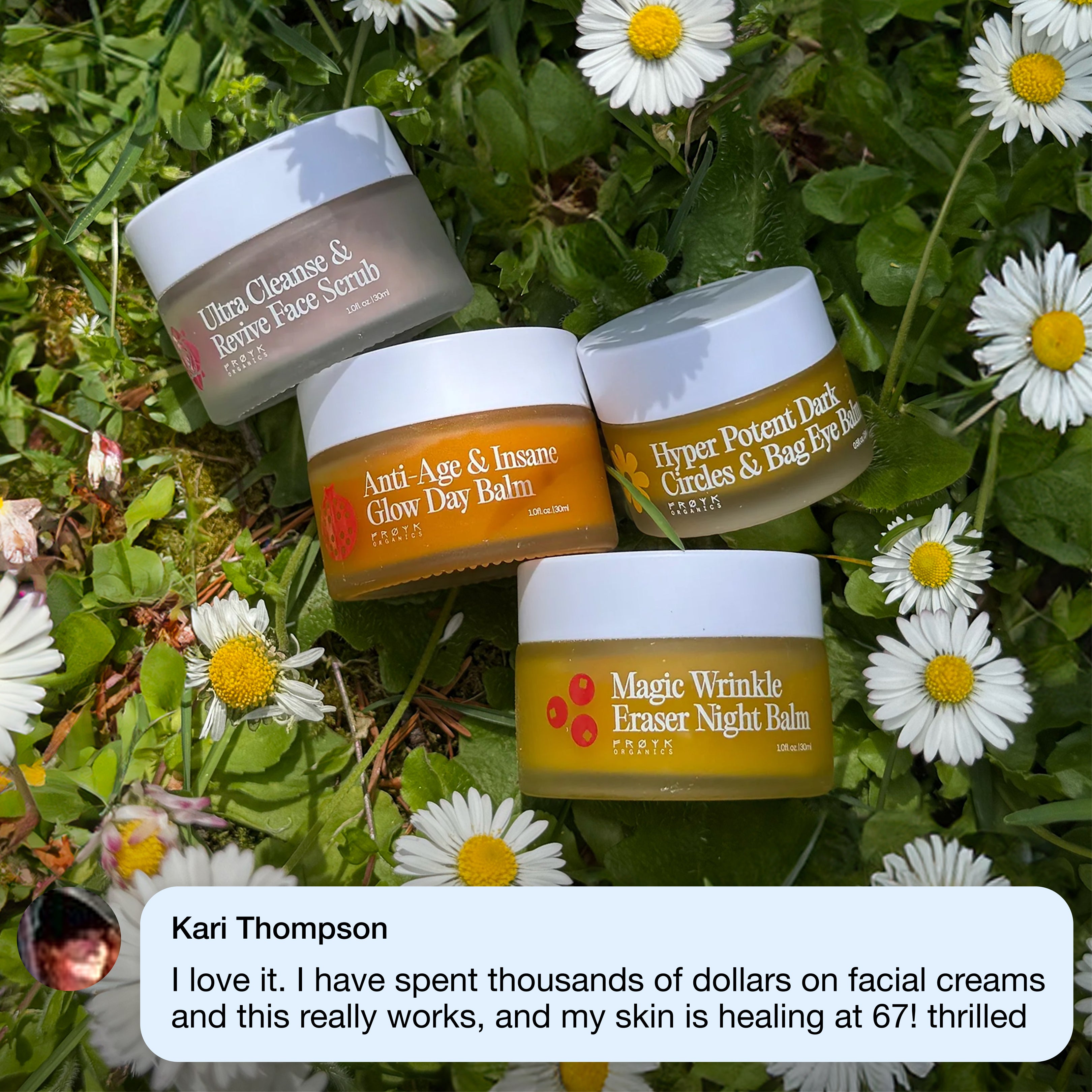
100% botanical actives. Sea buckthorn as the foundation. Zero water, zero synthetic preservatives. Rated 4.66/5 from 3,152+ reviews. 60-day money-back guarantee.
Shop the System - $11910. Simplify Your Routine to 3 Steps (Dermatologists Beg You To)
You don’t need 19 products. You don’t need 10 steps. Dr. Shireen Idris put it plainly: “Your skin is not a problem to solve. It’s a relationship to build.” Relationships don’t need 10 steps.
The AAD’s core protocol is three steps: mild cleanser, fragrance-free moisturizer (with HA, ceramides, and glycerin), and SPF 30+ daily. That’s the foundation. Everything else is optional layering.
Simplicity matters more after 45. A compromised barrier plus 19 products means cumulative irritation and cumulative endocrine disruptor exposure. Every product you remove is protection.
A simple routine you do every day beats a complex one you abandon by Thursday. Dr. Idris calls these “small wins,” and dermatology research confirms repeatedly: consistency beats complexity.
If you want to add more, do it slowly. Rosehip oil in the evening. Vitamin C in the morning. Arnica or sea buckthorn when your barrier feels reactive. But only after your three-step foundation is solid and your barrier is healthy. Give each new product four to six weeks before judging results.
You have permission to stop. You don’t need everything on this list. Start with three steps. Add one thing at a time.
11. Swap Your Cleanser (Foaming Formulas Strip Post-45 Skin)
If your face feels “squeaky clean” after washing, that’s not clean. That’s stripped. For skin over 45, it’s making everything worse.
The AAD recommends switching to a mild, non-foaming, sulfate-free cleanser. Cream or oil-based cleansers protect what’s left of your lipid barrier. With ceramides already down 60%, a harsh cleanser removes what little barrier lipids remain. You’re undoing your moisturizer’s work every morning.
Plant-based cleansing oils are a strong option. Jojoba oil is the closest match to your skin’s natural sebum. Sunflower seed oil and rosehip oil dissolve makeup and sunscreen without stripping. These dermatologist skincare recommendations are especially relevant if your current cleanser foams aggressively.
Avoid sodium lauryl sulfate (SLS) and sodium laureth sulfate (SLES). Avoid anything that foams aggressively.
Your skin should feel soft after washing. Not tight. If it feels tight, your cleanser is working against you. A simple test: wash your face, wait 15 minutes without applying anything. If your skin feels dry, taut, or flaky, switch to a cream or oil cleanser immediately.
12. Start Before You Think You Need To (Age 44 Is the Molecular Turning Point)
Stanford researchers found a biological inflection point at age 44. Not 50. Not 55. Forty-four. That’s when collagen breakdown, barrier weakening, and inflammation all spike according to their 2024 Nature Aging study.
Dr. Aleksandra Brown, a board-certified dermatologist with 15 years of clinical practice, recommends proactively shifting your routine before the dramatic changes fully hit. Don’t wait for the crisis. Meet it prepared.
What “proactive” looks like at 44: switch to barrier-supporting botanical oils (rosehip, borage, sea buckthorn) before the ceramide crash fully hits. Start rosehip oil as your plant-based vitamin A. Upgrade to mineral SPF. Eliminate fragrance from everything. These dermatologist skincare recommendations pay off most when they start early.
Before committing to any new routine, many dermatologists recommend starting with a thorough health assessment — particularly for women navigating the hormonal shifts of perimenopause. Skin changes at this stage rarely happen in isolation: they're often connected to systemic inflammation, thyroid fluctuations, or nutritional gaps that no topical product can fully address on its own. The growing use of AI solutions in healthcare is making this kind of personalised pre-screening far more accessible, helping women pinpoint underlying health contributors to their skin changes before their first dermatology appointment. That way, when you do sit down with a specialist, the conversation can go straight to targeted solutions - rather than spending valuable time ruling out the basics.
If you’re already past 44, it’s not too late. Skin is remarkably responsive to the right inputs at any age. But start now. Every week of barrier repair, sun protection, and nourishment compounds.
Perimenopause often begins in the 40s, sometimes as early as the mid-to-late 30s. The skin changes start earlier than most women expect. Knowing the timeline gives you the advantage of preparation rather than reaction.
13. Trust That Natural Can Be as Effective as Synthetic (The Science Says So)
You’ve been told - maybe by a dermatologist - that natural skincare is “nice but not serious.” That belief is outdated. The evidence says otherwise.
Rosehip seed oil delivers vitamin A activity through natural trans-retinoic acid alongside barrier-repairing linoleic acid. Cold-pressed botanical lipids supply the essential fatty acid precursors your skin uses to synthesise its own ceramides. L-ascorbic acid from sea buckthorn and kakadu plum is chemically identical to the synthetic version. Sea buckthorn has clinical trial data for moisture, brightness, and elasticity. These aren’t wellness marketing claims. They’re published science.
The bias exists because pharmaceutical actives had decades of funding for clinical trials. Botanicals didn’t. That’s changing. Personal care launches with plant-based claims grew 17% between 2020 and 2025 (Innova Market Insights), and the research is catching up to what traditional medicine has known for centuries.
The right question isn’t “natural or synthetic?” It’s “does this ingredient have evidence, and is the formulation correct?” Whether vitamin C comes from a lab or a berry, the molecule is the same.
Botanicals do have one structural advantage. They come packaged with co-factors: antioxidants, fatty acids, anti-inflammatories. Sea buckthorn isn’t only omega-7. It’s vitamins C and E, carotenoids, and flavonoids working together. Isolated synthetic actives don’t offer that.
You don’t have to choose between your values and your skin. The science backs both. For the full biology behind why 45+ skin responds so well to botanical actives, see our guide to natural and organic skincare after 45.


