

 Cuenta



La caléndula para la piel es uno de los remedios documentados más antiguos del herbalismo europeo, y funciona a través de tres vías simultáneamente: calma la inflamación, apoya la barrera de humedad y calma la piel reactiva. La planta es Calendula officinalis, también llamada caléndula o maravilla de jardín, nativa de la región mediterránea y cultivada en todo el mundo desde entonces. Sus propiedades fueron registradas siglos antes de que alguien pudiera medirlas.
Hay una mañana que muchas mujeres reconocen, cuando un bálsamo de confianza simplemente deja de funcionar. Mismo producto, misma rutina, pero la piel se siente más fina, más seca y extrañamente desconocida. Si has cruzado la línea de la menopausia, sabes exactamente lo que eso significa.
Tu piel no está dañada. Es fundamentalmente diferente ahora.
Lo que sigue es la química de sus compuestos, el estado honesto de la evidencia, y el único método de extracción que cambia cuánto de esta planta realmente llega a tu piel.
Qué Hace que el Extracto de Caléndula Sea Tan Efectivo en la Piel que Envejece
La caléndula funciona en varios frentes porque contiene varias clases de compuestos distintos, no una sola molécula estrella. Cada uno se dirige a algo diferente que sucede en la piel después de que el estrógeno comienza a disminuir.
Los ésteres de faradiol son la fracción más responsable de sus propiedades antiinflamatorias. Cuando los investigadores probaron varios preparados de caléndula hechos por extracción supercrítica de CO2, los que tenían más ésteres de faradiol monoéster produjeron la mayor reducción en la inflamación. Esa es una relación dosis-respuesta, que es evidencia más fuerte que simplemente la presencia de un compuesto.
Esto importa después de la menopausia porque la piel posmenopáusica vive en un estado de inflamación crónica de bajo grado que los investigadores llaman inflamación por envejecimiento.
Los flavonoides que incluyen quercetina, isorramnetina y kaempferol proporcionan defensa antioxidante. Atrapan los radicales libres que se acumulan más rápido a medida que las defensas propias de tu piel se debilitan, y esa acumulación es parte de lo que impulsa el envejecimiento prematuro.
Las saponinas triterpénicas, incluyendo calendulósido y glicósidos de ácido oleanólico, inhiben las enzimas MMP. Las MMP son colagenasas que descomponen las fibras de colágeno existentes, así que ralentizarlas protege lo que ya tienes.
Los carotenoides le dan a las flores de caléndula su pigmento naranja y contribuyen al apoyo antioxidante. Los taninos tienen una acción astringente que ayuda a la barrera a retener la humedad, y pequeñas cantidades de aceites esenciales completan el perfil.
La investigación publicada en Cosmetics sobre la actividad antiinflamatoria de la caléndula encontró que el extracto inhibe la producción de óxido nítrico a través de la vía iNOS, de manera dependiente de la dosis y sin dañar la viabilidad celular. Los autores señalan la rosácea, el melasma, el vitíligo y tanto la dermatitis por contacto alérgica como irritante como condiciones donde esa vía está desregulada.
Este fue trabajo de laboratorio en células inmunitarias en lugar de un ensayo en piel, pero explica el mecanismo detrás del largo historial de caléndula calmando cosméticos para piel sensible.
Para Qué Se Ha Usado Tradicionalmente la Caléndula
Mucho antes del trabajo de laboratorio, la caléndula era una planta doméstica con una función. Las flores de caléndula se secaban en ungüentos y bálsamos, se remojaban en agua de baño para la piel irritada, y se usaban en la práctica folclórica para heridas y quemaduras menores.
Los pétalos también servían como agente colorante en alimentos, sustituyendo al azafrán. Los jardineros todavía cultivan su propia caléndula exactamente por estas razones.
Ese historial importa por una razón práctica: te dice qué usos tienen siglos de observación detrás de ellos, y cuáles son marketing más reciente.
Apoyo al Colágeno: Lo Que la Investigación Realmente Muestra
La caléndula apoya la firmeza de la piel, y la versión honesta de esa afirmación es más estrecha de lo que la mayoría de los artículos admiten. Aquí está lo que se sostiene.
El Mecanismo Dual
Las saponinas triterpénicas de la caléndula inhiben las metaloproteinasas de la matriz, las enzimas que degradan el colágeno existente. Sus flavonoides reducen el estrés oxidativo que desencadena esas enzimas en primer lugar.
Si la firmeza es tu principal preocupación, nuestros bálsamos de cuidado que refuerzan el colágeno están construidos alrededor de botánicos que funcionan de esta manera.
El Contexto Honesto
Una estadística ampliamente circulada afirma que la caléndula aumenta la síntesis de procolágeno en un 83,7%. Esa cifra proviene de un estudio de 2018 sobre Tagetes erecta, una planta diferente que también se llama caléndula en común.
No la estamos repitiendo aquí, porque Tagetes y Calendula officinalis son especies separadas con química diferente. Si ves ese número adjunto a la caléndula en otro lugar, ha sido atribuido incorrectamente.
¿Qué Evidencia Humana Existe?
La mejor evidencia humana proviene de un estudio de 2011 donde 21 voluntarias usaron una crema de caléndula al 3% en sus mejillas todos los días durante ocho semanas. Un dispositivo llamado Cutómetro midió cómo su piel realmente respondió, en lugar de preguntarles cómo se sentía.
Dos cosas mejoraron por un margen significativo: firmeza e hidratación. Cinco otras mediciones se mantuvieron planas.
Las voluntarias estaban en sus veinte y treinta años. Así que el estudio muestra que la caléndula hace algo real en la piel humana, pero no te dice cuánto hace en piel a los 55.
Eso vale la pena saber en lugar de pasarlo por alto. La caléndula se gana su lugar en una fórmula, y funciona junto con otros botánicos en lugar de llevar toda la carga.
Reparación de la Barrera e Hidratación Profunda para la Piel Fina
El momento en que tu bálsamo confiable deja de funcionar no es aleatorio. Es biológico.
Después de la menopausia, la disminución del estrógeno reduce la producción de sebo, adelgaza la barrera externa, y aumenta la pérdida de agua transepidérmica. Tu piel está perdiendo agua más rápido que hace cinco años, y las fórmulas construidas para piel más joven no fueron diseñadas para eso.
La caléndula aborda esto a través de varios compuestos trabajando juntos. Los taninos aprietan las uniones intercelulares en el estrato córneo, ralentizando la velocidad a la que la humedad se escapa. El ácido calendulínico, un ácido graso insaturado distintivo de la caléndula, apoya la reconstrucción de la barrera lipídica, mientras que el mucílago de la planta retiene agua en la superficie.
El ensayo Akhtar de 2011 midió esto objetivamente. La mejora en el parámetro de hidratación R0 fueron datos de instrumentos, no cómo se sintió la piel.
Emparejado con cera de abeja orgánica, un oclusivo nutritivo que sella la humedad sin agua ni rellenos, el efecto es una barrera que permanece suave en lugar de tensa. Esa combinación se sienta en el centro de nuestra colección de reparación de barrera para piel sensible.
Calmar la Inflamación y el Enrojecimiento sin Esteroides
Brotes de rosácea. Enrojecimiento inexplicable. Piel que reacciona a cosas que toleró durante años.
La caléndula lo resuelve a través de tres vías antiinflamatorias distintas. Los ésteres de faradiol modulan la vía NFkB y reducen la producción de IL-6. Los flavonoides neutralizan las especies reactivas de oxígeno que desencadenan cascadas inflamatorias, y las saponinas triterpénicas proporcionan acción anti-edema directa.
Una revisión sistemática de caléndula para la cicatrización de heridas examinó 14 estudios, siete en animales y siete en humanos. La resolución más rápida de la fase inflamatoria fue consistente en cinco estudios en animales y un ensayo aleatorizado, mientras que los resultados en heridas crónicas y quemaduras fueron mixtos.
Esa es una señal real con límites honestos, y es una imagen más útil que las afirmaciones seguras que usualmente se hacen para esta planta.
A diferencia de los esteroides tópicos prescritos para el eczema y la rosácea, la caléndula no adelgaza la piel con el uso a largo plazo. Para piel posmenopáusica que ya se está adelgazando por la pérdida de estrógeno, esa distinción importa.
Esta es exactamente la razón por la que la caléndula se sienta cerca de la parte superior de la lista de ingredientes en nuestro Bálsamo de Día para Piel con Tendencia Acneica. Aparece como Extracto de Flor de Caléndula, segundo solo al aceite portador, y hace el trabajo calmante mientras que la cera de abeja orgánica sostiene una capa protectora sobre piel que ha dejado de tolerar cosas que solía.
Cicatrización de Heridas y Condiciones de la Piel Más Allá del Enrojecimiento
El uso documentado más antiguo de la caléndula es la cicatrización de heridas, y aquí es donde se asienta la mayoría de su investigación clínica. La práctica tradicional la usaba en rasguños, grietas y sarpullidos.
El trabajo de laboratorio y en animales muestra que la caléndula acelera el crecimiento de tejido epitelial y alienta el flujo sanguíneo localizado al área, que es el mecanismo detrás de la granulación más rápida. También muestra actividad antimicrobiana en pruebas de laboratorio, aunque eso no es lo mismo que prevenir la infección en la práctica.
La pomada de caléndula ha sido estudiada para dermatitis del pañal en bebés, y aparece en muchas cremas para sarpullido de pañal para bebés. En un ensayo triple ciego de 73 niños menores de dos años, una pomada de caléndula al 1,5% funcionó comparablemente a la pomada de oliva, sin efectos adversos en ninguno de los grupos.
Es ampliamente tolerada, que es el aprendizaje honesto en lugar de prueba de superioridad.
Para condiciones crónicas de la piel incluyendo psoriasis y eczema, la evidencia es más delgada. La caléndula calma y apoya en lugar de resolver, y cualquiera que maneje una condición diagnosticada debe trabajar con su médico.
Extracto de CO2 vs. Aceite Infusionado: Por Qué el Método de Extracción Cambia Todo
Dos productos pueden decir caléndula en la etiqueta y entregar cantidades muy diferentes de ella. El método de extracción es la razón.
Tres Métodos de Extracción Comparados
El aceite infusionado es la forma más común. Las flores secas se remojan en un aceite portador como girasol u oliva durante semanas, lo que extrae algunos compuestos lipófilos pero los diluye fuertemente. Típicamente aparece al 5 a 10% en una fórmula.
El extracto supercrítico de CO2 usa dióxido de carbono presurizado para extraer compuestos lipófilos directamente de las flores, sin portador y sin residuo de disolvente. El resultado es una pasta cerosa concentrada usada a solo 0,1 a 0,3%.
La glicerita o tintura captura compuestos solubles en agua en su lugar, y las tinturas usualmente llevan alcohol. Ese es un perfil completamente diferente, y no comparable para los activos lipófilos que impulsan los beneficios de la caléndula en la piel.
La Brecha de Potencia Es Medible
La señal más clara de la brecha es la tasa de uso. El aceite infusionado va a una fórmula al 5 a 10%, mientras que el extracto de CO2 hace el trabajo al 0,1 a 0,3%, porque la mayoría de lo que está en una botella infusionada es aceite portador.
Investigadores que trabajan con Calendula officinalis también usaron tecnología supercrítica para concentrar tres de sus antioxidantes, ácido clorogénico, caféico y ferúlico, alcanzando niveles 40 a 70% superiores al extracto original.
La concentración es solo la mitad de la historia. El aceite y los extractos de caléndula se degradan con la luz y el calor, así que almacena productos de caléndula en un lugar fresco y oscuro para extender su vida útil.
El Problema de la Etiqueta
No puedes distinguir el extracto de CO2 del aceite infusionado al leer una lista de ingredientes. Ambos llevan el mismo nombre INCI: Extracto de Flor de Calendula Officinalis.
Para identificar un auténtico extracto de CO2, busca marcas que declaren explícitamente la extracción supercrítica de CO2 en la página del producto. Si un aceite portador se sienta junto a la caléndula en la lista, es casi seguramente un aceite infusionado.
Una verificación más que vale la pena hacer en cualquier etiqueta de cosméticos: confirma que la especie es Calendula officinalis, no Tagetes. Ambas se venden como caléndula, y solo una tiene el historial de seguridad y eficacia descrito aquí.
Emparejamientos de Ingredientes Que Amplifican los Beneficios de la Caléndula
La caléndula funciona por sí sola. Los compañeros correctos la hacen funcionar más duro en piel madura, y estos cuatro aparecen juntos en fórmulas bien construidas por una razón:
- El aceite de espino amarillo es el emparejamiento más fuerte. Rico en omega-7, apoya la reparación de lípidos mientras la caléndula maneja la inflamación, y ambos son ricos en carotenoides así que su actividad antioxidante se superpone. Nuestra guía sobre beneficios del aceite de espino amarillo cubre por qué esa combinación se adapta a la piel después de los 45.
- La cera de abeja orgánica es lo que sostiene el resto en su lugar. Forma una capa protectora que mantiene los compuestos de caléndula contra tu piel en lugar de dejarlos evaporarse, que es también por qué un bálsamo sin agua supera a una fórmula acuosa llevando el mismo botánico.
- El aceite de rosa mosqueta aporta ácido linoleico y carotenoides naturales que apoyan el tono y la textura. Verás rosa mosqueta comercializada como retinol natural, que lo exagera: el ácido retinoico que contiene en trazas se sienta muy por debajo de cualquier dosis funcional de retinoide.
- La manzanilla es otro miembro de la familia Asteraceae con vías calmantes complementarias. Juntas los dos proporcionan calmante de espectro amplio sin activos sintéticos.
Cuando evalúes un aceite facial o bálsamo, mira lo que rodea a la caléndula. Una fórmula bien construida la empareja con lípidos y antioxidantes complementarios en lugar de dejarla funcionar sola.
Cómo Usar el Extracto de Caléndula en Tu Rutina Diaria
Usa caléndula dos veces al día, mañana y noche, en piel limpia. El aceite y los bálsamos de caléndula se adaptan ambos a este ritmo, y la consistencia importa más que la concentración.
Mañana

Comienza con un bálsamo de día en piel limpia. El Bálsamo de Día Antiedad y Luminosidad Increíble lleva caléndula junto a espino amarillo y granada, que es el emparejamiento descrito arriba. Si tu piel es propensa al acné o combinada, el Bálsamo de Día Mágico Revitalizante y Luminoso lleva el mismo botánico en una fórmula más ligera.
Una cantidad de punta de dedo es suficiente con fórmulas sin agua. Si tu piel se ve naranja, has usado demasiado.
Frøya Organics no trata el protector solar diario como obligatorio, y la exposición solar moderada tiene beneficios reales. Para largos períodos al aire libre, un protector solar mineral con óxido de zinc es la opción que recomendamos.
Noche

Aplica tu bálsamo nuevamente por la noche. La noche es cuando la reparación de la piel alcanza su punto máximo, así que los compuestos antiinflamatorios y de apoyo a la barrera de la caléndula se alinean con el ciclo propio de tu piel.
Para el área de los ojos, el Bálsamo Revitalizante de Ojos lista Extracto de Maravilla CO2, la forma supercrítica descrita arriba, emparejado con árnica para la piel más fina de tu cara. Si el enrojecimiento es tu principal preocupación, el Bálsamo de Día para Piel con Tendencia Acneica lleva caléndula segundo en su etiqueta y funciona como una capa fina antes de acostarse.
Los bálsamos Frøya Organics están diseñados como una rutina completa y autónoma, no como una capa para agregar encima de otros productos de cuidado de la piel. Menos pasos más concentrados se adaptan mejor a la piel fina que una larga pila.
Más Allá del Rostro
La caléndula no es solo para tu cara. El escote, las manos y los antebrazos todos muestran cambios menopáusicos, y la caléndula aplicada tópicamente se adapta a todos ellos.
Este es también donde las formas más antiguas de la planta todavía tienen sentido. Una loción, ungüento o bálsamo de caléndula en manos agrietadas hace el mismo trabajo que siempre ha hecho.
Línea de Tiempo Realista
El ensayo Akhtar midió cambios significativos a las ocho semanas. Probablemente notarás suavidad inmediata y calmante, pero las mejoras medibles en firmeza e hidratación requieren uso diario consistente durante dos meses.
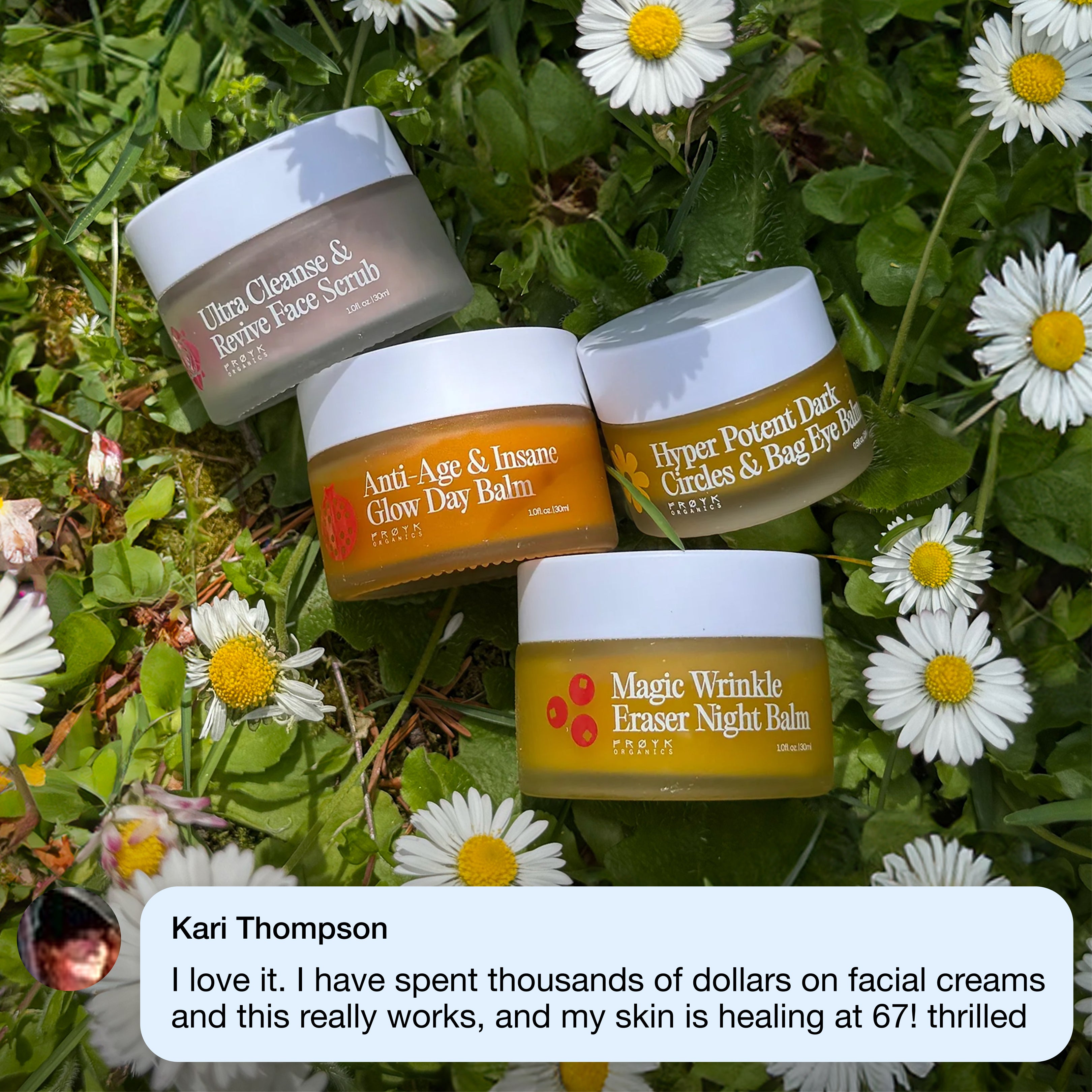
Plantas árticas silvestres y cera de abeja orgánica. Cero agua, cero fragancia sintética. Cuatro bálsamos en una rutina que alimentan los lípidos de barrera de los que depende un brillo duradero, respaldado por una garantía de devolución de dinero de 60 días.
Compra el Sistema - $119Frequently Asked Questions
¿Es seguro el extracto de caléndula para la piel propensa a la rosácea?+
¿Cómo puedo saber si un producto contiene extracto real de CO2 o solo aceite infusionado?+
¿Cuándo debo evitar el extracto de caléndula?+


