

 Account


One morning I looked in the mirror and realized my moisturizer, the one I'd trusted for years, was just sitting on my skin. Not absorbing. Not glowing. Just... there. If that moment sounds familiar, I want you to know: it wasn't the product that failed you.
Your skin's biology shifted, and nobody explained why. Women lose up to 30% of their skin collagen in the first five years after menopause. That single fact changes everything about what a skincare routine for mature women actually needs to look like.
This guide builds a skincare routine for aging skin around what your body actually requires now: fewer steps, oil-based formats that work with a changing barrier, and plant-based actives backed by clinical research. Nine steps, morning through night, grounded in biology. If you want to see the complete system we built for exactly this, it follows the same philosophy. But first, let me walk you through the why behind every step.
Step 1: Understand Why Your Skin Changed After 45
Here is a number that stopped me in my tracks: 30% collagen loss in the first five post-menopause years. That is not gradual decline. That is a cliff.
And it starts earlier than most women expect.
Estrogen drives collagen production. When estrogen begins dropping during perimenopause, which can start as early as age 39 or 40, collagen and elasticity follow. Elasticity decreases by roughly 1.5% per year after menopause. This is why skin that looked resilient at 42 can feel like a completely different organ at 48.
But collagen loss is only one piece.
Your barrier is leaking water. Research shows that mature skin loses water at 36.9 g/m²/hr compared to 28.6 g/m²/hr for younger skin. This is the mechanism behind that frustrating feeling of moisturizer "sitting on top" instead of sinking in. Your skin's water-holding capacity has fundamentally changed. And no, drinking more water won't solve it, because your body has become less efficient at retaining water, fats, and minerals after this hormonal shift.
Cortisol is quietly accelerating the damage. When progesterone declines during perimenopause, cortisol rises or becomes dysregulated. Cortisol actively breaks down collagen. It increases inflammation. It makes skin itchy, dry, and irritated. This isn't emotional stress showing on your face. It is a biochemical process happening beneath the surface, and it compounds every other change.
Microcirculation slows down. Estrogen supports the blood flow that creates a "lit from within" glow. Less estrogen means less circulation, which produces flat, tired-looking skin even when you slept eight hours. This dullness is commonly misread as fatigue by others, and it is one of the most frustrating parts of the transition.
Once you understand these four shifts, collagen loss, barrier dysfunction, cortisol disruption, and reduced circulation, the routine becomes obvious. Protect the barrier first. Deliver actives that support collagen naturally. Use formats that work with a compromised barrier, not against it. And keep it simple, because compliance with a routine you actually follow matters more than any single product.
Your skin did not betray you. It responded to a hormonal shift that nobody prepared you for. The products you trusted did not suddenly become useless. They were formulated for skin that no longer exists. What you need now is a skincare routine for mature women built around your skin as it actually is: a barrier that needs reinforcement, collagen that needs targeted support, and formats that deliver nutrition instead of evaporating off the surface.
You now know more about your skin than most skincare marketing will ever tell you. Every step that follows targets one of these biological shifts. You can read more about the science behind this approach here.

Step 2: Cleanse Without Stripping Your Barrier
If your face feels tight after washing, your cleanser is part of the problem. That tightness is not "clean." It is barrier damage happening in real time.
Most women over 45 are still using foaming or gel cleansers formulated for oily, younger skin. Sulfates and foaming agents strip the lipid barrier, the very layer that is already compromised after estrogen decline. Mature skin produces fewer natural oils. Stripping what little remains accelerates water loss and dullness.
Oil-based cleansing is the shift your skin is asking for. Oil dissolves oil. That means makeup, SPF, and sebum are removed without disrupting the lipid barrier underneath. This principle sounds counterintuitive if you grew up being told oil causes breakouts. But for skin that is losing its natural lipid protection, oil-based cleansing preserves exactly what needs preserving. This is the foundation of any natural skincare routine for mature women.
Here is the technique that makes a difference:
Lukewarm water only. Never hot. Hot water strips lipids faster than any cleanser. Use gentle circular motions with your fingertips. No scrubbing. Pat dry with a soft towel instead of rubbing. In the morning, if your skin does not feel oily, a water-only rinse is perfectly adequate. Your skin did not get dirty overnight.
A note on double cleansing. If you wore heavy SPF or makeup during the day, an oil-based first cleanse followed by a gentle second cleanse ensures everything is removed without harsh rubbing. For mornings or light-product days, a single cleanse is enough. Match your cleansing intensity to what your skin actually needs to remove, nothing more.
Exfoliation needs a reframe too. Cell turnover slows with age, so dead cells accumulate and contribute to dullness. Gentle physical exfoliation one to two times per week helps, but harsh scrubs with large particles create micro-tears on skin that is already thinner and more fragile. The Ultra Cleanse & Revive Face Scrub was designed with this exact balance in mind: plant-based exfoliation calibrated for mature skin that needs renewal without assault.

Step 3: Treat With Arctic Plant Actives That Have the Studies to Back Them
Your skin is losing specific nutrients, and the right plant actives put them back. Not with a prescription, not with weeks of peeling and irritation, but with concentrated botanical nutrition backed by clinical research.
Before we get to the actives, let me address something: if you are using a toner out of habit, ask yourself what it is actually doing. For mature skin with a compromised barrier, most toners add an unnecessary step. Many contain alcohol or astringents that do more harm than help. Going straight from clean skin to treatment is the "less is more" philosophy in action. Simple routines produce better compliance, and better compliance produces better skin.
Now, the actives that earn their place.
Sea buckthorn is the most nutrient-dense plant in Nordic skincare. It contains more than 190 bioactive compounds. It is one of the only plants in existence that naturally provides all four omega fatty acids: 3, 6, 7, and 9. The one that matters most for mature skin is omega-7, palmitoleic acid. This fatty acid is structurally identical to human sebum, the natural oil your skin produces less and less of after menopause. Omega-7 directly promotes collagen synthesis by activating the SIRT1 pathway in skin cells. A 2024 randomized controlled trial showed measurable improvements in skin elasticity, collagen density, and redness after 12 weeks of use.
Your skin is losing a specific fatty acid. Sea buckthorn puts it back. As sebum production declines after menopause, this is not a minor supplement. It is targeted replenishment of exactly what your skin stopped making on its own.
Rosehip delivers natural vitamin A and vitamin C without the side effects of synthetic retinoids. Rosehip oil is rich in a natural retinol precursor and vitamin C, making it a gentle but effective treatment for aging skin. It does not cause the photosensitivity, peeling, or irritation that prescription retinoids are known for.
Retinol gets the headlines. But for mature skin that is already reactive, that is already dealing with rosacea flares nobody connected to perimenopause, retinol's side effects (scaling, stinging, mandatory sun avoidance) can make things worse, not better. Plant-based actives deliver results while working with your skin's biology instead of against it. If you are building the best skincare routine for women over 50, these are the ingredients that earn their place.
Marigold (calendula) and pomegranate round out the collagen support. Marigold has a long history of use in wound healing and skin repair, with studies supporting its ability to promote collagen production. Pomegranate is rich in antioxidants that help reduce the oxidative damage that accelerates aging. These are not folk remedies passed down without evidence. They are active, studied ingredients.
Why this matters specifically for skin after 45: Anti-inflammatory properties become critical when skin turns reactive post-menopause. Plant oils deliver the fatty acids your barrier lost. They work with your changing biology, providing nutrition your skin can actually absorb and use.
These are the core actives in the Anti-Age & Insane Glow Day Balm and the Magic Wrinkle Eraser Night Balm. You can explore the full ingredient list and sourcing here.
Step 4: Give Your Eye Area Dedicated Protection
The skin around your eyes is up to 10 times thinner than the rest of your face. It has fewer oil glands and less collagen to begin with. If you are using your regular moisturizer in this area, you are giving it something that was never designed for its unique structure.
You blink 15,000 to 20,000 times per day. That constant movement, combined with fewer sebaceous glands and naturally thinner skin, means collagen loss hits harder here because there was less structural support to start with. Dark circles can deepen during perimenopause as thinning skin makes the blood vessels underneath more visible. That is not a sleep issue. It is a skin thickness issue.
What to look for in eye care products: anti-inflammatory ingredients to reduce puffiness, plant actives that support microcirculation (vitamin K from plant sources, caffeine), and concentrated formulations that reinforce elasticity in skin that never gets a moment of rest. Lightweight texture is essential. Heavy creams can pool in fine lines and create the opposite of what you want. Esthetician Amber, who has worked with perimenopause clients for over 13 years, emphasizes anti-inflammatory ingredients as the priority for this area.
Application technique matters more here than anywhere else on your face. Use your ring finger only. It applies the lightest natural pressure. Pat the product gently, never rub. Work in a C-shape: from the inner corner of your eye, up along the brow bone, around to the outer corner, and then under the eye back toward the inner corner. Morning and evening.
I spent years using my regular moisturizer around my eyes and wondering why nothing improved. The shift to a dedicated eye treatment made a visible difference within weeks. The Dark Circles & Eye Bag Remover was formulated with plant-based actives designed specifically for this delicate area, where a generic cream is not concentrated enough or gentle enough to do the job.
Step 5: Lock In Moisture With Oil-Based Formats
If your moisturizer sits on your skin instead of sinking in, it is not a bad product. It is the wrong format for how your skin works now.
Most moisturizers are 60 to 80% water. Water evaporates. For skin with higher transepidermal water loss (that 36.9 vs. 28.6 g/m²/hr difference we covered in Step 1), water-based formulas can actually make dryness worse. As the water in the cream evaporates, it can pull moisture from deeper skin layers along with it. This is the mechanism behind "sitting on top." The product is not failing. The format is failing your skin.
Waterless, oil-based formulations change the equation entirely. When you remove water from the formula, every drop is active ingredient. No filler. No dilution. Oil-based products replenish the fatty acids your barrier has lost and create a protective seal that reduces water loss from the outside. This is the difference between temporarily coating the surface and actually restoring the barrier's structural integrity. If you are searching for the best skin care routine for aging skin, format matters as much as ingredients.
Balms work differently from creams, and the distinction matters. A balm melts on contact with your skin's warmth, allowing the actives to penetrate rather than sit on the surface. It then creates an occlusive layer that locks in everything you applied underneath, your treatment step, your eye care, all of it. This is why the order of your routine matters. Treat first. Then seal.
Think of it this way: you would not water a garden and then leave the soil exposed to baking sun. You would mulch it. A balm is the mulch. It protects the investment you made in the steps before.
The concentration difference is significant. When a moisturizer is 70% water, you are paying for water and getting a small fraction of active ingredients per application. A waterless balm delivers its full formula, undiluted, every time. For mature skin that needs more from every product, not less, this concentration matters. You use less product, apply it once, and your skin receives more nutrition per drop than a water-based cream can provide in three applications.
For your morning moisture, the Anti-Age & Insane Glow Day Balm was designed with this exact logic: lightweight enough for daytime wear, concentrated enough to actually support a mature barrier. You can see the full ingredient breakdown here. It is the format designed for how your skin works now, not how it worked at 30.
Step 6: Protect Your Skin From UV Every Single Morning
Every step you have completed so far is undermined if UV exposure goes unchecked. Sun protection is not the glamorous part of skincare. But it is the step that protects all the others.
The American Academy of Dermatology recommends SPF 30 or higher, broad spectrum, every single day. Even indoors. UVA rays penetrate windows. This is the one recommendation every dermatologist, every research body, every clinical guideline agrees on without exception.
Most women use about a quarter of what they need. A full teaspoon of sunscreen for your face alone. If you are applying a thin layer, you are getting a fraction of the labeled SPF protection. Reapply every two hours if you are outdoors. And do not forget your neck, chest, and hands. These areas show age as dramatically as the face, sometimes more so, because they receive consistent sun exposure with almost no protection.
For mature skin, the formula type matters. Chemical sunscreens can irritate reactive, post-menopausal skin. Mineral formulas using zinc oxide or titanium dioxide tend to be gentler and sit well over oil-based products. Apply your SPF as the very last step of your morning routine, after your balm has had a moment to absorb. Give it two to three minutes to set before applying makeup.
Here is why consistency with this step compounds over time. Dermatologists estimate that UV exposure is responsible for the majority of visible facial aging, a phenomenon called photoaging. We tend to attribute wrinkles and dark spots to "getting older," but much of what we see in the mirror is accumulated sun damage, not chronological aging. The collagen and elastin you are working to support with plant actives and barrier repair are being broken down by UV every time you skip protection. Consistent SPF does not just prevent future damage. It gives your skin breathing room to actually repair and rebuild with the actives you are applying.
As dermatologist Dr. Dray puts it: it is never too late to start. The protection you apply today preserves every gain your routine produces tomorrow.
Step 7: Nourish Your Skin While You Sleep
Your skin does most of its repair work between 10 PM and 2 AM. What you put on before bed determines whether that repair window is productive or wasted.
This is not a wellness cliche. Your skin operates on a circadian rhythm. Cell turnover and repair ramp up at night. Blood flow to the skin increases, making it more permeable to active ingredients. And there is no UV exposure to worry about, which means you can use richer, more potent formulations without any photosensitivity concern.
Your evening cleanse depends on your day. If you wore SPF and makeup, a double cleanse works well: an oil-based cleanse to dissolve the day's layers, followed by a gentle second cleanse. If you had a minimal-product day, a single gentle cleanse is enough. The same principles from Step 2 apply here. Lukewarm water. No scrubbing. Pat dry.
Evening is when your treatment actives can do their deepest work. Sea buckthorn's omega-7 collagen support is especially effective when your skin is in active repair mode. The increased blood flow at night means better absorption. The absence of UV means no competing damage. This is the window where plant-based actives have the most impact.
Then seal everything in with a richer balm than you use during the day. Your night formulation should create an occlusive environment that prevents water loss over the hours you sleep, because you cannot reapply anything at 2 AM. The Magic Wrinkle Eraser Night Balm is formulated specifically for this overnight repair window: richer than a day balm, packed with the Arctic plant actives that support your skin while it does its heaviest lifting.
An optional step that makes a real difference: daily lymphatic movement with a gua sha tool. Licensed esthetician Amber, who has worked with perimenopause clients for over 13 years, recommends evening gua sha to reduce puffiness, improve circulation, and help products absorb more effectively. It does not need to take long. Two to three minutes is enough. Gentle, upward strokes along the jawline, cheekbones, and forehead. It becomes a ritual, not a chore.
Your sleep environment matters too. A silk or satin pillowcase reduces friction on skin that is already thinner and more delicate. It also helps your night balm stay on your face instead of being absorbed into cotton fibers. A cool, slightly humidified room supports your skin's overnight repair process by reducing environmental water loss while you sleep.
Step 8: Stop Using What's Working Against You
Sometimes the most powerful step in a skincare routine is what you remove. If you have been spending $2,000 to $4,000 a year on skincare that is not delivering results, some of those products may be actively working against your skin.
If retinol makes your skin red, peeling, or sensitive, it is not "working." Irritation is not a sign of efficacy for mature skin. It is a sign of barrier damage on a barrier that is already compromised. The sea buckthorn and rosehip actives covered in Step 3 deliver collagen support and skin renewal without the scaling, stinging, or mandatory sun avoidance that retinol demands. If retinol is hurting you, you have permission to stop.
Alcohol-based toners and astringents need to go. They strip the barrier you are working to rebuild. If a product stings when you apply it, that is not a sign that it is doing something. It is doing harm. Your barrier cannot afford what these products take from it.
Check your ingredient labels for "parfum" or "fragrance." Synthetic fragrance is one of the most common irritants in skincare. Mature skin is more reactive post-menopause because estrogen, which helped regulate inflammation, has declined. Fragrance triggers inflammation, redness, and allergic reactions in skin that no longer has the same capacity to manage them.
Stop over-cleansing. If you are washing your face more than twice a day, or using hot water, you are destroying the lipids your barrier needs to function. Morning water rinse, evening gentle cleanse. That is enough. I know it feels wrong to "not really wash" in the morning. But your skin did not get dirty overnight. What it did do is produce a thin layer of natural oils that are protecting your barrier. Washing those away first thing sets you up for a drier, more irritated day.
Be cautious about what social media tells you. Over 50% of skincare information on social media is misinformation. The 12-step routines, the "slug everything" trends, the insistence that you need retinol or you are doing it wrong. Research consistently shows that simple three to four step routines produce better compliance and better outcomes than elaborate regimens. The most effective skin care routine for mature skin is the one you actually follow, every day.
Here is the liberation in this step. Cutting products saves money. It reduces irritation. And counterintuitively, it often improves results. Every product you eliminate that was working against your barrier gives your barrier a better chance to function on its own. Less truly is more for mature skin.
The average menopausal woman spends $2,000 to $4,000 a year on symptom management. Supplements, cooling products, hormonal support, sleep aids, skincare for changes nobody explained. Much of that spending is reactive, addressing symptoms one product at a time. A focused routine that addresses the root biology, barrier repair, collagen support, and anti-inflammatory protection, replaces that scattered spending with something that actually works.

Step 9: Adjust Your Routine by Decade
"Mature skin" is not one thing. A woman navigating perimenopause in her early 40s has different skin needs than a woman who has been post-menopausal for a decade. Here is how to adjust the routine you just built.
Your 40s: The Perimenopause Shift
Perimenopause can begin 10 to 15 years before your final menstrual period. That means skin changes may start at 39 or 40, years before you connect them to hormones. If you are looking for a skin care routine for women over 40, start here.
The signs are subtle at first. Slightly drier skin. Products that feel slightly less effective. A bit less bounce when you press your cheek. This is the prevention window, and it is the most valuable time to start this routine. Focus on barrier protection and introducing plant-based actives for collagen support. The lightweight versions of everything: a day balm, gentle cleansing, consistent SPF.
One thing almost nobody connects to perimenopause: rosacea flares. If your skin is suddenly more red, more reactive to products that never bothered you before, this may be hormonal. Estrogen helps regulate inflammation, and as it declines, your skin's inflammatory response becomes less controlled. Women see a dermatologist for rosacea, get a prescription, and never hear that the root trigger may be the hormonal transition they are already experiencing. Understanding this connection changes how you approach treatment. Anti-inflammatory plant actives, like the ones in Step 3, address this directly.
Your 50s: The Collagen Cliff
This is the decade of the 30% collagen loss window. Skin changes feel dramatic and sudden because, biologically, they are. For women building an anti aging skincare routine after 50, this decade demands the full routine.
The full routine becomes critical now. Richer formulations every day, not just occasionally. Night balm becomes a nightly essential, not an occasional treat. Sea buckthorn's omega-7 for collagen support is especially important during this window because your skin is losing the specific fatty acid it replaces. Consider adding the gua sha practice as a regular evening ritual to support lymphatic drainage and circulation.
If you have not already switched to oil-based formats, this is the decade where the difference becomes most obvious. Water-based moisturizers that felt adequate at 45 will feel insufficient at 52. Your barrier needs the fatty acid replenishment that only oil-based products deliver.
This is also the decade when many women first hear about their skin changes from a doctor, if they hear about it at all. Dr. Marissa Garcia notes that dryness, dullness, loss of elasticity, lines, and wrinkles are the signature changes of this window. They are not signs of failure. They are signs of a biological transition that responds to the right approach.
Your 60s and Beyond: Nourish and Protect
Collagen loss continues at roughly 2.1% per year. Skin is thinner, more fragile, and more vulnerable to UV damage.
This is the decade for the gentlest possible cleansing and the richest possible moisture. SPF becomes even more important, not less, because thinner skin provides less natural UV protection. Mineral sunscreens are your friend.
Dermatologist Dr. Dray raises a point that skincare brands rarely mention: bone and fat loss also drive visible facial aging. Your eye sockets enlarge, cheek bones recede, and the framework that holds your skin in place shifts. No topical product addresses this. Dental health preserves facial bone structure. Resistance training supports bone density. A nutrient-rich diet with adequate calcium, vitamin D, and protein contributes to the structural support your skin sits on.
Skincare is one piece. But it matters. And at this stage, simplicity wins. A consistent three to four step aging skincare routine with the right formats outperforms a complicated regimen you abandon by Thursday. Dr. Marissa Garcia, speaking during Menopause Awareness Month, put it well: it is not about reversing aging. It is about better aging. Nutrient-rich foods, staying hydrated, managing stress, and light exercise all complement what your skincare routine does on the surface.
The Constant Across All Decades
The core does not change: barrier protection, plant-based actives, oil-based formats, and a simple routine you follow every day. What scales up is the richness and intensity. The Complete System for Mature Women's Skin was designed to work across these decades, providing a foundation that adapts as your skin continues to evolve.
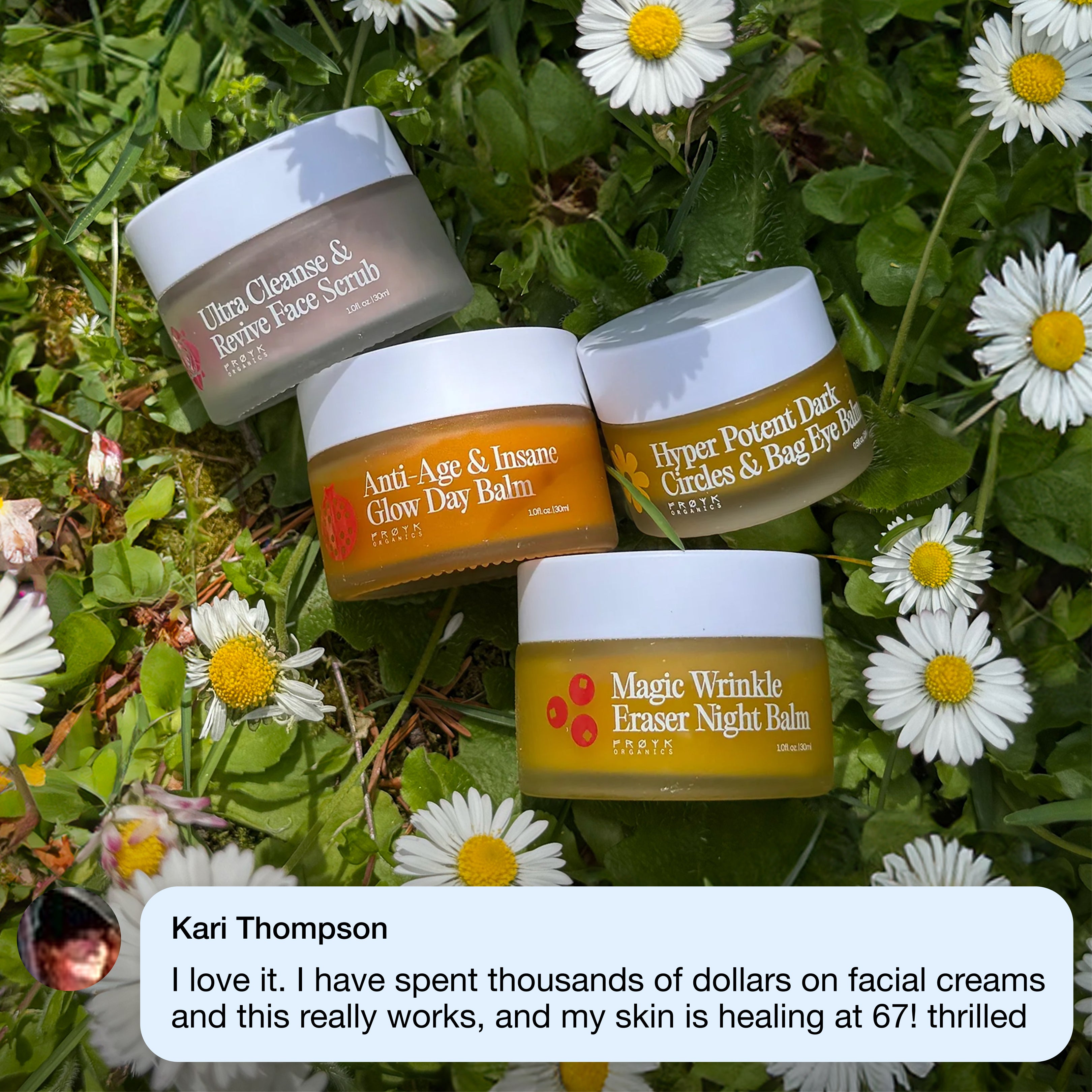
Wild Arctic botanicals and organic beeswax. Zero water, zero synthetic fragrance. Four concentrated balms that calm and nourish sensitive, reactive skin, backed by a 60-day money-back guarantee.
Shop the System Today


