

 Account


My skin is as dry as a lizard, and the moisturizer I used for ten years suddenly stings. r/Menopause · posted last winter
I’ve read that exact sentence, in slightly different words, hundreds of times. It’s not in your head. The cream didn’t change. You did.
The moisturizer that worked at 38 was never built to compensate for that level of biological change.
This is a different angle. Twelve ways to moisturize dry skin naturally, grounded in plant oils your skin recognizes, layering rules almost no one is taught, and a few inside-out shifts that do more than another tube of cream. We’ll cover dry versus dehydrated (they’re not the same), the hero ingredients worth your money, and a nightly protocol that resets a compromised barrier in about two weeks.
Start with the one oil I’d hand you if you only had room for one.
1. Sea Buckthorn Oil: The Omega-7 That Mimics Your Sebum
Most natural-skincare articles miss this. After menopause, your sebum production falls 40 to 50%. Sebum isn’t grease. It’s the lipid layer that keeps water in and irritation out.
When sebum drops, almost no plant oil can fill the gap, because almost no plant oil contains palmitoleic acid, the omega-7 fatty acid that’s the closest botanical match to what your skin used to make on its own.
Sea buckthorn does. The berry oil is one of the only plant sources of palmitoleic acid in meaningful concentration, and that fatty acid is structurally identical to a key component of human sebum. Apply it, and your skin recognizes it.
Topically, sea buckthorn is a finishing oil. Press 3 to 4 drops into damp skin at night, after your moisturizer, or layer it over a humectant serum. The color is naturally orange, so use less than you think you need.
For the full breakdown of why this single fatty acid keeps showing up in mature-skin research, I wrote a longer piece on sea buckthorn and omega-7 skin benefits.
If you only add one oil to your routine after 50, make it this one.
2. Rosehip Seed Oil: 45% Linoleic Acid for Ceramide Repair
Most plant oils can’t claim that. The reason rosehip can comes down to one molecule.
Rosehip seed oil is roughly 45 to 50% linoleic acid, an omega-6 fatty acid your skin doesn’t just absorb, it converts. Linoleic acid is the precursor your body uses to build ceramide 1 (EOS), the long-chain ceramide that holds the bricks-and-mortar structure of your skin barrier together. Less ceramide 1, looser barrier, faster water loss. More linoleic acid in the diet and on the skin, more raw material to rebuild it.
This is also why rosehip outperforms coconut oil for compromised, mature skin. Coconut is 1 to 3% linoleic acid. Rosehip is forty-five times higher in the exact fatty acid your barrier needs to repair itself. The marketing tells you “natural oil.” The chemistry tells you which one actually does the job.
I use rosehip as my middle layer, after a humectant and before a heavier oil or balm. Three to five drops on damp skin at night. It absorbs cleanly, doesn’t sit on top, and pairs beautifully with sea buckthorn as the final step.
3. Dry vs. Dehydrated: Diagnose Before You Treat
“Dry” and “dehydrated” sound like the same thing. They are not, and treating one with the other’s solution is why most readers feel like nothing works.
Dry skin lacks oil. It’s a skin type, often genetic, often worsened by hormonal shifts. The fix is emollients (rosehip, jojoba, squalane) and occlusives (plant butters, balms) that replace and seal in lipids.
Dehydrated skin lacks water. It’s a temporary condition. Anyone can have it, including oily skin types. The fix is humectants (glycerin, hyaluronic acid, honey) that pull water into the upper layers, plus actually drinking enough water.
In menopause, you usually have both at once. A single-category product never wins. A rich oil on dehydrated skin feels heavy and still tight. A water-based serum on dry skin evaporates and leaves you parched in twenty minutes.
Most “moisturizing” cream marketing blurs this on purpose. One product can’t fix both. If your moisturizer feels like it disappears in 20 minutes, that’s the test right there.
4. The Layering Order That Actually Works: Humectant, Emollient, Occlusive
Hyaluronic acid can dehydrate your skin. I’ve watched women double down on the same serum for months while their face got tighter and tighter, never told that the issue isn’t the product. It’s the order.
Humectants like hyaluronic acid and glycerin are water magnets. They hold up to a thousand times their weight in water. In a humid environment, they pull moisture from the air into your skin. In a dry room, with the heat on or the AC running, they pull water from the deeper layers of your skin upward, where it evaporates. You end up drier than when you started.
The fix is sequencing. Three steps, in this order, every night.
Glycerin or hyaluronic acid, applied within 60 seconds of cleansing while the face is still slightly wet. This pulls water in.
Rosehip, jojoba, or squalane. A few drops pressed in. This fills the gaps between skin cells where the barrier has thinned.
A plant butter, balm, or final layer of squalane. This is the lid on the jar. It seals everything underneath so it can’t escape overnight.
Skip step three in dry winter air, and step one will quietly work against you. The American Academy of Dermatology recommends applying moisturizer to damp skin within 60 seconds of washing for exactly this reason.
Wet skin, then thin to thick. That single rule will outperform a $200 product applied wrong.
5. Jojoba Oil: The Wax Ester Your Skin Recognizes
Jojoba isn’t technically an oil. It’s a liquid wax ester, and that distinction is the whole point.
Your skin’s surface produces its own wax esters as part of sebum. Jojoba’s molecular structure is almost a one-to-one match. When you apply it, your skin doesn’t read it as a foreign lipid sitting on top. It reads it as more of itself. That’s why it absorbs cleanly, doesn’t clog pores, and rarely causes the stinging reaction that oilier-feeling oils can trigger on a thinned barrier.
The American Academy of Dermatology lists jojoba among its recommended ingredients for dry skin, and it’s one of the few plant-derived options safe for rosacea-prone, eczema-prone, and reactive skin. If sea buckthorn feels too rich or rosehip stings during a flare, jojoba is the one I reach for first.
Jojoba is endlessly flexible. A few drops mixed into your moisturizer in the palm of your hand stretches a heavier cream and improves spreadability. A drop or two pressed into the cheekbones midday revives skin that’s gone matte and tight. It also makes a clean cleansing oil for dissolving sunscreen and makeup at the end of the day.
Reach for jojoba when your skin is reactive, when the air is dry but you don’t want a heavy occlusive, or when you simply want one bottle that does several jobs without arguing with your skin.
6. Squalane: The Emollient That Fills the Cracks
Your skin already makes squalene. By age 30, production has started to slow. By menopause, it’s dropped sharply, and the intercellular spaces it used to fill are part of why your barrier feels looser and your skin feels rougher.
Squalane (with an A) is the shelf-stable, hydrogenated version of squalene (with an E). It’s almost always plant-derived now, usually from olives or sugarcane, and it slots into the exact gaps between corneocytes (the flat cells of your outer skin) that age has emptied out. That’s why it works for so many skin types at once: non-comedogenic for combination skin, calming for rosacea, gentle enough for eczema flares, and useful for dry mature skin as a final occlusive layer.
Squalane is one of the most elegant oils to apply. It’s nearly weightless, leaves zero greasy film, and absorbs in under a minute. You can wear it under SPF in the morning or layer it over a heavier balm at night.
I keep it in two places in my routine: as a finishing oil after moisturizer, especially in winter, and blended one-to-one with rosehip when I want the linoleic-acid benefits with a lighter feel.
A few drops at night, after your moisturizer, is enough.
7. Eat Your Way to Hydration: Omega-3 and Omega-7 from the Inside
No topical can replace a fatty acid your body never receives. Your skin barrier is built from what arrives through your bloodstream as much as what you smooth on at night.
Omega-3 fatty acids, the kind in salmon, sardines, mackerel, walnuts, flaxseed, and chia, lower systemic inflammation and feed the lipid layer that holds your barrier together. Most women in their fifties are running on a fraction of what their skin needs.
Omega-7 from sea buckthorn berry shows up in clinical research with measurable results. The 12-week trial at 1,000 mg per day reduced transepidermal water loss and improved skin elasticity. The same supplementation has been studied for dry eyes and vaginal dryness, both of which trend in the same direction during menopause. When you fix the underlying lipid supply, the symptoms in different tissues often improve together.
Linoleic acid food sources matter too. Sunflower seeds, walnuts, hemp hearts, and a small daily handful of pumpkin seeds give your skin the raw material it needs to synthesize ceramide 1, the same molecule rosehip oil supports topically.
Hydration baseline is simpler than the wellness internet makes it. Two to two and a half liters of water a day is a fair target. Alcohol and excess caffeine both increase water loss through the skin, which is part of why a glass of wine the night before tends to show up under your eyes the next morning.
8. The Overnight Protocol: 5 Steps to Reset a Compromised Barrier
When everything stings and nothing works, the answer is not another product. It’s a reset that takes about a week to start, and roughly two weeks to finish.
Stop all actives. Pause vitamin C, retinol, AHAs, BHAs, exfoliating acids, and scrubs. On a barrier that’s already breached, they’re pouring acid on a scrape. Apply a simple single-ingredient occlusive twice a day. Clean squalane works, or a thin layer of zinc oxide paste on patches that are actively flaking or red.
Stay gentle. Reintroduce a humectant (glycerin is the calmest choice) on damp skin, then an emollient (rosehip or squalane), then your occlusive. Cleanser stays minimal: a non-foaming, fragrance-free formula at night only.
Reintroduce one active. Vitamin C in the morning is usually the gentlest re-entry. Wait a full week before adding anything else. If anything stings, pull it back out.
Rebuild. Now you can layer in barrier-supporting ingredients on purpose: ceramides, plant fatty acids, niacinamide if it’s tolerated. Skin loses more water overnight than during the day, and at this stage cell turnover slows roughly ten days per decade. The protocol still works inside two weeks if you let it.
9. Why Coconut Oil Isn’t the Answer (And What to Use Instead)
The most common natural-skincare advice on the internet is also one of the worst pieces for menopausal skin: rub coconut oil on it.
Coconut oil is roughly 45 to 50% lauric acid, with only 1 to 3% linoleic acid. Lauric acid is antimicrobial, which is genuinely useful in a soap. It does almost nothing for a thinned, ceramide-depleted barrier, because your skin can’t convert it into the structural lipids it actually needs. The other large component of coconut oil is oleic acid, which in high concentrations can loosen the lipid layers of an already-compromised barrier and make dryness worse, not better.
There’s also the practical issue. Coconut oil is comedogenic for combination and acne-prone skin. Plenty of women in their fifties still get hormonal breakouts along the jaw, and coconut oil can stack the deck against them.
- Safflower oil ∼75% linoleic acid
- Grapeseed oil ∼70% linoleic acid
- Sunflower oil ∼65% linoleic acid
- Rosehip seed oil ∼45% linoleic acid (plus natural retinoic acid precursors)
- Jojoba oil ∼5–10% linoleic acid, balanced by its wax-ester structure
Any of those will outperform coconut for dry mature skin, and rosehip remains my first pick for the combination of barrier support and clinical results.
10. Skip the Morning Cleanser (Yes, Really)
The single fastest way to improve dry skin in your fifties costs zero dollars: stop washing your face in the morning.
While you sleep, your barrier produces and redistributes lipids. By dawn, your skin has done several hours of repair work that you do not want to rinse down the drain. A surfactant-based cleanser, even a gentle one, lifts those lipids before your serum and SPF have a chance to act on top of them.
The dermatologist Dr. Aleksandra Brown has been making this point for years. For dry, mature, or reactive skin, lukewarm water alone is enough in the morning. If you wore heavy SPF or a strong active the night before, that’s a different story, but most nightly routines don’t need to be cleansed off twice.
Save your real cleanser for the evening, when the day’s sunscreen, makeup, sweat, and pollution genuinely need to come off. Use a low-foam or oil-based cleanser, and follow it with the layering order above.
11. Lukewarm Showers and the 60-Second Rule
Hot showers feel amazing. They also dissolve the protective lipid layer of your skin, including the ceramides and sebum you’re trying to preserve. Water above roughly 40°C (104°F) destabilizes the barrier, and a ten-minute shower strips noticeably more than a four-minute one.
The temperature trade-off is real. The 60-second rule is how you recover most of the loss without giving up the shower altogether.
Within 60 seconds of stepping out, while your skin is still damp, apply your moisturizer or body oil. Damp skin holds the water you just absorbed; dry skin has already let most of it evaporate. Pat with the towel, do not rub, and leave the skin slightly wet on purpose. The American Academy of Dermatology has been recommending exactly this for years, and it’s one of the only guidelines that costs nothing and works immediately.
For the body, a few pumps of squalane or a rich plant-butter cream applied on damp legs and arms outperforms almost any lotion applied to fully dry skin twenty minutes later. For the face, the same rule applies after cleansing.
12. Run a Humidifier (and Read Your Labels)
Your bedroom in February is drier than the Sahara. A $40 humidifier can outperform a $200 cream in that environment, because no topical can win against air that’s actively pulling moisture out of your skin.
Indoor humidity in heated or air-conditioned homes regularly drops to 20 to 30%. The comfortable range for skin is 40 to 60%. A small humidifier in your bedroom, running overnight while your barrier is at its most permeable, gives every product you applied a fighting chance to do its job.
While you’re auditing your environment, audit your labels too.
- Watch for denatured alcohol and SD alcohol high on the ingredient list. They evaporate fast and take water with them.
- Watch for sulfates (SLS, SLES) in cleansers. They strip the barrier you’re working to rebuild.
- Watch for high-percentage essential oils on broken skin. They can sting and sensitize even when the rest of the formula is clean.
Fix the environment first. The product matters less when the air around you isn’t fighting you.
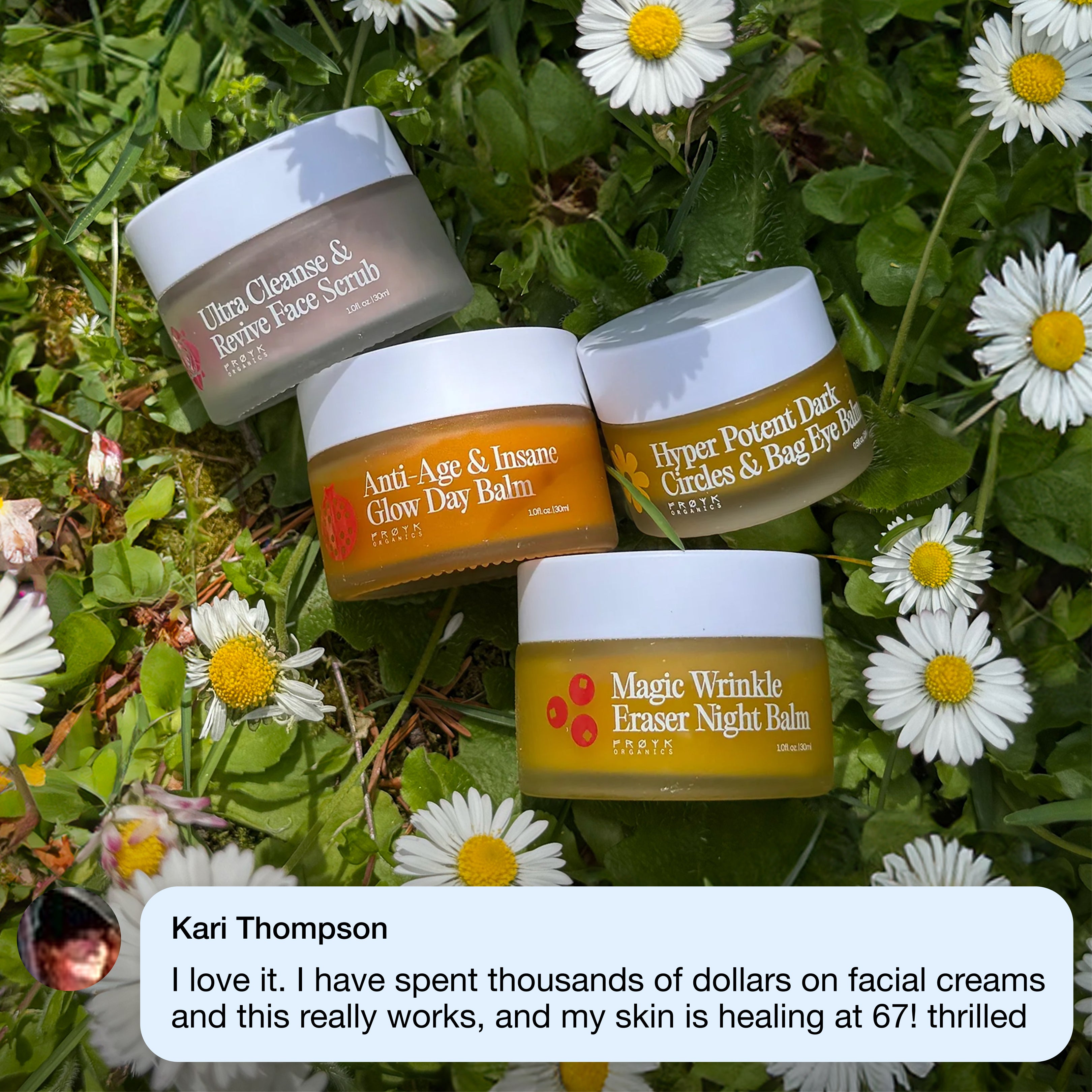
The full Frøya dry-skin system: cold-pressed rosehip, sea buckthorn, jojoba, and squalane formulated for women in their 50s and beyond. No synthetic fragrance. No water-first fillers. Everything this article covers, in one routine.
Shop the Dry Skin System


