

 Compte


Vous avez une étagère pleine de produits censés régler ce problème. Le sérum que tout le monde jurait efficace, la crème vue en publicité, le rétinol qui vous a laissé la peau rouge pendant une semaine. Et votre peau reste sèche, paraît plus terne qu'avant, et tire dès que vous essayez quelque chose de nouveau.
Voici ce que personne ne vous dit : après 50 ans, ce n'est pas d'en faire plus qui résout le problème. Votre peau n'est pas devenue plus difficile à soigner. Elle devient en réalité plus facile à vivre dès que vous arrêtez de la combattre avec des produits agressifs et que vous lui offrez des soins plus doux.
Ce qui a changé se situe en profondeur. Quand les œstrogènes chutent, votre peau produit moins de collagène et moins de sébum, ce qui la rend plus sèche et plus fine. La bonne nouvelle, c'est qu'une fois qu'on comprend cela, la solution devient beaucoup plus simple.
Je veux vous expliquer ce changement, quels ingrédients méritent votre argent, et lesquels aggravent discrètement les choses. Pas de battage marketing, pas de routine en 12 étapes que vous abandonnerez d'ici vendredi.
Points clés
- La plupart des changements cutanés après 50 ans s'expliquent par la baisse des œstrogènes et du collagène, et non par quoi que ce soit que vous ayez mal fait.
- Une barrière cutanée solide compte plus que n'importe quel actif anti-âge isolé.
- Des ingrédients agressifs comme les rétinoïdes et les acides peuvent se révéler contre-productifs sur une peau plus fine et plus sèche.
- Une routine courte que vous suivez réellement vaut mieux qu'une étagère de produits que vous abandonnez.
Comment la peau change après 50 ans

Votre peau change après 50 ans surtout parce que les œstrogènes chutent, et ce sont eux qui la maintenaient ferme et rebondie. Quand ils diminuent, la production de collagène ralentit, et le collagène est la protéine qui donne à la peau son élasticité. Le résultat : des ridules et des rides, moins de fermeté, et une sensation de finesse.
Ce relâchement s'explique par la perte de collagène. Une étude sur la peau ménopausique a montré que les femmes en perdent près de 30 % durant les cinq premières années après la ménopause, puis environ 2 % par an ensuite. Votre peau produit également moins de sébum, ce qui réduit sa capacité à retenir l'eau et lui donne une sensation de tiraillement.
Une circulation sanguine plus lente et des années d'exposition au soleil ajoutent des taches brunes et un teint irrégulier, deux des signes de l'âge les plus courants. Rien de tout cela ne signifie que votre peau est abîmée. Elle a simplement besoin de soins différents de ceux qu'elle recevait à 35 ans, ce qui commence par comprendre ces changements cutanés liés à la ménopause.
Actifs et ingrédients anti-âge courants
De nombreux actifs anti-âge peuvent aider la peau mature, mais chacun a ses compromis, qu'il vaut mieux connaître avant d'acheter. Connaître votre type de peau vous aide aussi à choisir ce qui vous convient. Voici la version honnête de ce que propose le marché.
- Acide hyaluronique : attire l'eau vers la peau pour un effet repulpant à court terme, ce qui explique sa présence dans tant de crèmes hydratantes pour peau mature. Il retient l'hydratation mais ne répare pas la barrière cutanée, donc une peau sèche peut à nouveau tirer dès le milieu de la journée.
- Rétinoïdes : stimulent le collagène et réduisent les ridules, mais provoquent souvent rougeurs, desquamation et picotements. Après 50 ans, une peau plus fine réagit plus fort et met plus longtemps à se stabiliser.
- Vitamine C : stimule la production de collagène et lutte contre les radicaux libres, tout en aidant à atténuer les taches brunes. Les produits à la vitamine C fonctionnent mieux dans un emballage opaque et peuvent picoter à forte concentration, bien que la vitamine C soit aussi présente naturellement dans certaines huiles végétales.
- Niacinamide : soutient l'uniformité du teint et l'élasticité à faible dose, bien qu'elle puisse provoquer des rougeurs chez certaines.
- AHA et BHA : des acides comme le glycolique lissent le grain de peau et aident contre l'acné, mais un usage excessif fragilise la peau et affaiblit la barrière cutanée.
Le schéma est simple. Les actifs puissants peuvent aider, mais ils sollicitent beaucoup une peau plus mature, donc la douceur est généralement le choix le plus judicieux après 50 ans.
Barrière cutanée : réparer et protéger
Votre barrière cutanée est la couche externe qui retient l'hydratation et empêche les irritations de s'installer. Quand elle s'affaiblit, la peau devient sèche, réactive et picote facilement. Après 50 ans, une barrière plus fine explique souvent pourquoi vos anciens produits de soin vous semblent soudain agressifs.
Le conseil habituel est de se tourner vers des lipides réparateurs comme les céramides, et c'est un bon point de départ. L'idée principale, c'est que la peau mature a besoin d'aide pour retenir son hydratation, pas qu'on la lui retire. Les produits conçus pour réparer la barrière des peaux sensibles conviennent bien mieux à ce stade que les nettoyants moussants qui laissent la peau tirer.
Quand les actifs puissants sont trop agressifs pour une peau mature
C'est là que beaucoup de femmes se retrouvent bloquées. Le même rétinol ou le même acide qui fonctionnait à 40 ans peut désormais vous laisser rouge, irritée et sensible, car des œstrogènes plus bas signifient une barrière plus fine qui laisse ces ingrédients pénétrer plus vite.
Les rapports sur les effets secondaires du rétinol montrent que ce phénomène s'aggrave après la ménopause, avec des temps de récupération plus longs. Quand votre peau réagit ainsi, persister ne fait généralement qu'aggraver les choses. C'est le signal qu'il faut opter pour quelque chose de plus doux.
Quels soins les dermatologues recommandent-ils pour la peau mature ?
Les dermatologues recommandent généralement une routine simplifiée centrée sur l'hydratation, un nettoyage doux, le soutien de la barrière cutanée et la protection solaire. Les recommandations classiques insistent fortement sur une SPF quotidienne, expliquant qu'elle aide à prévenir la dégradation continue du collagène et que la SPF minérale bloque une grande part du vieillissement prématuré causé par les UV. Les actifs vedettes viennent après ces bases.
Pour les préoccupations plus profondes, les produits professionnels comme ceux en vente libre ont chacun leur place :
- Les peelings chimiques pour lisser le grain de peau et atténuer les pigments.
- Le laser pour les taches brunes tenaces et les dommages solaires.
- Les rétinoïdes sur prescription pour les rides que les crèmes ne peuvent pas déplacer.
75 % de la façon dont nous vieillissons dépend de facteurs extrinsèques, pas de la génétique. » Dr Saranya Wyles, dermatologue, Mayo Clinic
Voici la partie encourageante. La majeure partie du vieillissement de votre peau est entre vos mains, pas dans vos gènes, puisque les facteurs extérieurs pèsent bien plus sur le vieillissement cutané que les gènes avec lesquels vous êtes née. Cela signifie que vos soins quotidiens comptent vraiment.
Donc, si une tache paraît nouvelle, change de forme, ou ne guérit pas, consultez un dermatologue pour la faire examiner rapidement.
Une routine plus douce pour la peau mature : comment Frøya vous aide

Il existe une façon plus douce de faire le travail de barrière et d'hydratation dont la peau mature a besoin, et elle vient des plantes plutôt que de synthétiques agressifs. Frøya Organics construit ses formules autour de plantes arctiques sauvages et de cire d'abeille biologique, qui accompagnent une peau qui s'affine au lieu de la fragiliser davantage.
La star discrète, c'est l'argousier, un ingrédient qui figure rarement sur les listes habituelles de soins de la peau mais qui repose sur une science solide. C'est la source végétale la plus riche en oméga-7, cet acide gras que votre peau produit déjà et perd lentement avec l'âge. Il contient aussi de la vitamine C naturelle qui unifie le teint, tandis que l'églantier apporte une forme douce et végétale de vitamine A.
La cire d'abeille et le chardon scellent cette hydratation et soutiennent la réparation, tandis que l'arnica et le calendula apaisent les rougeurs et le teint irrégulier. C'est un soin de la barrière cutanée sans aucune sensation de brûlure.
Construire une routine simple, matin et soir
Une bonne routine de soin pour une femme de 50 ans est courte et facile à répéter. Le matin, nettoyez en douceur, appliquez votre baume de jour, puis ajoutez un soin des yeux. Le soir, nettoyez, puis appliquez un baume de nuit pour que la peau puisse se réparer pendant que vous dormez.
Utilisez votre gommage visage seulement deux à trois fois par semaine, et ajoutez un nouveau produit à la fois pour identifier ce qui fonctionne. N'oubliez pas votre cou, car il révèle aussi l'âge. C'est la régularité qui donne des résultats, pas une grande quantité de produit en une seule fois.
Les quatre étapes ci-dessous proviennent du Système Complet Anti-Âge pour Peau Mature, conçu comme une seule routine pour cette étape de la vie.
|
Étape (quand l'utiliser) |
Ce qu'elle cible |
Comment elle agit |
|
Gommage Visage Purifiant & Revitalisant (2 à 3 fois par semaine) |
Le teint terne lié au renouvellement cellulaire plus lent |
La rose arctique associée à la poudre de riz et d'abricot élimine les cellules mortes de surface sans retirer les huiles dont votre peau a besoin |
|
Baume de Jour Anti-Âge & Éclat (matin) |
Sécheresse, teint terne, teint irrégulier |
L'argousier, la grenade et l'églantier apportent un éclat antioxydant et retiennent l'hydratation |
|
Baume Contour des Yeux Ultra-Concentré Anti-Cernes & Poches (matin ou soir) |
Cernes, poches, ridules |
L'arnica arctique et le squalane soutiennent cette zone délicate et la maintiennent hydratée |
|
Ridules et rides |
La vitamine A naturelle de l'églantier, l'arnica et la cire d'abeille soutiennent la réparation nocturne |
Crèmes et soins périoculaires
La peau autour de vos yeux est la plus fine de votre visage, c'est pourquoi les cernes, les poches et les ridules y apparaissent en premier. Elle réagit aussi le plus vite aux produits agressifs, ce qui explique pourquoi les crèmes et baumes pour les yeux sont formulés plus doucement que le reste de votre routine.
Recherchez des ingrédients qui hydratent et soutiennent cette zone fragile plutôt que de la fragiliser. Le Baume Contour des Yeux Ultra-Concentré Anti-Cernes & Poches mise justement sur l'arnica arctique et le squalane pour cette raison. Tapotez-le, ne le frottez jamais, et une petite quantité suffit largement.
Taches brunes et taches de vieillesse : prévention et soin
Les taches de vieillesse sont des marques brunes et plates laissées surtout par des années d'exposition au soleil, ce qui explique qu'elles apparaissent sur le visage, les mains et le corps. Elles sont inoffensives, mais beaucoup de femmes souhaitent les atténuer pour un teint plus uniforme et un aspect plus lumineux.
Un soin régulier et doux les atténue progressivement. Les huiles végétales riches en antioxydants et une protection solaire quotidienne constante aident à en empêcher l'apparition de nouvelles. Avec le temps, les produits conçus pour unifier le teint peuvent atténuer les taches déjà présentes.
Pour les taches foncées qui ne s'atténuent pas, un dermatologue peut proposer des peelings ou du laser. Rien ne presse, et il n'y a aucune honte à aimer votre peau telle qu'elle est.
Habitudes quotidiennes qui soutiennent une peau saine
Le soin de la peau ne s'arrête pas au flacon, et votre vie quotidienne se lit sur votre visage. Les dermatologues insistent sur des habitudes saines comme une alimentation riche en fruits et légumes colorés, qui fournit à votre peau les éléments nécessaires à la production de collagène tout en soutenant votre santé générale.
Le sommeil, le mouvement et une hydratation constante comptent aussi. L'exercice stimule la circulation sanguine, qui nourrit votre peau, et un bon sommeil est le moment où la réparation se produit. Prendre soin de votre corps maintient votre peau en meilleure forme qu'un seul produit ne pourrait le faire.
De petites habitudes régulières protègent l'éclat que vous recherchez et soutiennent une peau saine sur le long terme.
Les vrais résultats prennent du temps pour la peau mature

Une peau saine après 50 ans se construit lentement, ce n'est pas un résultat du jour au lendemain. La plupart des soins à base de plantes demandent une utilisation régulière avant que vous ne voyiez le changement, c'est pourquoi Frøya présente ses résultats sur une période complète de 60 jours. Laissez du temps, restez constante, et laissez les petits changements s'accumuler.
Les photos avant et après ci-dessous viennent de femmes qui ont suivi leur routine avec constance. Remarquez les traits plus adoucis, le teint plus uniforme, l'éclat qui revient. C'est ce que la patience et un peu de soin beauté quotidien peuvent donner sur une vraie peau.
Si vous n'avez constaté aucun changement après quelques mois, consultez un professionnel de santé. Votre peau est capable de retrouver son éclat bien plus que cette saison ne vous le laisse croire.
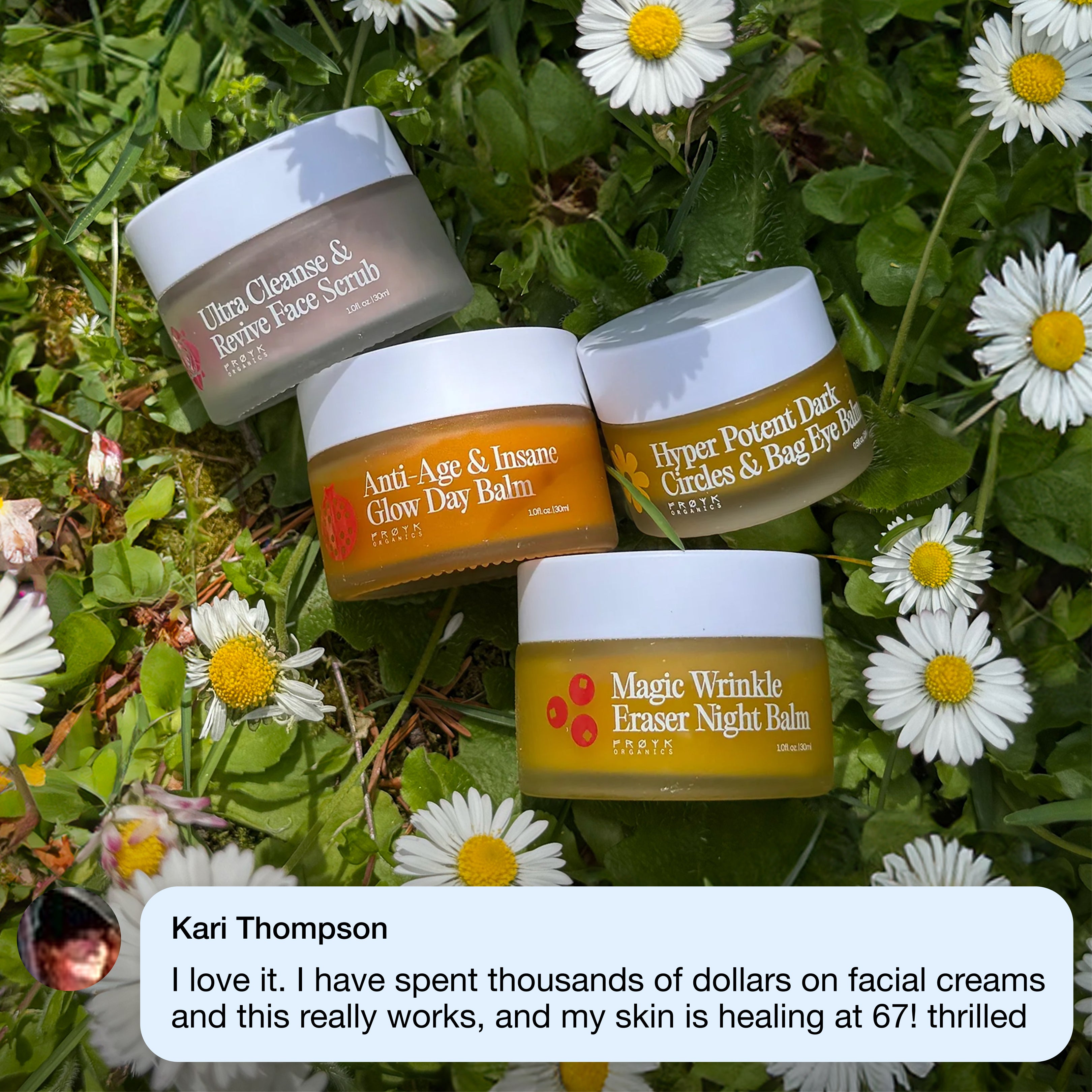
Plantes arctiques sauvages et cire d'abeille biologique. Zéro eau, zéro parfum synthétique. Quatre baumes en une seule routine qui nourrit les lipides de la barrière cutanée dont dépend un éclat durable, avec une garantie de remboursement de 60 jours.
Découvrir le Système - $11Questions Fréquemment Posées
Quel est le meilleur traitement pour une peau de 50 ans ?+
Quelle est la meilleure marque de soins pour les peaux matures ?+
Pourquoi la peau devient-elle si sèche après la ménopause ?+
Comment devrais-je envisager la crème solaire après 50 ans ?+
La peau mature peut-elle utiliser des soins naturels à la place d'actifs puissants ?+
N'est-il jamais trop tard pour commencer une routine de soins ?+


