

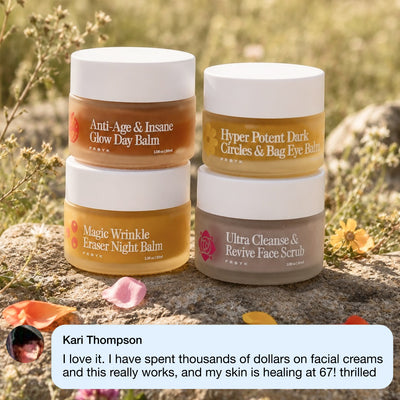
 Compte


L'anti-âge ne s'agit plus d'effacer les signes du temps, mais de mettre en place une stratégie pour préserver la santé dermique. Pour la consommatrice d'aujourd'hui, les corrections agressives font place à un soutien durable de la barrière cutanée.
Le secteur de la beauté naturelle en chiffres
Global Market Insights prévoit que le secteur de la beauté naturelle atteindra 70,8 milliards de dollars d'ici 2035, occupant une part importante de l'industrie cosmétique mondiale évaluée à 831 milliards de dollars. Au fur et à mesure que les consommatrices abandonnent l'inflammation immédiate en faveur de la santé cellulaire, le « bien-vieillir » s'impose comme la norme incontournable du secteur, selon Frøya Organics.

L'émergence de la beauté nordique et l'extraction minimaliste
Le marché mondial est actuellement dominé par trois philosophies régionales : la K-beauty (coréenne), la J-beauty (japonaise) et la N-beauty (nordique) en pleine expansion. Tandis que la K-beauty et J-beauty privilégient les rituels multi-étapes et l'hydratation, les soins nordiques mettent l'accent sur le skinimalism, autrement dit l'utilisation de moins d'ingrédients mais plus puissants, formulés pour résister aux facteurs de stress environnementaux.
Cette dynamique vers la résilience stimule l'intérêt pour les marques qui proposent des formulations minimalistes utilisant des ingrédients natifs des régions nordiques.
Ces plantes arctiques sont cultivées pour leur résistance naturelle aux climats subarctiques extrêmes et à l'exposition UV estivale intense, offrant une concentration élevée d'antioxydants et d'acides gras.
Ce modèle d'ingrédients résilients satisfait un segment de marché croissant qui s'éloigne des routines complexes pour privilégier des produits simplifiés et hautement performants renforçant les mécanismes d'auto-réparation cutanée.
Définir les soins biologiques haute performance
Le secteur biologique moderne a dépassé les simples mélanges botaniques pour développer des formulations haute performance. Ces produits utilisent des matières premières certifiées biologiques transformées par une biotechnologie avancée pour obtenir des résultats d'efficacité clinique.
Cela implique d'isoler des composés botaniques spécifiques pour stimuler les mêmes voies cellulaires que visent habituellement les ingrédients synthétiques, comme la synthèse du collagène et la production d'élastine, mais avec une meilleure tolérance dermique. En se concentrant sur les molécules bio-actives, le bien-vieillir sans appareils permet aux consommatrices d'obtenir des résultats mesurables sans risque de sensibilité à long terme.
La comparaison Rétinol vs Bakuchiol
L'exemple le plus probant de cette transition est le passage du rétinol synthétique au Bakuchiol.
Bien que le rétinol reste un traitement anti-âge majeur, les recherches cliniques publiées dans Experimental Dermatology montrent que le Bakuchiol agit comme un modulateur inflammatoire puissant, réduisant significativement les cytokines pro-inflammatoires que la vitamine A synthétique peut parfois déclencher.
Contrairement au rétinol synthétique, qui est synthétisé en laboratoire et provoque souvent une réaction inflammatoire initiale caractérisée par des desquamations et un purging, le Bakuchiol est un ingrédient d'origine végétale extrait de la plante Psoralea corylifolia. Néanmoins, le composé utilisé dans les soins haute performance subit un processus d'extraction moléculaire sophistiqué pour atteindre une pureté de 99 %.
Le risque pro-inflammatoire de l'acide hyaluronique synthétique
Bien que l'acide hyaluronique (AH) soit un incontournable de la plupart des hydratants, la méthode de production détermine la réponse biologique de la peau. L'AH synthétique est généralement produit par fermentation bactérienne. Pour augmenter la pénétration, les laboratoires utilisent souvent l'AH de faible poids moléculaire (AFHPM).
À l'inverse, l'AH d'origine botanique offre une synergie biologique distincte. Dérivé du champignon Tremella fuciformis, ce polysaccharide constitue une alternative hautement performante aux variantes cultivées en laboratoire.
L'analyse du LA Times confirme que le composé peut retenir 500 fois son poids en eau, mais son avantage structural n'en est pas moins significatif. Comme ses particules moléculaires sont naturellement plus petites que leurs équivalentes synthétiques, il facilite une pénétration dermique plus profonde. Cela assure une livraison d'hydratation sans le risque de « signalisation » pro-inflammatoire généralement associé aux versions synthétiques de faible poids moléculaire.
L'avenir d'une beauté centrée sur la barrière cutanée
La transition vers le anti-âge biologique représente un changement dans la façon dont les consommatrices gèrent leur santé dermique. En privilégiant l'intégrité cutanée à long terme plutôt que la quête de solutions instantanées, l'industrie s'aligne sur une approche plus durable et biologiquement fondée du vieillissement.

