

 Compte


L'huile de pépins de raisin occupe une place étrange sur les étagères. Tout le monde en parle. Presque personne ne la prend au sérieux.
La version que la plupart des gens achètent à l'épicerie est cristalline, inodore et raffinée en quelque chose de neutre. Cette version est essentiellement un ingrédient différent de celui qu'un formulateur attentionné choisirait.
Après 45 ans, les changements de la peau ne sont pas bruyants. Vous remarquez une perte progressive d'élasticité, une terne qui n'était pas là avant, et une sécheresse que l'hydratant seul ne règle pas.
La périménopause fait un travail discret dessous. L'estrogène diminue, le collagène baisse d'environ 30 % au cours des cinq premières années suivant la ménopause, et les canaux d'eau de votre peau commencent à se fermer. La bonne huile de pépins de raisin pour la peau parle directement à cette biologie.
Cet article couvre la version qui vaut la peine d'être utilisée et les véritables bénéfices de l'huile de pépins de raisin pour la peau après 45 ans. Vous verrez la différence de qualité qui compte, les composés OPC qui rendent la première pression froide digne de cette prime, et ce que la preuve clinique montre. L'étiquette peut indiquer « huile de pépins de raisin » ou « huile de pépins de raisin », mais parmi ces huiles naturelles, celle-ci mérite un examen plus attentif que la plupart.
Huile de pépins de raisin première pression à froid vs raffinée : pourquoi la différence est tout
La plupart de l'huile de pépins de raisin sur les étagères a été chauffée au-delà de 200 °C, lavée à l'hexane, blanchie et désodorisée. Au moment où elle atteint votre peau, presque tout ce que la recherche a mesuré dans le raisin a disparu.
L'huile de pépins de raisin première pression à froid et raffinée partagent un nom et un profil d'acide gras. Elles ne partagent pas les principes actifs. Cette distinction est toute la conversation.
Ce que la première pression à froid préserve
Le pressage mécanique à basse température garde les composés qui rendent l'huile de pépins de raisin fonctionnelle. Cela signifie les OPC (proanthocyanidines oligomériques), les tocophérols de vitamine E, les polyphénols, et un profil d'acide linoléique largement intact.
Vous pouvez le voir à l'œil nu. L'huile de pépins de raisin première pression à froid est vert pâle à dorée, avec un léger arôme de vin ou de raisin. Incolore et inodore signifie raffinée.
Ce que le raffinage détruit
La désodorisation à haute température, l'extraction à l'hexane, le blanchiment et la neutralisation caustique éliminent presque tous les composés qui rendent l'ingrédient utile. Ce qui reste est surtout un acide gras inerte.
Elle ajoute toujours l'hydratation, mais ce n'est plus l'ingrédient que la recherche évalue. Certaines huiles raffinées contiennent également des stabilisants synthétiques comme le BHT ou le BHA, l'inverse de ce que vous voulez à côté d'une peau qui perd déjà sa défense antioxydante.
Point de vue expert et durée de vie
Karina Freedman, une esthéticienne de New York avec 25 ans de travail clinique, est directe. L'huile première pression à froid et de qualité clinique est essentielle, et l'huile de pépins de raisin bon marché et oxydée peut faire plus de mal que de bien.
Si une étiquette n'indique pas « première pression à froid » ou « vierge », supposez qu'elle est raffinée. Pour la peau après 45 ans, ce seul mot sur une bouteille fait la différence entre un hydratant et un soin.
Huile de pépins de raisin pour peau mature : ce qui change après 45 ans
Vous connaissez cette sensation. Une peau plus fine, plus sèche et moins résiliente qu'il y a cinq ans, même si vous faites tout ce que les magazines disaient.
Rien n'est cassé, mais quelque chose ne répond pas de la façon qu'il l'avait l'habitude de faire. Ce n'est pas de l'imagination. C'est de l'endocrinologie.
L'huile de pépins de raisin, utilisée correctement, parle de trois changements spécifiques dans la santé de la peau qui se produisent dessous. C'est un helper doux à l'intérieur des soins de la peau pour peau mature, pas une solution miracle.
La falaise du collagène
L'estrogène soutient l'activité des fibroblastes, qui est comment votre peau produit du collagène. Quand l'estrogène diminue à travers la périménopause, cette production de collagène ralentit.
La chute est abrupte au début. Les études mettent la perte à environ 30 % au cours des cinq premières années suivant la ménopause, puis environ 2 % par an après cela. Vous le voyez comme une moindre élasticité, des ridules plus profondes, et cette qualité que les gens appellent « rebond » s'estompant tranquillement.
L'huile de pépins de raisin ne peut pas remplacer le collagène perdu. Ce que ses OPC peuvent faire, c'est protéger le collagène que vous avez encore contre la dégradation oxydative. Pensez à cela comme un soutien d'échafaudage pour la structure déjà en place, tandis que des actifs plus puissants font le travail de construction.
Amincissement de la barrière et acide linoléique
L'estrogène soutient également la matrice lipidique qui maintient votre barrière cutanée ensemble. Au fur et à mesure qu'elle diminue, les niveaux de céramide changent et le mélange d'acides gras dans votre peau change. L'acide linoléique, en particulier, a tendance à diminuer.
L'huile de pépins de raisin est environ 70 à 76 % d'acide linoléique, l'un des niveaux les plus élevés de toute huile de support. Appliquée sur la peau, l'acide linoléique aide à maintenir la barrière d'hydratation et à retenir l'eau, ce qui soulage cette sensation « ma peau ne peut pas rester hydratée ». Son action apaisante soulage également la peau réactive et sensible qui apparaît avec la baisse de l'estrogène. C'est le même objectif derrière la réparation de la barrière pour la peau sensible.
Le morceau de déshydratation AQP3
Vos cellules cutanées contiennent une protéine de canal aqueux appelée aquaporine-3 (AQP3). Elle déplace l'eau et le glycérol entre les cellules.
L'expression d'AQP3 baisse aux côtés de l'estrogène. C'est une raison majeure pour laquelle la peau mature se sent déshydratée même quand vous hydratez plus que jamais.
Une recherche de Tsuchiya et ses collègues en 2020 a trouvé que la procyanidine B1, un composé OPC concentré dans le pépins de raisin, favorise l'expression d'AQP3 dans les cellules cutanées. De nouvelles perspectives métaboliques comme celle-ci montrent que le mécanisme s'aligne avec la biologie, pas seulement avec le marketing.
OPC : le composé antioxydant qui rend l'huile de pépins de raisin digne d'être utilisée
La véritable valeur de l'huile de pépins de raisin première pression à froid réside dans un groupe d'antioxydants appelés OPC. Les études décrivent leur pouvoir antioxydant comme 20 fois plus puissant que la vitamine E et 50 fois plus puissant que la vitamine C. Ce n'est pas une ligne de marketing. C'est ce que la recherche sur les polyphénols du raisin rapporte.
Si vous ne vous souvenez que d'une seule chose sur la raison pour laquelle l'huile de pépins de raisin première pression à froid vaut cette prime, rappelez-vous cela. Ces puissants antioxydants sont la raison pour laquelle elle mérite une place dans les soins de la peau anti-âge.
Ce que sont réellement les OPC
Les OPC, abréviation de proanthocyanidines oligomériques, sont des polyphénols concentrés dans les graines du raisin, Vitis vinifera. Ils apparaissent également dans l'écorce de pin et la cranberry, et ils donnent à l'huile de pépins de raisin première pression à froid sa teinte verte.
Dans la plante, ils protègent la graine de l'oxydation pour qu'elle puisse survivre assez longtemps pour germer. Sur la peau, ils font quelque chose de similaire. Ils défendent contre les dommages causés par les radicaux libres, le stress oxydatif qui décompose le collagène et entraîne un vieillissement prématuré.
Le mécanisme d'AQP3
L'étude Tsuchiya 2020 a examiné la procyanidine B1, l'un des composés OPC abondants dans le pépins de raisin. Dans un essai clinique randomisé, elle a favorisé l'expression de l'aquaporine-3 dans la peau.
L'AQP3 est comment les cellules cutanées déplacent l'eau. Son expression diminue avec la baisse de l'estrogène, et cela entraîne la plainte « peu importe ce que je mets, ma peau se sent sèche ».
Un ingrédient qui pousse l'AQP3 vers le haut n'hydrate pas seulement la surface. Il soutient la façon dont la peau retient l'eau en premier lieu.
Protection du collagène, pas stimulation
Karina Freedman décrit les OPC comme « un soutien d'échafaudage ». Ils protègent le collagène existant contre la dégradation oxydative plutôt que de construire un nouveau collagène de la façon qu'un rétinoïde le fait.
Ce rôle protecteur est la logique derrière les baumes de soin du collagène à base de plantes. C'est une aide régulière plutôt qu'un changement rapide.
Le label « antioxydant » est collé sur presque toute huile végétale en soins de la peau. Les OPC méritent leurs propriétés antioxydantes avec une puissance réelle et un mécanisme qui correspond à la biologie de la peau mature.
Ce que la preuve clinique montre réellement
La plupart des huiles botaniques sont sur-affirmées. Le pépins de raisin est inhabituel car il y a un petit mais corpus de travail clinique spécifique à examiner. La réponse honnête se situe entre le battage médiatique et le scepticisme.
L'étude 2025 de Rached sur la barrière et le collagène
Le pépins de raisin a un petit mais vrai corpus de travail clinique derrière lui. Un essai clinique 2025 publié dans le journal Cosmetics a testé un sérum d'extrait de pépins de raisin sur 40 femmes sur 12 semaines.
Les résultats qui ont atteint la significativité concernaient l'humidité et les ridules, pas un changement du jour au lendemain :
- Une augmentation claire de l'hydratation cutanée au cours des 12 semaines.
- Une baisse visible de la profondeur des ridules autour des yeux.
- Un apaisement directionnel des rougeurs, bien que plus faible.
Une meilleure hydratation signifie que votre peau retient l'eau plus efficacement. Des ridules plus douces sont la récompense lente et structurelle qui apparaît au cours des mois, pas des jours. C'est un soutien régulier, pas une solution rapide.
AQP3 dans le contexte clinique
Associez les résultats de Rached au travail mécanistique de Tsuchiya 2020, et une chaîne plausible apparaît. Les OPC régulent positivement l'AQP3, les cellules cutanées retiennent plus d'eau, la barrière s'améliore, et la perte d'eau baisse.
Un travail antérieur de Kim et ses collègues (2017) a montré que les OPC protègent le procollagène dans les fibroblastes. Yarovaya et ses collègues (2020) ont trouvé que l'extrait de pépins de raisin protège les fibroblastes des dommages causés par les UVA. Le pépins de raisin montre également des propriétés antibactériennes qui favorisent la cicatrisation, ce qui soutient son utilisation sur les rougeurs ou les lésions qui cicatrisent lentement.
Limites honnêtes
Ce sont pour la plupart de plus petites études, souvent sur l'extrait de pépins de raisin plutôt que l'huile première pression à froid elle-même. La base de preuves est bien loin de la montagne de recherche derrière les rétinoïdes ou la crème solaire.
L'huile de pépins de raisin est un ingrédient de soutien avec un soutien réel mais modeste, et plus de recherche affinerait l'image. Comme Karina Freedman le dit, l'huile est un acteur de soutien, pas la vedette.
C'est là que les baumes de Frøya s'intègrent dans cette même science. Système Complet Anti-Âge pour Peau Mature est construit sur des plantes arctiques avec une logique antioxydante et de réparation de barrière similaire, ce qui est pourquoi tant de clientes l'utilisent comme une routine complète pour la santé de leur peau.
Comment utiliser l'huile de pépins de raisin dans une routine de soin mature

L'erreur la plus courante pour la peau après 45 ans est d'utiliser l'huile de pépins de raisin seule et d'attendre un soin. Elle n'agira pas comme un.
La peau mature ne répond rarement à des solutions à ingrédient unique, et la plupart des routines s'appuient sur plusieurs produits qui font des travaux différents. Le placement est simple une fois que vous comprenez la logique.
Placement dans votre ordre d'opérations
L'huile vient après vos produits à base d'eau et avant les crèmes ou baumes plus lourds. Elle donne de l'hydratation sans lourdeur.
Lors de l'application de l'huile de pépins de raisin, réchauffez trois à cinq gouttes dans vos paumes. Puis appuyez, ne frottez pas, dans la peau encore légèrement humide de votre sérum, pour qu'elle ne sente pas grasse.
- La peau humide aide l'huile à absorber rapidement et uniformément.
- Sa texture soyeuse en fait une belle huile de massage pour le visage et le cou.
- Vous pouvez la mélanger avec d'autres hydratants ou sérums pour une hydratation supplémentaire.
Utiliser des actifs plus puissants, et leurs compromis
Vous pouvez augmenter les résultats avec des actifs plus puissants, mais ils comportent des effets secondaires. Le rétinol et les acides exfoliants accélèrent le renouvellement cellulaire, pourtant ils causent souvent de la sécheresse, des desquamations et une sensibilité au soleil.
Si l'irritation survient, ces actifs en sont généralement la raison. Beaucoup de femmes préfèrent les baumes botaniques doux qui évitent les acides, donc ils soutiennent la barrière cutanée sans empiler les produits qui piquent.
Appariements synergiques
L'huile de pépins de raisin est une huile légère et pénétrante. Elle s'enfonce rapidement et ne laisse aucun résidu gras, ce qui en fait un partenaire naturel pour d'autres huiles naturelles :
- L'huile de rose musquée pour un renouvellement doux et des acides gras supplémentaires.
- L'huile de graines de grenade pour des antioxydants supplémentaires et la structure.
- Un petit sérum de vitamine C en dessous pour la défense de jour.
Elle fonctionne également comme un support pour d'autres huiles essentielles, les diluant pour qu'elles s'assoient en toute sécurité sur le visage. Parmi les huiles faciales, c'est l'une des plus légères, ce qui est pourquoi elle convient à la peau grasse et mixte. Elle a une note de 1 sur l'échelle comédogène, donc elle est douce sur tous les types de peau.
L'histoire d'approvisionnement : pourquoi l'huile de pépins de raisin est l'ingrédient circulaire silencieux des soins de la peau
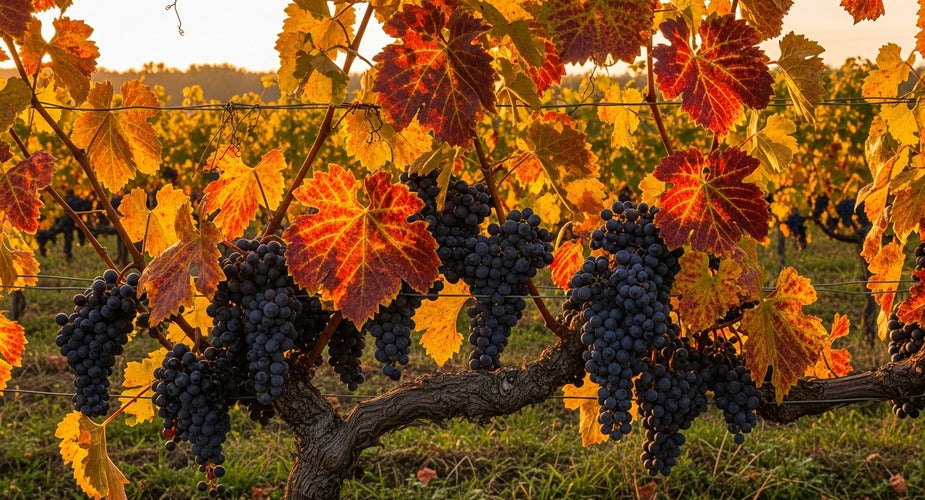
Chaque litre de vin laisse derrière lui un marc de raisin : les peaux, les tiges et les graines. Pour la plupart de l'histoire du vin, ceux-ci ont été simplement jetés.
L'huile de pépins de raisin existe parce que quelqu'un a découvert que les graines étaient un produit fonctionnel caché dans le flux des déchets.
L'histoire du sous-produit
La chaîne est directe. Les raisins sont pressés pour le vin, le marc se sépare, et les graines sont séchées et pressées à froid pour l'huile.
Rien n'est cultivé spécifiquement pour l'huile. Contrairement aux cultures plantées pour répondre à la demande de soins de la peau, l'huile de pépins de raisin transforme un flux de déchets existant en un ingrédient de grande valeur. Les véritables histoires d'approvisionnement circulaire sont rares en cosmétiques, et c'en est une.
La qualité correspond à l'approvisionnement
Le raffinage industriel existe pour maximiser le rendement à partir de graines de faible qualité. La première pression à froid nécessite une meilleure matière première, des petits lots, et un traitement plus artisanal.
L'huile de pépins de raisin première pression à froid d'une marque sans cruauté qui y prête attention retrace presque toujours des régions viticoles européennes avec une véritable traçabilité. Les meilleurs ingrédients sont ceux où l'histoire sur la bouteille correspond à la biologie sur votre peau.


