

 Compte


Si vous avez un tiroir de salle de bain rempli de sérums entamés qui promettaient de raffermir, repulper ou restaurer votre peau sans jamais tenir leurs promesses, vous n'êtes pas seule. Autour de 45 ans, les soins de la peau cessent de fonctionner comme avant.
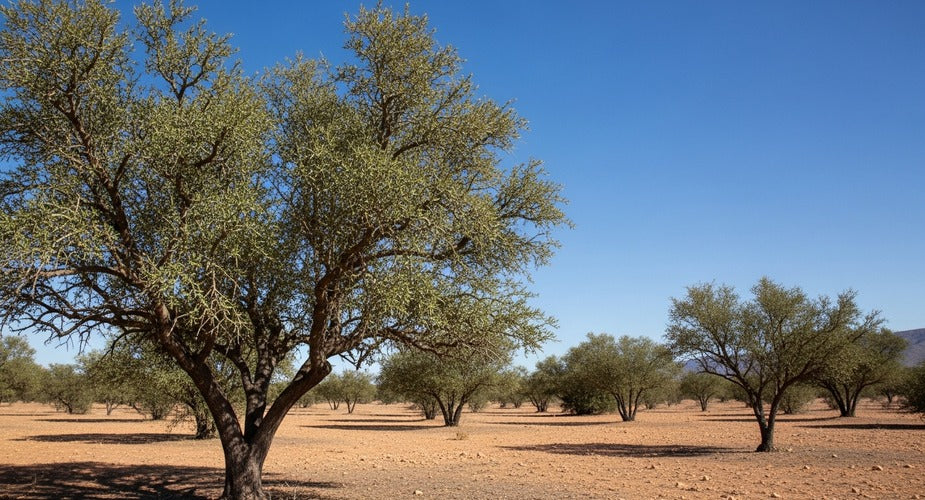
L'huile d'argan pour la peau revient sans cesse, et ce n'est pas un hasard marketing. Son profil en acides gras et sa fraction antioxydante reflètent exactement ce que la peau ménopausée perd : précurseurs de céramides, squalène, gamma-tocophérol. C'est pourquoi une simple huile végétale, pressée à froid à partir d'un fruit d'Afrique du Nord, surpasse la plupart des sérums coûteux qui dorment dans ce tiroir.
Voici ce que l'huile d'argan fait réellement, et pourquoi seule la version pressée à froid mérite d'être utilisée après 45 ans.
Pourquoi la peau mature réagit différemment à l'huile d'argan
Autour de la ménopause, votre peau perd trois choses coup sur coup. La production de sébum diminue. La synthèse des céramides ralentit. Les réserves antioxydantes qui protégeaient votre collagène depuis des décennies s'épuisent. Ce n'est pas une simple impression : c'est pour cela que votre peau semble différente au toucher.
Le déclin des œstrogènes remodèle la structure de la peau. La perte d'œstrogènes après la ménopause réduit la production de collagène de type 1, compromet l'intégrité des fibres élastiques et interrompt les voies sébacées et céramidiques qui maintenaient la souplesse de votre peau depuis des décennies. L'épaisseur du derme diminue d'environ 1,13% par an au cours des cinq premières années suivant la ménopause. Ces changements sont structurels, et non cosmétiques, ce qui explique pourquoi les produits de surface ne peuvent pas les corriger.
Le squalène remplace directement le sébum en baisse. L'huile d'argan contient de 0,3 à 1% de squalène, ce même lipide que vos glandes sébacées produisent en moindre quantité après la ménopause. Appliqué sur la peau, le squalène se comporte comme une huile cutanée native plutôt que de rester en surface. Votre peau le reconnaît et l'intègre à sa barrière. Les hydratants synthétiques ne peuvent pas reproduire cet effet, car la molécule doit être une correspondance structurelle exacte.
L'acide linoléique reconstruit la barrière cutanée. L'huile d'argan est composée de 29 à 36% d'acide linoléique, l'acide gras essentiel nécessaire à la synthèse du céramide 1-EOS, le céramide principal qui maintient la cohésion de la peau mature. La peau ménopausée manque chroniquement de précurseurs d'acide linoléique. L'argan les fournit directement, ce qui explique pourquoi la barrière recommence à retenir l'hydratation en quelques jours seulement, et non en semaines.
Le gamma-tocophérol et l'acide férulique protègent ce qu'il reste. Ce sont les deux antioxydants uniquement concentrés dans la fraction insaponifiable de l'argan, environ 1% de l'huile. Le gamma-tocophérol est plus puissant que l'alpha-tocophérol présent dans la plupart des soins, et l'acide férulique le stabilise contre l'oxydation. Ensemble, ils protègent le collagène et l'élastine du stress oxydatif qui s'accélère après 45 ans. Contrairement aux mélanges synthétiques de vitamine E, ces deux composés arrivent déjà dans le ratio qui permet à chacun de rester actif plus longtemps sur la peau.
Les preuves cliniques sur l'huile d'argan et la peau ménopausée
En 2015, des chercheurs ont recruté 60 femmes ménopausées âgées de 49 à 61 ans et leur ont fait consommer ou appliquer de l'huile d'argan pendant 60 jours. La moitié l'appliquait sur la peau. L'autre moitié la consommait, avec un groupe témoin sous huile d'olive. Ce résultat est ce qui se rapproche le plus d'une preuve que l'huile d'argan produit un effet mesurable sur le vieillissement cutané.
L'étude a été publiée dans Clinical Interventions in Aging par Boucetta et ses collègues. Il s'agit du seul essai randomisé sur l'huile d'argan mené spécifiquement auprès de femmes ménopausées, et presque aucun article beauté ne le cite nommément.
Le groupe application topique a montré une amélioration statistiquement significative de l'élasticité cutanée après 60 jours (p < 0,05). La mesure a été effectuée à l'aide d'un cutomètre, qui utilise une légère aspiration pour quantifier l'étirement de la peau et sa vitesse de retour. Ni questionnaire, ni évaluation subjective : un test mécanique de la fonction cutanée, calibré selon les valeurs de référence initiales de chaque participante.
Les résultats liés à la consommation étaient encore plus frappants. Les femmes consommant 25g d'huile d'argan par jour ont montré une amélioration de 9,2% du temps de résonance (un marqueur de la fermeté cutanée), une amélioration de 12,5% de l'élasticité nette, et une amélioration de 15% de l'élasticité biologique. Le groupe témoin sous huile d'olive n'a montré aucun changement significatif sur aucun marqueur. Les améliorations ont été observées sur une zone du corps non traitée directement, ce qui confirme que l'effet était systémique plutôt que localisé.
Les chercheurs ont attribué ce résultat à la teneur en acide férulique et en gamma-tocophérol de l'argan, tous deux plus biodisponibles et plus puissants que les composés comparables présents dans l'huile d'olive. L'huile d'olive a été choisie comme témoin précisément pour cette raison : son profil lipidique est globalement similaire, ce qui permet d'attribuer toute différence de résultat à la fraction insaponifiable de l'argan. C'est la preuve la plus claire que la chimie antioxydante de l'argan est fonctionnellement supérieure, et pas seulement bien commercialisée.
Aucun de ces chiffres ne tient si l'huile que vous achetez a été chauffée, raffinée ou désodorisée. Ce qui nous amène au mot le plus important à repérer sur une étiquette d'huile d'argan.
Pressée à froid ou raffinée : pourquoi ce mot change tout
Vous pouvez acheter de l'huile d'argan en pharmacie pour $12 ou auprès d'une petite marque artisanale pour $60. Le liquide dans les deux flacons provient du même arbre. Ce qui fait la différence de prix, et ce qui change tout dans l'effet de l'huile sur votre peau, c'est la chaleur.
La pression à froid est une extraction mécanique réalisée à moins de 120°F (49°C). Aucun solvant, aucun traitement thermique, aucune désodorisation. Les amandons passent dans le pressoir, l'huile en ressort, et rien n'en est retiré. La couleur reste dorée-ambrée. Le parfum reste légèrement noisetté. La fraction insaponifiable (les tocophérols, polyphénols, phytostérols et le squalène qui font tout le travail) reste intacte.
Le raffinage détruit les composés essentiels. Le raffinage industriel utilise une chaleur supérieure à 400°F, des argiles décolorantes et une désodorisation pour produire une huile claire, inodore et stable dans le temps. Ce processus élimine la majeure partie de la fraction insaponifiable. Il ne reste plus que des acides gras essentiellement inertes. L'huile reste glissante au toucher. Elle hydrate toujours. Mais la chimie antioxydante et réparatrice de la barrière a disparu.
La chaleur est spécifiquement l'ennemie de l'argan. Le gamma-tocophérol et l'acide férulique, les composés exacts derrière les résultats de l'étude de Boucetta, sont sensibles à la chaleur. Ils commencent à se dégrader au-delà de 140°F, bien avant d'atteindre les températures de raffinage. Une huile d'argan raffinée peut toujours légalement porter le nom « huile d'argan » sur l'étiquette, mais elle ne peut pas produire les effets démontrés par la recherche. Vous achetez le nom, sans la molécule.
L'argan authentique pressé à froid est fabriqué comme il l'a toujours été, depuis des siècles. Les coopératives de femmes marocaines utilisent des meules de pierre. Les producteurs modernes utilisent des presses mécaniques à vis avec contrôle de la température. Les deux méthodes produisent moins d'huile par kilogramme d'amandons que l'extraction par solvant, ce qui explique le prix plus élevé de l'huile pressée à froid. Ce rendement plus faible est précisément tout l'enjeu. Un traitement sans chaleur protège tout ce qui est fragile et précieux dans l'huile, et l'écart de prix reflète la chimie, pas le marketing.
Lorsque vous achetez de l'huile d'argan pour la peau, vous achetez en réalité un seul mot. Voici les autres éléments à vérifier sur l'étiquette.
Comment reconnaître une huile d'argan pure en rayon
Le mot « argan » est devenu un atout marketing, ce qui signifie qu'il finit sur des flacons qui n'en contiennent presque pas. Voici six éléments à vérifier avant de dépenser votre argent.
Recherchez la mention « pressée à froid » ou « extraite à froid » sur l'étiquette. Si le producteur ne le précise pas explicitement, considérez que l'huile a été raffinée. Les marques sérieuses indiquent toujours leur méthode d'extraction. Le silence est révélateur.
Vérifiez la liste INCI, elle doit ne contenir qu'un seul ingrédient. Elle doit indiquer uniquement « Argania Spinosa Kernel Oil ». La présence d'huiles porteuses, de vitamine E ajoutée, de parfum ou de conservateurs signifie que vous achetez un mélange. L'argan pur pressé à froid n'a besoin d'aucun additif. Sa propre teneur en tocophérols la préserve.
Privilégiez un flacon en verre teinté. Le verre ambré ou bleu foncé protège les tocophérols de la dégradation par les UV. Un flacon en verre transparent ou en plastique signale que le producteur ne se soucie pas de la stabilité du produit. La lumière du soleil oxyde l'huile pressée à froid en quelques semaines.
La couleur doit être dorée-ambrée, jamais transparente. L'argan authentique pressé à froid présente une teinte jaune doré chaud, parfois avec une légère nuance verte selon la récolte. Une couleur paille pâle ou incolore signifie presque toujours que l'huile a été désodorisée et décolorée. Les pigments font partie intégrante du profil antioxydant.
Le parfum doit être doux et légèrement noisetté. L'argan non raffiné dégage un arôme subtil, presque beurré. L'absence d'odeur signifie qu'elle a été désodorisée. Une note parfumée signifie qu'elle est parfumée ou mélangée. Votre nez reste le contrôle qualité le plus fiable dont vous disposez.
La certification bio est un bon critère de départage. ECOCERT et USDA Organic sont les labels les plus crédibles. Tous les producteurs de qualité ne se font pas certifier, son absence n'est donc pas rédhibitoire, mais entre deux flacons similaires, elle peut faire pencher la balance.
Une fois que vous aurez trouvé le bon flacon, vous n'aurez plus besoin de cette liste. Votre nez et vos yeux feront le reste.
100% d'actifs botaniques. L'argousier comme base. Zéro eau, zéro conservateur synthétique. Noté 4,66/5 sur plus de 3,152+ avis. Garantie satisfait ou remboursé de 60 jours.
Découvrir le Système - $119Comment utiliser l'huile d'argan sur une peau mature
Le moyen le plus rapide de conclure que l'huile d'argan ne fonctionne pas, c'est de mal l'appliquer. Le deuxième, c'est d'abandonner avant que votre peau n'ait eu le temps de se reconstruire.
Appliquez-la sur une peau humide, après votre crème hydratante. L'huile est occlusive. Elle scelle tout ce qui se trouve en dessous. Sur une peau sèche, elle n'a rien à retenir et reste en surface, avec une sensation de gras. Sur une peau humide, appliquée par-dessus la crème, elle emprisonne cette hydratation dans la couche cornée pendant des heures. Ce seul ajustement fait toute la différence entre une huile d'argan efficace et une huile d'argan décevante.
Deux à trois gouttes suffisent pour tout le visage. La peau mature absorbe l'huile plus lentement qu'une peau plus jeune, donc en mettre davantage n'apporte pas plus de nutrition, seulement un résidu en surface. Réchauffez d'abord les gouttes entre vos paumes. La chaleur aide l'huile à se répartir uniformément sur les zones plus fines et plus sèches (autour des yeux, les plis nasogéniens, la mâchoire) qui en ont le plus besoin.
Pressez et tapotez, ne frottez jamais. Frotter tire sur une peau amincie et perturbe la barrière que vous essayez de reconstruire. Pressez doucement vos paumes sur votre visage. Tapotez l'excédent du bout des doigts. Utilisez votre annulaire sous les yeux, car il exerce naturellement la pression la plus légère.
L'application du soir est non négociable. Celle du matin est facultative. C'est la nuit que la synthèse des céramides atteint son pic, donc l'huile d'argan appliquée avant de dormir a des heures pour nourrir ce processus. Le matin, l'argan se superpose facilement sous la protection solaire et donne à la peau un fini doux, lumineux de l'intérieur. Si vous n'avez le temps que pour une seule application, choisissez celle du soir.
Laissez à l'huile un cycle cutané complet avant de la juger. L'hydratation et la douceur apparaissent dès la première semaine. Les changements structurels (élasticité, fermeté, teint) demandent quatre à six semaines, car la peau ménopausée se renouvelle environ tous les 40 à 45 jours, plus lentement que le cycle de 28 jours d'une peau plus jeune. Ce n'est pas un hasard si l'étude de Boucetta a duré 60 jours. Ne tirez pas de conclusion au bout de deux semaines.
L'huile d'argan n'a rien de spectaculaire. Elle agit avec constance. Laissez-lui un cycle complet avant de vous prononcer.
Associer l'huile d'argan à d'autres huiles végétales après 45 ans
Après 45 ans, l'huile d'argan est rarement la seule huile dont votre peau a besoin. Elle constitue presque toujours la base idéale. Sa teneur en acide oléique (43 à 49%) en fait un excellent véhicule, aidant les huiles plus ciblées à pénétrer plus profondément et à rester actives plus longtemps.
La rose musquée pour les rides plus profondes et le grain de peau irrégulier. L'huile de rose musquée contient des précurseurs d'acide trans-rétinoïque, la version naturelle la plus douce de la chimie de la vitamine A. Mélangée à l'argan et appliquée le soir, elle atténue les ridules et la pigmentation sans l'irritation associée aux rétinoïdes de synthèse. L'acide oléique de l'argan aide les actifs de la rose musquée à atteindre les couches profondes de l'épiderme, là où se régule le collagène. Quelques gouttes de chaque, mélangées dans la paume, suffisent amplement.
L'argousier pour illuminer une peau abîmée par le soleil. L'argousier est exceptionnellement riche en caroténoïdes et en acides gras oméga-7. Tous deux ciblent l'hyperpigmentation, le teint terne et l'irrégularité qui s'installent après des décennies d'exposition au soleil. Une goutte mélangée à trois ou quatre gouttes d'argan suffit pour tout le visage. Utilisé pur, l'argousier teinte temporairement la peau d'une légère nuance orangée, c'est pourquoi il est presque toujours utilisé en booster plutôt que seul.
Ce qu'il ne faut pas associer à l'argan. Ne superposez pas l'argan directement avec des acides actifs (AHA, BHA) ou des rétinoïdes prescrits au cours de la même application. L'huile peut freiner leur pénétration. Alternez plutôt les soirées : rétinoïde le lundi, argan le mardi, acide le mercredi, argan le jeudi. C'est l'erreur la plus courante qui pousse à conclure que l'argan ne fonctionne pas, alors que le vrai problème est un conflit de planning.
Considérez l'huile d'argan comme la fondation. Tout ce que vous appliquez ensuite sur une peau mature fonctionne mieux grâce à sa présence.


