

 Compte


Vos articulations accomplissent un million de petites tâches par jour, et vous ne les remarquez que lorsqu'elles commencent à vous faire mal.
Le soulagement naturel des douleurs articulaires utilise les plantes, l'alimentation, le mouvement, la chaleur ou le froid pour calmer la douleur articulaire, au lieu de dépendre uniquement des médicaments. Il ne reconstruit pas le cartilage usé, mais il peut réduire l'inflammation et vous aider à vous mouvoir avec moins d'effort.
Voici ce que la plupart des gens oublient : certaines des plantes les plus étudiées pour soulager la douleur fonctionnent mieux frottées directement sur la zone endolorie, plutôt qu'avalées sous forme de comprimé. Frøya Organics en mélange six dans un seul Baume de Massage sans eau.
Dans ce guide, vous découvrirez les huit plantes arctiques ayant une véritable base scientifique, pourquoi elles agissent sur la peau, et les habitudes quotidiennes simples qui les soutiennent.
Points clés
- Le soulagement naturel des douleurs articulaires fonctionne par l'inflammation et la circulation sanguine. Les plantes calment l'enflure et renforcent la circulation exactement là où ça fait mal.
- L'arnica et la consoude ont les études topiques les plus solides. Les deux ont soulagé l'arthrose du genou et de la main dans des essais sur l'humain.
- Six plantes éprouvées se trouvent dans un seul baume. L'arnica, la consoude, le gingembre, le camphre, la menthe poivrée et l'eucalyptus travaillent ensemble, il n'y a rien à mélanger soi-même.
- Le curcuma et autres suppléments ont leurs inconvénients. La plupart sont des comprimés avec des risques digestifs ou d'interactions médicamenteuses, contrairement à un baume que vous appliquez sur la peau.
- Les habitudes quotidiennes comptent aussi. Le mouvement doux, la gestion du poids, la chaleur ou le froid, et les aliments anti-inflammatoires soutiennent chaque remède que vous essayez.
Pourquoi vos articulations vous font mal dès le départ

La plupart des douleurs articulaires remontent à l'inflammation et à l'usure à l'intérieur de l'articulation. L'arthrose, le trouble articulaire le plus courant au monde, se produit lorsque le cartilage qui amortit vos os s'use au fil du temps.
La polyarthrite rhumatoïde fonctionne différemment. Votre système immunitaire attaque la membrane articulaire, ce qui provoque un gonflement, une raideur et une douleur chronique qui peuvent se déplacer dans votre corps.
L'inflammation est le fil qui les relie. Certaines conditions de santé, y compris les maladies chroniques comme la maladie inflammatoire de l'intestin, ajoutent à cette charge inflammatoire. C'est pourquoi la réduire est l'objectif derrière la plupart des façons naturelles de trouver du soulagement.
Comment les plantes appliquées sur la peau soulagent la douleur articulaire
Frotter un baume botanique sur une articulation endolorie fonctionne par deux voies simples. Certaines plantes calment l'inflammation à la source, tandis que d'autres agissent comme contre-irritants, créant une sensation de chaleur ou de fraîcheur qui vous fait oublier la douleur.
Cet effet contre-irritant apporte aussi plus de flux sanguin vers la zone touchée, ce qui aide à détendre les muscles autour de l'articulation. Une revue Cochrane de 2013 sur les thérapies à base de plantes topiques a découvert que le gel d'arnica soulageait l'arthrose de la main presque aussi bien qu'un gel anti-inflammatoire.
Si vous souhaitez explorer des options créées à cet effet, Frøya les regroupe sous baumes naturels pour douleurs articulaires. Ensuite, voici les huit ingrédients à connaître.
8 ingrédients naturels qui soulagent les douleurs articulaires et musculaires
Chaque plante ci-dessous a une base scientifique pour son utilisation contre la douleur articulaire ou musculosquelettique. Six d'entre elles se trouvent ensemble dans un baume Frøya, nous y reviendrons bientôt.
Arnica

L'arnica est l'une des plantes les plus étudiées pour calmer l'inflammation articulaire. Elle agit pour soulager la douleur à la source plutôt que simplement la masquer, c'est pourquoi le soulagement tend à durer plus longtemps qu'une sensation de refroidissement rapide.
La plante contient des composés longtemps associés à l'apaisement de la réaction inflammatoire dans une articulation endolorie. Dans un essai portant sur 79 personnes atteintes d'arthrose du genou, l'application deux fois par jour d'huile d'arnica a montré une douleur réduite, moins de raideur et une meilleure mobilité après six semaines.
Cela fait de l'arnica un élément clé pour tout baume articulaire, et elle rivalise facilement avec les options conventionnelles.
Consoude

La consoude a l'une des plus fortes preuves topiques pour les douleurs au genou. Ses composés végétaux, dont l'allantoïne et l'acide rosmarinique, sont longtemps valorisés pour calmer l'inflammation.
Voici ce qui compte pour votre utilisation. La consoude topique est sûre car très peu traverse la peau. Prise par voie orale, la plante brute peut stresser le foie, c'est pourquoi elle appartient à un baume que vous frottez, et non à un comprimé.
Gingembre

Le gingembre apporte la chaleur et des composés anti-inflammatoires à une articulation endolorie. Les mêmes composés qui donnent sa saveur au gingembre en cuisine aident aussi à apaiser l'inflammation dans le corps.
Frotté sur la peau sous forme d'huile de racine de gingembre, il agit comme un agent de réchauffement doux. Cette chaleur aide à réduire la douleur et à assouplir la raideur qui s'accumule autour d'une articulation endolorie.
Camphre

Le camphre est un contre-irritant classique qui augmente le flux sanguin là où vous le frottez. Cet afflux de circulation est ce qui crée la sensation de picotement léger et aide à soulager.
La chaleur fait deux choses à la fois. Elle distrait les nerfs de la douleur, et un flux sanguin plus important vers une articulation raide signifie que les muscles autour peuvent se détendre et récupérer plus rapidement.
Menthe poivrée

L'huile de menthe poivrée et son menthol actif refroidissent la peau et engourdissent légèrement les petites douleurs. La FDA américaine reconnaît le menthol comme un analgésique topique qui fonctionne en stimulant les propres récepteurs nerveux de la peau.
Ce picotement rafraîchissant est la raison pour laquelle un bon frottement musculaire se sent apaisant dès qu'il s'applique. Il apaise aussi les douleurs quotidiennes du cou dues aux longues heures au bureau, car le menthol calme rapidement les nerfs de surface.
Eucalyptus

L'huile de feuille d'eucalyptus contient des composés végétaux qui aident à calmer l'enflure et à réduire l'inflammation articulaire. Les gens s'y sont fiés dans les huiles de massage et les frottements pour les muscles et articulations endoloris depuis des générations.
Elle pénètre rapidement dans la peau, ce qui explique pourquoi elle se sent si rafraîchissante. L'eucalyptus s'associe aussi naturellement aux plantes réchauffantes comme le camphre et le gingembre, équilibrant le froid et le chaud dans un seul mélange.
Cire d'abeille

La cire d'abeille est l'ouvrier silencieux d'un baume botanique. En soi, elle n'engourdit pas la douleur, mais elle rend chaque autre plante plus efficace.
Elle apporte les huiles actives plus profondément dans la peau et retient l'humidité pendant qu'elles agissent. Parce qu'elle est sans eau, une petite quantité couvre beaucoup, et rien ne reste dans le pot en tant que filler.
Romarin

Le romarin soutient la circulation et la récupération musculaire, c'est pourquoi il apparaît dans les baumes destinés aux douleurs et à la raideur. Un meilleur flux sanguin signifie que les nutriments atteignent les muscles fatigués plus rapidement.
Il apporte aussi son propre profil apaisant et riche en antioxydants pour compléter le mélange. Ensemble, ces huit plantes couvrent le tableau complet : moins d'inflammation, meilleur flux sanguin, et soulagement plus rapide.
Et le curcuma, la boswellie et autres options populaires ?
Vous avez probablement vu ces éléments recommandés comme remèdes à base de plantes ou suppléments alimentaires pour les douleurs articulaires. Ils peuvent aider certaines personnes, mais la plupart sont des comprimés avec des inconvénients à connaître.
- Curcuma : contient la curcumine, qui aide à diminuer l'inflammation, mais la recherche porte surtout sur les capsules et il peut déranger votre estomac à doses élevées.
- Boswellie : son acide boswellique montre une promesse anti-inflammatoire, bien qu'encore une fois en tant que supplément oral.
- Écorce de saule : agit comme une aspirine naturelle, il est donc risqué avec les anticoagulants ou une allergie à l'aspirine.
- Glucosamine et chondroïtine : peuvent réduire la douleur due à la perte de cartilage, bien que les études suggèrent des résultats mitigés.
- Crème à la capsaïcine : la recherche suggère qu'elle peut réduire la douleur articulaire avec une utilisation régulière, mais elle provoque souvent une sensation de brûlure.
Un baume botanique évite les comprimés et les soucis digestifs. Vous l'appliquez là où ça fait mal, et les plantes se mettent au travail immédiatement.
Le Baume de Massage Frøya : Où les 8 se retrouvent

Six de ces huit plantes vivent déjà dans un baume sans eau. Le Baume de Massage mélange l'arnica, la consoude, le gingembre, le camphre, la menthe poivrée et l'eucalyptus, avec la cire d'abeille et le romarin qui complètent le tout.
Les études ci-dessus ont testé ces plantes seules, et Frøya les réunit dans un seul baume pour que vous les obteniez en une étape. Parce qu'il est sans eau, une minuscule quantité couvre beaucoup, donc un pot dure.
L'utiliser prend des secondes. Voici la routine simple :
- Prélevez une petite quantité au bout du doigt. Le baume est potent, vous en avez besoin de moins que vous ne le pensez.
- Massez-le sur la zone endolorie. Travaillez-le dans l'articulation ou le muscle qui fait mal, comme un genou, une épaule, un coude ou le bas du dos.
- Sentez le picotement. Un léger picotement de chaleur et de fraîcheur signifie que le camphre et la menthe poivrée agissent pendant que le flux sanguin augmente.
- Réappliquez selon les besoins. Vous pouvez l'utiliser deux à trois fois par jour, ou chaque fois que la raideur s'intensifie.
Appliquez sur une peau propre et intacte, éloignez-le de vos yeux, et faites un test rapide sur une petite zone d'abord si votre peau réagit facilement.
Qu'y a-t-il dans l'Apothicaire Complet

Le baume articulaire vient aussi dans l'Apothicaire Complet Visage & Corps, une boîte de trois baumes qui couvre les articulations endolories et les problèmes de peau qui les accompagnent souvent. Voici ce que chacun fait.
|
Baume dans l'ensemble |
Ce qu'il fait |
|
Apaise les articulations et muscles endoloris, votre incontournable pour les douleurs et la raideur |
|
|
Calme les rougeurs et les imperfections du visage |
|
|
Apaise la sécheresse, les démangeaisons et les squames |
Chaque baume agit sur sa zone propre, il n'y a rien à superposer ou à mélanger. Vous frottez le baume articulaire sur les articulations et muscles endoloris, lissez le baume pour la rougeur sur votre visage, et appliquez le baume peau sèche partout où la peau se sent tendue ou irritée.
Pour les douleurs articulaires spécifiquement, le Baume de Massage est celui qui fait le travail. Si les douleurs sont votre seule préoccupation, ce seul baume est tout ce dont vous avez besoin. L'ensemble a du sens quand la peau sèche ou irritée apparaît aux côtés de la douleur articulaire.
Habitudes quotidiennes qui soutiennent le soulagement articulaire
Les baumes fonctionnent mieux aux côtés de quelques habitudes simples. Celles-ci ne coûtent rien et soutiennent tout ce que les plantes font.
- Bougez doucement. L'exercice à faible impact comme la natation et le cyclisme renforce les muscles autour de vos articulations et les maintient lubrifiées. Visez environ 150 minutes d'activité physique par semaine, la ligne directrice américaine pour les adultes.
- Essayez le mouvement corps-esprit. Le tai-chi utilise des mouvements lents qui améliorent la mobilité articulaire, et le yoga peut réduire la douleur et améliorer la flexibilité.
- Gérez votre poids. Chaque livre perdue enlève environ quatre livres de pression sur vos genoux, et perdre même une petite quantité peut soulager la douleur articulaire, car le poids excessif surcharge les articulations portantes et le tissu adipeux excessif libère des substances chimiques inflammatoires.
- Mangez pour moins d'inflammation. Une alimentation saine avec du poisson gras comme le saumon, l'huile d'olive et les légumes à feuilles vertes apporte des oméga-3 qui réduisent l'inflammation. Éliminer les aliments transformés de votre alimentation quotidienne aide aussi.
Les petits choix quotidiens s'accumulent et peuvent améliorer les fonctions au fil du temps.
Autres thérapies à connaître
Au-delà des baumes et du régime alimentaire, quelques thérapies alternatives peuvent soulager la douleur continue. Elles se marient bien avec tout ce qui précède.
- La thermothérapie et la cryothérapie. La thermothérapie détend les muscles tendus et renforce le flux sanguin. La cryothérapie, utilisant des compresses froides, engourdit la douleur aiguë et réduit l'enflure après l'effort.
- Massage thérapeutique. Le massage des tissus profonds apaise la tension musculaire et améliore la circulation. Une étude a découvert qu'il fonctionnait presque aussi bien que les médicaments anti-inflammatoires non stéroïdiens pour les douleurs lombaires.
- Acupuncture. De fines aiguilles peuvent soulager la douleur articulaire chronique et stimuler la libération d'endorphines, ce que les études suggèrent peut améliorer la douleur et la qualité de vie.
- Physiothérapie. Un physiothérapeute peut construire un programme d'exercices qui renforce les muscles et apaise la raideur, et ces approches complémentaires peuvent améliorer considérablement le confort quotidien.
Quand consulter un médecin
Les remèdes naturels gèrent bien les douleurs quotidiennes légères. Certains signes signifient que vous devriez consulter un professionnel de santé et revoir vos options de traitement.
- Douleur qui persiste plus d'une ou deux semaines malgré les soins à domicile
- Gonflement soudain, chaleur ou rougeur dans une articulation
- Douleur articulaire avec fièvre, ou douleur qui vous empêche de faire vos tâches quotidiennes
Les personnes plus âgées et tous ceux qui prennent un médicament régulier doivent parler à un médecin avant d'ajouter des suppléments. Vos soins doivent correspondre à votre corps, et un bon plan de traitement commence là.
Un vrai soulagement naturel des douleurs articulaires

Vous ne devez pas accepter les articulations roides et endolories comme simplement une part du vieillissement. Les douleurs articulaires sont courantes, mais vivre autour d'elles tous les jours ne devrait pas être le plan.
Les plantes de ce guide ont une véritable base scientifique, et utilisées correctement, elles peuvent calmer l'inflammation, soulager la raideur et vous aider à vous mouvoir au quotidien avec moins d'effort. Un baume sans eau répond à la douleur là où elle vit, directement à l'articulation, sans les comprimés ou les effets secondaires.
Frøya construit ses soins articulaires autour de baumes botaniques arctiques qui travaillent avec votre corps, pas contre. Faits avec des ingrédients naturels et biologiques, ils sont une option douce à choisir en premier. Vous pouvez voir des avant et après des clients qui ont choisi une voie naturelle.
Disclaimer : Ce contenu est fourni à titre informatif uniquement et n'est pas un avis médical ou un substitut aux soins professionnels. Les produits Frøya Organics soutiennent et apaisent les articulations et muscles endoloris, mais ils ne traitent pas, ne guérissent pas et ne remplacent pas le traitement médical. Parlez à un professionnel de santé à propos des douleurs articulaires persistantes ou avant de commencer un nouveau remède.
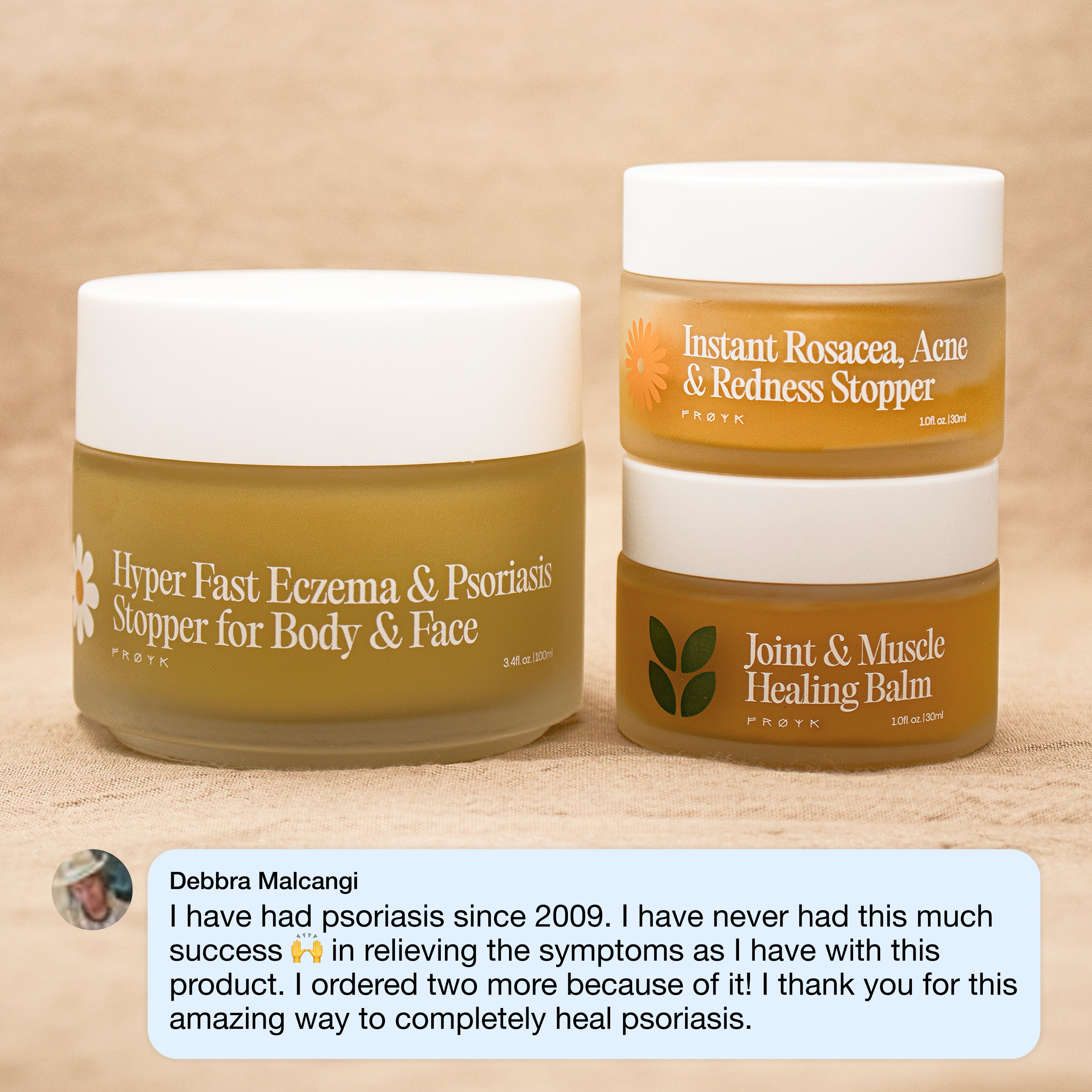
Trois baumes sans eau pour les douleurs articulaires, la rougeur et la peau sèche. Les plantes arctiques sauvages et la cire d'abeille biologique apaisent les douleurs et soutiennent la peau du visage et du corps, soutenues par une garantie de remboursement sur 60 jours.
Achetez le Système Aujourd'huiQuestions Fréquemment Posées
Qu'est-ce qui pourrait causer des douleurs articulaires partout dans le corps ?+
Quels sont les remèdes naturels pour soulager les douleurs arthritiques ?+
Quels sont les remèdes à base de plantes qui peuvent aider à soulager les douleurs arthritiques ?+
Quels sont les moyens de traiter les douleurs et raideurs articulaires ?+
Quels aliments dois-je éviter si j'ai de l'arthrite ?+


