

 Cuenta


La granada no es un único ingrediente de cuidado de la piel. Son tres, y cada uno hace cosas completamente diferentes en tu rostro.
Las semillas dan un aceite. La cáscara da un extracto. El jugo da algo completamente distinto. La mayoría de las marcas mezclan los tres en una sola palabra en la etiqueta, por eso terminas pagando por un beneficio que tu producto no puede entregar.
Esta fruta natural es conocida por sus antioxidantes, y esa reputación está bien ganada. Lo que casi nadie explica es que los nutrientes clave detrás de cada beneficio se encuentran en diferentes partes de la fruta.
A continuación, encontrarás los verdaderos beneficios de la granada para la piel, qué respalda la investigación y cómo usarla después de los 45.
Puntos clave
- El aceite de semilla de granada, el extracto de cáscara y el jugo llevan compuestos distintos y entregan resultados diferentes.
- El aceite de semilla sostiene tu barrera y capa externa, lo que mantiene la piel sana día a día.
- La investigación sobre colágeno pertenece al extracto de cáscara, no al aceite de semilla en la mayoría de los productos.
- La evidencia humana más sólida para beneficios antiedad viene de comer granada, no de aplicarla.
- El ácido púnico se degrada en agua y luz, así que el formato de tu producto importa tanto como sus ingredientes.
¿Qué es la Granada y Qué Parte Termina en el Cuidado de la Piel?
La granada (Punica granatum) ofrece al cuidado de la piel tres materias primas separadas, y no son intercambiables.
- El aceite de semilla de granada se prensa en frío desde las semillas. Lleva ácido púnico y otros ácidos grasos, y es lo que usa la mayoría de productos a base de aceite.
- El extracto de cáscara de granada viene de la corteza, llevando punicalaginas y ácido elágico.
- El jugo de granada viene de los arilos que comes. Lleva vitamina C, y la mayoría de su investigación analiza beberlo para la salud general.
Los investigadores probaron estos lado a lado y encontraron que hacen cosas casi opuestas.
Los autores describieron esto como reparación en direcciones opuestas, con los extractos acuosos ayudando a la capa más profunda y el aceite de semilla ayudando a la superficie. Por eso los extractos de frutas en una etiqueta merecen una segunda mirada. "Extracto de granada" sin nombrar la parte te deja adivinando qué realmente compraste.
7 Beneficios de la Granada para la Piel

Aquí está lo que el aceite de semilla de granada realmente hace, y cuánta evidencia respalda cada uno.
1. Lucha Contra el Daño de Radicales Libres de los Rayos UV y la Contaminación
Tu piel siempre ha generado sus propias defensas antioxidantes. Después de los 45, genera menos de ellas, justo cuando las necesita más.
Los radicales libres son moléculas inestables creadas por contaminación, estrés y rayos UV. Extraen electrones de células de piel sana, y ese daño se acumula silenciosamente durante años hasta que se muestra como opacidad y aspereza.
La granada ayuda a luchar contra el daño de radicales libres causado por rayos UV y contaminación. La investigación de laboratorio también sugiere que sus antioxidantes protegen la piel del daño UVB y UVA y ayudan a prevenir la descomposición del colágeno por exposición UV.
Dos cosas para ser clara. Ese es trabajo a nivel celular, no prueba de protección solar en tu rostro. Y la granada no es una herramienta de prevención del cáncer de piel, así que trátala como apoyo diario en lugar de un escudo. Esta pérdida lenta de defensa antioxidante es una gran parte de por qué la piel madura pierde su brillo, incluso cuando tu rutina no ha cambiado.
2. Sella la Humedad e Impide la Sequedad
El ácido púnico es un raro ácido graso omega-5 que constituye una gran parte del aceite de granada. Es casi único de esta planta.
Junto con los otros ácidos grasos en el aceite, ayuda a retener agua en la piel. Eso importa más después de los 45, cuando tu barrera se adelgaza y pierde humedad más rápido de lo que solía.
La sequedad no es solo sobre comodidad. La piel que ha perdido agua se ve más plana y muestra líneas más claramente, por eso la hidratación cambia cómo se ve tu rostro antes de que nada estructural haya cambiado.
3. Apoya tu Barrera de Piel
Tu barrera es la capa externa que mantiene la humedad dentro y los irritantes afuera. Se construye en gran parte a partir de ácidos grasos, que es donde entra el aceite de granada.
No todos los ácidos grasos hacen el mismo trabajo. El ácido linoleico ayuda a mantener la barrera que controla la pérdida de agua, y el aceite de semilla de granada es 29% ácido linoleico.
Los aceites vegetales también funcionan sentándose en la superficie y ralentizando la pérdida de agua, que es parte de por qué una textura más rica retiene mejor la hidratación que una ligera.
Una barrera más fuerte está tranquilamente detrás de la mayoría de los otros beneficios en esta lista. Cuando funciona correctamente, la piel retiene humedad, reacciona menos y se recupera más rápido.
4. Ayuda a Calmar la Inflamación y Reducir el Enrojecimiento
En estudios celulares, el aceite de semilla de granada suprimió varios marcadores inflamatorios vinculados a irritación.
Eso respalda su uso en piel inflamada y lo convierte en una opción sensata cuando quieres calmar la irritación sin un activo agresivo. Los mismos compuestos antiinflamatorios también ayudan a reducir el enrojecimiento con el tiempo.
Vale la pena notar: este es trabajo de laboratorio en lugar de un ensayo en humanos. También significa que la granada no es un tratamiento para ciertas condiciones inflamatorias de la piel como eczema o psoriasis, que necesitan cuidado médico adecuado.
5. Apoya la Renovación en la Capa Externa
La investigación de 2006 encontró que el aceite de semilla estimuló la actividad en las células de piel más externas, con un espesamiento suave de esa capa.
La regeneración celular se ralentiza con la edad. Tu piel solía reemplazar células dañadas rápidamente, y ahora esas células persisten, lo que es lo que le da a la piel madura una superficie cansada y desigual.
Esa ralentización también es por qué la paciencia importa más después de los 45 de lo que importaba a los 30. Apoyar la renovación en la capa externa suaviza gradualmente la textura de la piel, pero el cambio es real y lento en lugar de dramático, por eso de cuatro a ocho semanas es un cronograma justo.
6. Devuelve un Brillo Natural
Mejor hidratación y una barrera más fuerte reflejan luz más uniformemente en tu rostro.
Eso es lo que la mayoría de las personas realmente quieren decir con piel radiante. No brillo, ni un acabado resaltador, sino una superficie uniforme que se vea como piel sana haciendo su trabajo.
La piel madura pierde esa uniformidad porque es más delgada y seca, no porque necesite más pulido. Si tu piel se ha visto plana últimamente, la solución suele ser hidratación y apoyo de barrera en lugar de otro paso exfoliante. Una tez radiante sigue de la piel siendo cómoda.
7. También Funciona desde Adentro
La evidencia humana más sólida para la granada y la piel viene de comerla, no de aplicarla.
Los investigadores realizaron un ensayo aleatorio, doble ciego de cuatro semanas usando un suplemento de granada estandarizado en lugar de fruta fresca o jugo.
Los investigadores fueron honrados en que no podían precisar por qué. Su mejor explicación es que la granada es rica en antioxidantes y puede ayudar a proteger contra la descomposición del colágeno. El mismo documento señala que los compuestos de granada protegieron las células de la piel del daño UVA y UVB en pruebas de laboratorio.
Dos cosas a tener en mente. Este fue un estudio piloto con un grupo pequeño, y los participantes tomaron un suplemento concentrado, no un puñado de semillas rojo rubí.
Así que comer granada es un hábito razonable para tu salud general. No es un sustituto de lo que pones en tu rostro.
¿La Granada Realmente Apoya la Producción de Colágeno?
No desde el aceite de semilla, no. Aquí es donde la mayoría de artículos sobre granada se equivocan.
La afirmación usual va así: la granada es alta en vitamina C, la vitamina C ayuda a apoyar la producción de colágeno, así que la granada mantiene la piel firme. Cada paso suena bien, pero la cadena se quiebra en el medio.
La vitamina C se encuentra en los arilos y el jugo, no en el aceite de semilla prensado en frío. Prensar semillas te da ácidos grasos, no ácido ascórbico.
La verdadera investigación sobre colágeno apunta al extracto de cáscara, que apoya el procolágeno y limita la enzima que descompone el colágeno. Ese hallazgo es genuino. Solo pertenece a una parte de la fruta que rara vez llega a tu botella.
Lo que el aceite de semilla apoya es tu barrera, y la piel bien hidratada sigue viéndose más suave.
Por Qué la Mayoría del Cuidado de Piel con Granada Nunca Entrega
Tres cosas se interponen, y ninguna es culpa de la fruta.
- El ácido púnico se oxida fácilmente. Se descompone en luz, calor y humedad, así que las fórmulas cargadas de agua trabajan en su contra desde el primer día.
- La mayoría de los productos son principalmente agua. Los sueros y lociones son 70 a 90% agua, empujando el aceite muy abajo en la lista.
- Las máscaras caseras pierden el punto. Mezclar jugo de granada fresco con miel te da compuestos solubles en agua. Los ácidos grasos viven en la semilla.
Por qué el ácido púnico necesita protección: Un ingrediente que se degrada en agua necesita un formato construido alrededor de ese problema. Remover el agua es la solución más simple, que es el argumento detrás del cuidado de piel sin agua después de los 40. Un bálsamo se comporta muy diferente de un aceite facial o un suero aquí.
¿Es la Granada Segura para Piel Sensible?
La granada es bien tolerada por la mayoría de tipos de piel, incluyendo piel sensible y seca. Las reacciones son infrecuentes pero posibles.
A diferencia del retinol y los ácidos exfoliantes, el aceite de semilla de granada no causa purga, descamación o ardor. Esos activos aceleran la renovación celular, por eso a menudo te dejan con semanas de descamación e irritación de la piel antes de que algo mejore.
Esa suavidad importa cuando la salud de la piel ya es frágil. Obtienes el apoyo antioxidante sin el período de recuperación.
Aún así, prueba en el interior de tu brazo y espera 24 horas. Revisa también la lista completa de ingredientes, ya que los bálsamos a menudo contienen aceites de frutos secos. Si tienes una condición de piel o un historial de alergias, habla con tu médico primero.
Cómo los Bálsamos Árticos sin Agua Entregan Aceite de Semilla de Granada a la Piel Madura
Frøya Organics usa aceite de semilla de granada prensado en frío en bálsamos sin agua. Sin agua en el frasco, la granada se mantiene cerca de la parte superior de la lista de ingredientes en lugar de quedarse atrás.
Bálsamo de Día Antiedad y Luminosidad Increíble

El Bálsamo de Día Antiedad y Luminosidad Increíble es la única fórmula que nombra granada en su mezcla, junto con espino amarillo. La granada se ubica cuarta de catorce, emparejada con rosa mosqueta para que el trabajo antioxidante sea compartido.
Aplica una capa fina en piel limpia cada mañana. Una cantidad de la punta del dedo es suficiente, y si tu piel se ve naranja has usado demasiado.
Bálsamo Ultra Concentrado Anti-Ojeras & Bolsas

El Bálsamo Ultra Concentrado Anti-Ojeras & Bolsas lleva dos materiales de granada, aceite de semilla y extracto de semilla. Ambos son derivados de semilla, lo que importa dado lo que ahora sabes sobre la división.
Palmadita con una pequeña cantidad alrededor del área de los ojos por la noche. Contiene ACEITE DE ALMENDRA DULCE, así que sáltalo si tienes alergia a frutos secos.
Bálsamo de Día Mágico Revitalizante y Luminoso

El Bálsamo de Día Mágico Revitalizante y Luminoso sostiene la posición de granada más alta en la línea, tercero de quince. Fue construido para piel combinada y propensa al acné, con aceites ligeros que no se sentarán pesadamente en piel que ya produce bastante de los suyos. Enjuágate el rostro por la mañana, luego aplica una capa fina.
Cómo Añadir Granada a tu Rutina de Cuidado de la Piel
El aceite de semilla de granada funciona mejor aplicado diariamente en piel limpia, en pequeñas cantidades.
- Comienza limpia. Enjuaga o limpia para que nada se interponga entre el aceite y tu rostro.
- Usa una cantidad de la punta del dedo. Los bálsamos sin agua son concentrados, y demasiado se ve como un tinte naranja.
- Aplica mañana, noche, o ambas. No hay período de ajuste ni días de descanso.
- Dale 60 días. Los cambios en el tono y textura de la piel tardan de cuatro a ocho semanas.
- Mantén la simplicidad. Más productos no es lo mismo que mejores resultados.
La consistencia vence la complejidad, que es el mismo principio detrás del mejor cuidado de piel para mujeres mayores de 50. Para la línea más amplia, la colección de bálsamos para piel madura está construida de la misma manera.
Cómo Lucen Realmente 60 Días con el Sistema Completo

El aceite de semilla de granada es un sólido ingrediente antioxidante y de barrera. No es un constructor de colágeno, así que los resultados vienen del uso constante en lugar de un único activo poderoso.
Aquí es donde un conjunto simple ayuda. Cuatro pasos en un orden fijo significa sin dudas sobre cuál producto funciona mejor, y la consistencia es lo que le falta a la mayoría de las rutinas.
Sesenta días es la prueba más justa que puedes darle a cualquier bálsamo, porque la fuerza de la barrera, la elasticidad de la piel y la textura cambian lentamente. Estos resultados reales de piel de clientes vienen de mujeres que usaron los mismos cuatro pasos diariamente y rastrearon la diferencia ellas mismas.
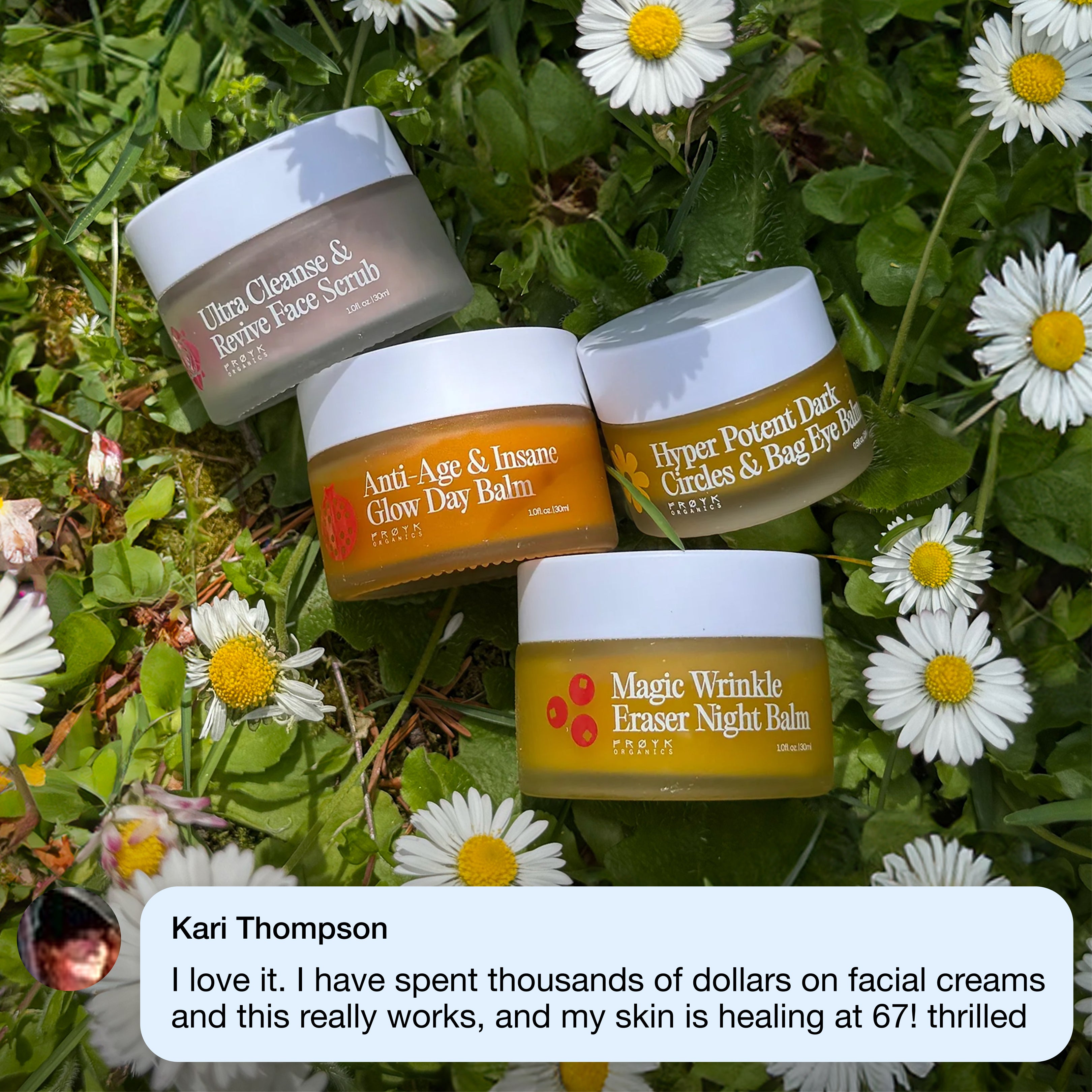
Plantas árticas silvestres y cera de abeja orgánica. Cero agua, cero fragancia sintética. Cuatro bálsamos en una rutina que alimentan los lípidos de la barrera de los que depende un brillo duradero, respaldados por una garantía de devolución de dinero de 60 días.
Compra el Sistema - $119Preguntas Frecuentes
¿Cómo usar la granada en tu rostro?+
¿Qué sucede si comemos granada a diario para la piel?+
¿Qué no mezclar con la granada?+
¿Cuál es la mejor fruta para la piel?+


