

 Account


You skipped the jar that smelled like a spa, grabbed the one that said "unscented," and your cheeks still went pink and hot by lunch. (If you've noticed your skin getting pickier since your 40s, it's not your imagination.)
That's because "unscented" only tells you how a product smells, not what's in it. Some unscented products even hide a little fragrance, just enough to cover up the smell of everything else. "Fragrance-free" gets you closer, but it isn't a promise either.
You don't need a chemistry degree to tell them apart. Once you know which words to look for on the ingredient list, it takes about 30 seconds, and we'll show you exactly how.
Key Takeaways
- "Unscented" tells you how a product smells, while "fragrance-free" tells you nothing was added to give it a scent.
- Unscented products can hide fragrance with masking agents, so the front label isn't enough.
- Natural fragrance and essential oils can still cause reactions, so "natural" isn't a free pass.
- Your best tool is the ingredient list, where words like "fragrance," "parfum" and named essential oils give fragrance away.
- Patch test every new product for 7 to 10 days before it goes on your face.
What Is The Difference Between Fragrance-Free And Unscented Skincare?

Fragrance-free products contain no ingredients added to give them a scent. Unscented means no noticeable odor, even if it took an extra ingredient to get there.
That extra ingredient is often a masking agent. The FDA's guide to cosmetic fragrances notes that some unscented products contain just enough fragrance to mask the smell of other ingredients, without giving the product a noticeable scent.
McGill University chemist Joe Schwarcz explains that an ingredient's purpose decides the label, not your nose. For example, a product made with a scented oil can still be called fragrance-free, because the oil is there to soften skin, not to add scent. It just couldn't be called unscented.
That's why fragrance-free products may have a faint natural odor from their base ingredients, like the light honey smell of beeswax. Neither label has a universally recognized definition, so brands don't always use them the same way. Here's how they compare:
| Fragrance-Free | Unscented | "Fragrance" Or "Parfum" On The List | |
|---|---|---|---|
| What it describes | What was added | How it smells | A blend of scent ingredients |
| Can it smell? | Faintly, from base ingredients | Not noticeably | Yes |
| Can it contain masking agents? | Not by most definitions | Yes | Yes |
| Has one official definition? | No | No | No, and one word can cover many ingredients |
| Best for | A diagnosed fragrance allergy | Skin that dislikes strong smells | Skin with no fragrance reactions |
Neither label tells you what's actually in the jar, though. That's why the Complete System for Mature Women's Skin names every ingredient, including the botanicals behind its light herbal scent.
Why Fragrance Is A Common Trigger For Sensitive Skin After 40
Fragrance is one of the most common causes of allergic skin reactions, and skin after 40 has less defense against it.
That's because skin tends to get thinner and more prone to dryness with age, so irritants slip through more easily. A healthy barrier helps keep them out, and here's how your skin barrier works.
It also helps to know what kind of reaction you're dealing with. Irritation usually stings or turns red fast, while an allergic reaction can take a few days to show, so it's easy to blame the wrong product. If you suspect an allergy, a board-certified dermatologist can do in-office patch testing to pin down the real trigger.
So who should go strictly fragrance-free? If you suffer from eczema flares, the American Academy of Dermatology's eczema skin care tips say to choose "fragrance-free" and skip "unscented," since unscented products can contain fragrance that's been covered up.
If you already know fragrance sets your skin off, fragrance-free skincare lowers your risk of contact dermatitis and irritation.
Natural Fragrance Vs. Synthetic Fragrance: Is Natural Kinder To Your Skin?
Not automatically. Your skin reacts to the molecule, not to where it came from. A 2026 Dermatology Review on Fragrance Safety found that natural fragrance compounds can trigger reactions too, not just synthetic ones.
Take eugenol, the molecule behind the warm smell of cloves. It's the same whether it comes from a clove or a lab, so "natural" on a beauty label isn't a free pass.
Essential oils need a little extra care. They're highly concentrated, and the review notes that light, heat or air speed up their oxidation into byproducts that make skin more likely to react, so keep them capped and away from heat and sunlight.
The amount matters too. Ingredient lists run from most to least, so an essential oil near the end usually means a small amount.
That doesn't make essential oils the enemy. The review's authors call for more research into naturally scented ingredients and greater product transparency, and our guide to essential oils for mature skin covers the ones worth knowing. What matters more is whether you can actually see an ingredient on the label, and that's where things get tricky.
The Labeling Loophole That Hides Fragrance In Unscented Products
In the US, one word, "fragrance," can stand in for dozens of scent ingredients. The FDA allows it because fragrance formulas are treated as trade secrets, so brands don't have to spell out the stuff inside the blend.
Masking agents use the same loophole, which is how unscented products can carry hidden allergens. If you're allergic to lavender, you could buy an "unscented" product made with lavender and never know it.
Even "fragrance-free" isn't a sure thing. When Northwestern dermatologists checked the ingredients in best-selling moisturizers, plenty of products labeled fragrance-free still listed an ingredient that can set off a reaction in people allergic to fragrance. Some of those were botanicals, which won't bother everyone, but you can only judge them when they're named.
How To Read A Skincare Label For Hidden Fragrance

Skip the front of the packaging and go straight to the ingredient list. That's the FDA's own advice in its guide to allergens in cosmetics, since "hypoallergenic" and "fragrance-free" have no federal standard behind them. Reading the list works for every skin type, acne-prone included, and takes about 30 seconds once you know what to look for.
Fragrance shows up in a wide range of products, from your summer sunscreen to your body lotion. Here's what to check:
- "Fragrance," "parfum," "perfume" or "aroma." Each one is a blend that isn't broken down on the label. On an "unscented" product, it likely points to a masking agent.
- Named essential oils. These aren't hidden: they're the scent source, named in plain sight. If you've reacted to one before, like lavender, skip anything that lists it.
- Allergen names. Linalool, limonene, geraniol and eugenol sound like a chemistry pop quiz, but they're some of the most common fragrance allergens around. US labels don't have to list them separately yet, so the oil's name is your best clue to what's inside.
- "Hypoallergenic," "natural" or "non-irritating." None of these is a regulated promise, and hypoallergenic products can still cause a reaction. Treat them as a starting point, and let the full ingredient list back them up.
- Drying alcohols like "alcohol denat." They aren't fragrance, but a lot of them near the top of the list can add to irritation on sensitive skin.
The shorter and more fully named the list, the faster you can check it.
How To Patch Test A New Skincare Product
Give every new product 7 to 10 days on a small patch of skin before it goes on your face. Dermatologists recommend testing new skincare products this way, new makeup included. Unlike a dermatologist's allergy testing, this at-home check shows how your skin handles the one product you're about to use.
Here's how to do it:
- Pick a small test spot, like your inner forearm.
- Apply the product twice a day, the same way you'd use it regularly.
- Watch for redness, itching or swelling.
- If your skin stays calm after 7 to 10 days, it's ready for your face.
Don't call it at 24 hours. Allergic reactions can take a few days to appear, so a product that looks fine on day one can still react later in the week.
A Botanical Skincare Routine Where Every Ingredient Is Named

If you want to know exactly what's touching your skin, choose a routine where nothing hides behind the word "fragrance." That's how we built the Complete System for Mature Women's Skin: four steps formulated without water or synthetic fragrance, with every ingredient named.
We'll be straight with you, though. Our balms aren't unscented, because they carry a light herbal scent from botanicals listed on the label, like chamomile flower oil. That's exactly why we show you the full list.
The routine is built for skin over 40 and suits dry skin, oily skin and everything in between, sensitive skin included, as long as botanicals agree with you. In a 60-day clinical trial run by Citruslabs, an independent research lab, 35 women used the full routine, and a dermatologist rated 88% of them as having brighter skin after 60 days.
Here's what each step does:
| Product | When To Use | Scent Comes From | What It Does |
|---|---|---|---|
| Ultra Cleanse & Revive Face Scrub | 2 to 3 times a week | Rose petal powder | Exfoliates without acids |
| Anti-Age & Insane Glow Day Balm | Morning | Red cedar oil, grapefruit peel oil | Softens skin, adds a natural glow |
| Magic Revive Eye Balm | Night | Chamomile flower oil | Cares for thin under-eye skin |
| Wrinkle Smoothing Night Balm | Night | Chamomile flower oil | Supports the skin barrier overnight |
Real Results From Women Who Stopped Guessing At Labels
So, is all this label reading worth it? Honestly, yes. Thirty seconds with an ingredient list can minimize a lot of surprises with new purchases and save you from one more jar you use twice and push to the back of the cabinet.
Still, a label only tells you what's inside. How your skin looks and feels a few weeks later is the real test, so we'd rather show you than tell you.
Here's what a few of our customers shared after switching to the full routine:

You can scroll through more real customer skin results on our reviews page.
If you'd like to see it on your own skin, start slow. Patch test for the full 7 to 10 days, then give the routine 60 days, which our money-back guarantee covers. (And since our balms are made without water, a little goes a long way, so one jar takes you further than you'd expect.)
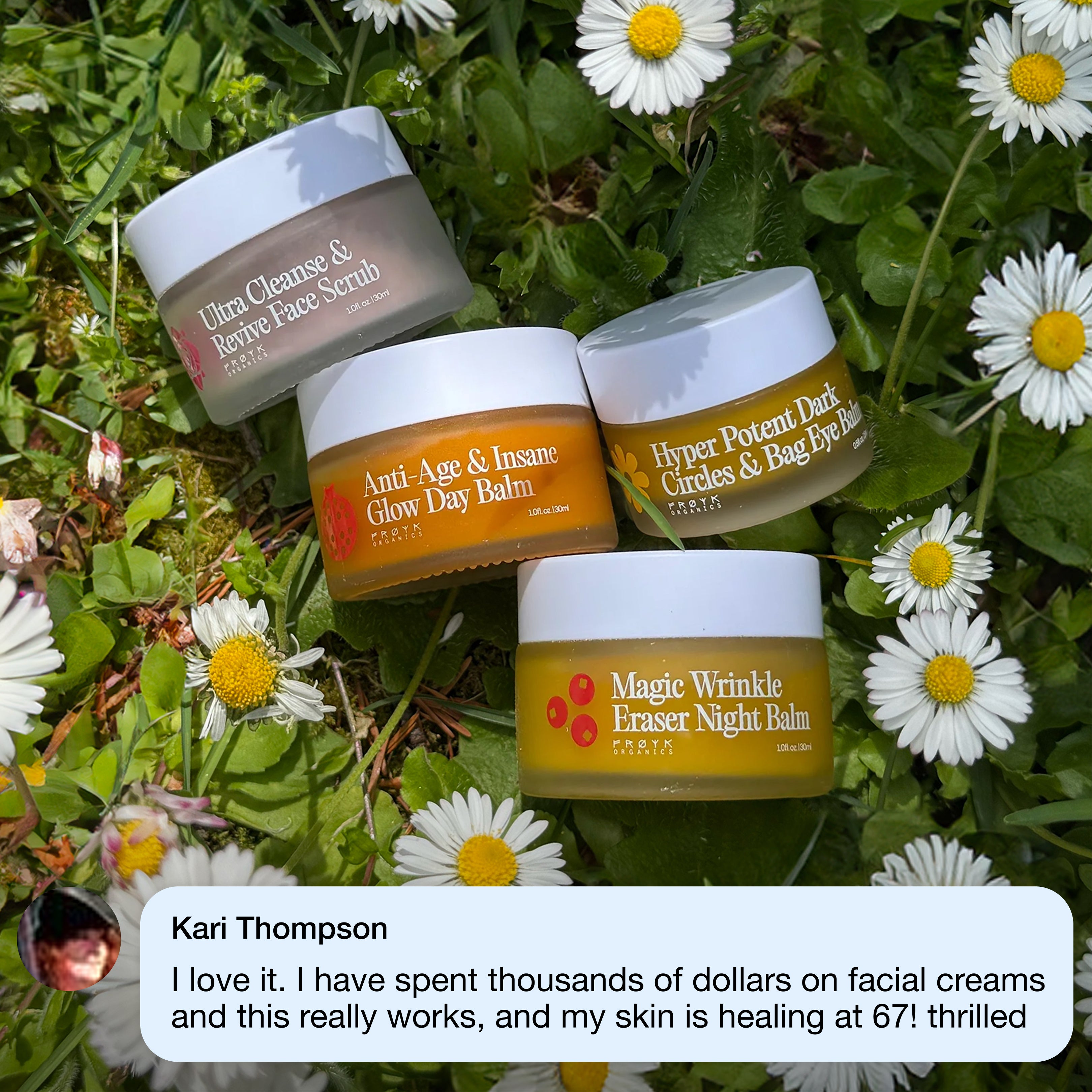
Four waterless botanical steps in one set: day balm, night balm, eye balm, and cleansing scrub, made in Norway from wild Arctic botanicals and organic beeswax, backed by a 60-day money-back guarantee.
Shop the System TodayDisclaimer: This article is for general information only and isn't medical advice. Frøya Organics balms are cosmetic products made to soothe and support the skin, not to treat any condition. If you have a known fragrance allergy or a lasting skin reaction, talk to a board-certified dermatologist before trying new products.
Häufig gestellte Fragen
Is there a difference between scent free and fragrance free?+
Is fragrance-free better than unscented?+
What is a good unscented moisturizer?+
What are some hypoallergenic skin care products?+
What are some chemical-free skin care products available?+


