

 Account


Psoriasis treft ongeveer 3% van de mensen, en als je het hebt, ken je het patroon al: droge, schilferige plaques die jeuken, scheuren en steeds terugkomen, wat je ook probeert.
Het korte antwoord: er is geen genezing, maar de meest betrouwbare natuurlijke behandeling voor psoriasis is eenvoudige dagelijkse verzorging die ontstekingen kalmeert en je huidbarrière herstelt. Een dikke, botanische balsem zoals de Balsem voor de Droge, Jeukende Huid doet precies dat: het kalmeert jeuken en verzacht plaques zonder steroïden of sterke zuren.
Wat veel mensen nooit horen: hydrateren is niet alleen comfort. Het is het meest wetenschappelijk ondersteunde wat je thuis kunt doen om uitbarstingen onder controle te houden.
Hieronder lees je wat echt helpt, wat het onderzoek zegt over aloe vera, havermouttbaden en zonlicht, welke middelen je moet overslaan, en hoe je een zachte routine opbouwt die je huid eindelijk wat rust geeft.
Belangrijkste Punten
- Psoriasis is niet te genezen, maar de juiste dagelijkse verzorging kan jeuken kalmeren, plaques verzachten en uitbarstingen verlichten.
- Hydrateren is de meest wetenschappelijk ondersteunde thuismaatregel, omdat het verzegelen van je huidbarrière scheuren en irritatie vermindert.
- Natuurlijke middelen zoals aloe vera, havermouten zonlicht werken het beste als aanvulling, niet als vervanging van medische zorg.
- Stress, voeding en koud weer zijn veel voorkomende triggers, dus het beheersen ervan helpt symptomen onder controle te houden.
- Een dikke botanische balsem met kalmerende ingrediënten geeft je huid zachte verlichting zonder steroïden of sterke zuren.
Waarom Psoriasis Ontstaat: de Huidcel en Immunsysteemcyclus

Psoriasis is een chronische auto-immuunziekte waarbij je immuunsysteem je huid veel sneller laat groeien. Normale huidcellen vervangen zich in ongeveer 30 dagen. Volgens Cleveland Clinic versnelt een overactief immuunsysteem dit tot slechts 3 of 4 dagen, waardoor cellen zich ophopen in de verheven, zilveren vlekken die psoriasisplaques worden.
Dit is belangrijk omdat het verandert wat een goede behandeling zou moeten doen. Plaquegraafpsoriasis is niet gewoon een droogteprobleem dat je met elke willekeurige crème kunt oplossen. Het is een ontstekingstoestand die door je immuunrespons wordt aangestuurd, dus het kalmeren en beschermen van je huid werkt beter dan schuren.
Die plaqueophoping verzwakt ook je huidbarrière, de buitenste laag die vocht binnenhouden. Een zwakkere barrière betekent meer droogheid, scheuren en de jeukende, schilferige psoriasyssymptomen die je goed kent. Het herstellen van die barrière is waar echt comfort begint.
Wat Natuurlijke Behandeling voor Psoriasis Kan en Niet Kan Doen
Natuurlijke behandelopties werken het beste als aanvulling, niet als vervanging van medische zorg. Ze kunnen symptomen zoals jeuk, roodheid en schilfers verlichten. Ze kunnen de aandoening niet genezen en zijn geen vervanging voor wat je arts voorschrijft voor matige tot ernstige gevallen.
De National Psoriasis Foundation zegt dat natuurlijke opties kunnen helpen wanneer ze naast traditionele behandeling worden gebruikt, maar raadt aan eerst met je arts te spreken. Dit is vooral belangrijk met kruidenremedies, die kunnen interageren met medicijnen, en als je zwanger bent, borstvoeding geeft of aandoeningen als diabetes of hoge bloeddruk beheert.
Denk aan verzorging in drie eerlijke lagen:
- Wat medische behandeling doet: vertraagt huidcelgroei en kalmeert immuunovermoeide activiteit met voorschriften.
- Wat natuurlijke topische verzorging doet: kalmeert symptomen, sluit vocht in en ondersteunt de huidbarrière.
- Wat niet werkt: elk middel dat beweert psoriasis permanent te behandelen.
Houd dit in gedachte en je spot marketing-hype snel. Het doel hier is voelbare verlichting.
Dagelijkse Hydratatie en Barrièreverzorging: de Basis van Verlichting
Als je één ding voor je psoriasis doet, hydrateer je huid. Het is het meest wetenschappelijk ondersteunde van alle huismiddelen en het werkt door water in je huid in te sluiten.
De gezamenlijke richtlijnen van de American Academy of Dermatology en National Psoriasis Foundation bevestigen dat niet-geneeskundige vochtinbrengende middelen helpen jeuk en schilfers te verminderen als onderdeel van een algemeen behandelplan. Emolliënten werken door vocht in je huid buitenste laag vast te houden, wat irritatie kalmeert en helpt de barrière te herstellen.
Waarom hydrateren werkt: Emolliënten houden water vast in je huid buitenste laag, waar barrièreherstel plaatsvindt. De AAD en NPF staan op de lijst als veilig met bijna geen bijwerkingen, en ze kunnen zelfs tijdens zwangerschap worden gebruikt.
Een paar dingen zetten hydratatie echt aan het werk:
- Ga dik. Een rijke balsem of dikke crème houdt veel beter stand dan een waterige lotion op gescheurde huid.
- Timing is alles. Breng aan binnen enkele minuten nadat je een warm bad hebt genomen om vocht in te sluiten.
- Hou het zacht. Zoek naar formules zonder synthetische geur en kleurstof, die irritatie kunnen triggeren.
Consistentie loont hier. Plaques vochtinbrengend houden voorkomt dat ze scheuren, wat de jeukkrabbel-cyclus doorbreekt. Hier lees je hoe je een beschadigde huidbarrière natuurlijk herstelt.
Warme Baden, Havermouten en Zouten voor Jeukverlicht
Een warm bad kan schilfers tillen en jeuk snel kalmeren. Het sleutelwoord is warm, niet heet. Heet water trekt je huid zijn natuurlijke oliën af en kan psoriasis erger maken.
Een colloïdaal havermouttbad is een veelgebruikerde favoriet voor jeukverlicht. Het bestaat uit fijngemaalde haver die in water oplost, en veel mensen merken dat het roodheid kalmeert. Cleveland Clinic verwijst naar een onderzoek waarin colloïdale haver symptomen bij de meeste deelnemers verbeterde, hoewel meer onderzoek helpt.
Epsomsaltzoutbaden en Dode-Zeezoutbaden zijn een ander zacht alternatief. Een warm bad met een paar theelepels kan schilferige schilfers verwijderen en ontstekingen verlichten. Zak ongeveer 15 minuten, dep dan droog en hydrateer terwijl je huid nog damp is.
Eenmaal per dag baden is meer dan voldoende. Vaker dan dat kan je uitdrogen en de verlichting die je hebt behaald ongedaan maken.
Botanische en Kruidenremedies Die Mensen voor Psoriasis Proberen
Veel natuurlijke middelen worden voor psoriasis besproken, en enkelen helpen echt. Sommige hebben degelijk onderzoek achter zich, andere zijn vooral van horen zeggen. Hier is een eerlijk overzicht, gerangschikt naar hoeveel onderzoek elk ondersteunt.
|
Middel |
Hoe Het Kan Helpen |
Ondersteunend Bewijs |
|
Aloe vera |
Vermindert roodheid en schilfers |
Gematigde, zoek naar 0,5% aloe |
|
Oregondruif |
Kalmeert milde tot gematigde psoriasis |
Gematigde, 10% crème onderzocht |
|
Kurkuma (curcumine) |
Verlaagt ontstekingen, verandert TNF |
Veelbelovend, vooral oraal |
|
Visolie |
Kan schilfers en jeuk verminderen |
Gemengd, bewijs conflicteert |
|
Appelazijn |
Kalmeert jeuk op de hoofdhuid bij psoriasis |
Zwak, alleen anekdotisch |
|
Theeboemolie |
Antibacterieel, antischimmelig |
Geen klinisch bewijs, allergie-risico |
De zachtere opties zijn het waard om te kennen. Gel uit de aloëveraplant heeft kalmende, ontstekingsremmende eigenschappen en werkt het beste als crème met minstens 0,5% aloe. Oregondruif brengt antimicrobiële en antioxidante eigenschappen die milde uitbarstingen kunnen kalmeren.
Een paar trendykeuzes vereisen meer voorzichtigheid. Appelazijn kan steken of beschadigde huid beschadigen, en theeboemolie en andere essentiële oliën veroorzaken allergische reacties bij sommige mensen. De conclusie is eenvoudig: je huid gedijt het beste met zachte, kalmerende botanicaliën, niet sterke enkelvoudige ingrediënten die ertegenin gaan.
Lichttherapie en Verstandig Zonneblootstelling
Zonlicht kan psoriasis echt helpen. De UVB-stralen van de zon vertragen huidcelgroei, wat plaques in de loop der tijd minder ernstig kan maken. Korte, regelmatige blootstelling is het idee, niet een lange dag buiten.
Lichttherapie, ofwel fototherapie, is de klinische versie. Het levert geconcentreerde UVB af in een artsenpraktijk en wordt gebruikt voor hardnekkige gevallen. Sommige mensen vragen ook naar vitamine D, omdat het huidcelgroei kan vertragen wanneer het wordt gebruikt in voorgeschreven topische zalfjes, hoewel het via de mond nemen minder bewezen is.
Verstandige zonnezorg is hier van belang. Het doel is gematigde blootstelling zonder verbranding, omdat zonnebrand psoriasis kan verergeren en uw huidkankerrisico in de loop van de tijd verhoogt. Fysieke bescherming komt eerst, dus gebruik schaduw en kleding om je tijd in sterke zon te beheren, en reserveer een minerale zonnebrandcrème met zinkoxide voor langere perioden buiten.
Als je een voorgeschiedenis van huidkanker hebt, sla de zonbenadering over en praat met je arts.
Conventionele Psoriasisbehandelingen, Beknopt
Het helpt om te weten hoe de medische route eruitziet. Voor matige tot ernstige psoriasis bereiken dermatologen sterker gereedschap dat snel werkt.
Deze topische psoriasisbehandelingen omvatten corticosteroïdcrèmes, teerproducten, salicylzuur en biologica voor de moeilijkste gevallen. Ze kunnen effectief zijn, maar veel dragen bijwerkingen met zich mee zoals irritatie, dunner wordende huid of vlekken, en sommige zijn niet bedoeld voor dagelijks langdurig gebruik.
Oudere totale benaderingen zoals Ayurvedische geneeskunde en andere traditionele geneeskunde systemen verschijnen ook in de behandeling van psoriasis, hoewel het bewijs sterk varieert. Natuurlijke botanische verzorging staat naast deze, niet ertegenin.
Als je de eerlijke vergelijking wilt, breekt steroïden versus botanica voor psoriasis uit. Veel mensen gebruiken zachte dagelijkse verzorging tussen uitbarstingen terwijl ze traditionele behandelopties van hun arts volgen.
Stress, Voeding en Dagelijkse Triggers
Je huid flakkert niet in een vacuüm. Emotionele stress is een van de grootste triggers, en het kan de jeuk erger maken, wat dan meer stress voelt.
Een paar gewoonten helpen echt bij het beheren van uitbarstingen:
- Verlicht stress met mindfulness, die de immun-huidverbinding positief kan beïnvloeden, of oefen yoga om symptomen te verlichten.
- Eet ontstekingsremmend voedsel rijk aan omega-3's, plus veel fruit en groenten.
- Zorg voor je gewicht, omdat het handhaven van een gezond gewicht de ziektelast voor psoriasispatiënten kan verminderen.
Dit vervangt geen topische verzorging, maar het neemt druk van je immuunsysteem en kan zelfs helpen pijn van psoriasis-artritis-uitbarstingen te verlichten. Kleine, constante veranderingen tellen op.
Omdat hormonale verschuivingen ook een rol spelen, lees je hier waarom menopauze jeukende huid kan triggeren en wat het kalmeert.
Een Botanische Balsem Gebouwd voor Droge, Jeukende Psoriasisgevoelige Huid

Alles hierboven wijst naar één prioriteit thuis: hou je barrière verzegeld en kalm met een dikke, botanische balsem. Dat is waarvoor de Balsem voor de Droge, Jeukende Huid gemaakt werd.
Het is een waterloze kamille- en distelbijenwaxbalsem, dus elk stukje gaat aan het werk verzegelen en kalmeren in plaats van op het oppervlak te zitten zoals een waterige crème. Blauwe kamille kalmeert ontstekingen, jeuk en roodheid, terwijl bijenwas en rijke zaadoliën vocht insluiten en de barrière ondersteunen terwijl deze herstelt.
De formule slaat het sterke spul over. Geen steroïden, geen synthetische geur, geen zuren. Bij het eigen testen van het merk had 80% van de gebruikers minder droge, jeukende huid en zag 79% hun huid opklaren binnen 60 dagen dagelijks gebruik.
Je hebt slechts een klein vingertopje nodig op schone huid, twee tot drie keer per dag. Het is een eenvoudige manier om je huid kalm en comfortabel te houden tussen uitbarstingen.
Complete Apotheek voor Gezicht & Lichaam: Hoe het Systeem Samenwerkt

De verlichting balsem is de ster, maar hoort bij een drie-balsem-set gebouwd voor huid die op meer dan één manier optreden kan. De Complete Apotheek voor Gezicht & Lichaam paren het met twee meer balsems die dezelfde botanische, waterloze basis delen, dus elk een ander werk doet.
|
Balsem |
Wat het Doet voor Psoriasisgevoelige Huid |
Hoe te Gebruiken |
Belangrijkste Botanicaliën |
|
Kalmeert en verzegelt droge, jeukende, schilferige plaques |
Breng aan op schone, droge huid 2 tot 3 keer dagelijks, dun en vaak |
Blauwe kamille, bijenwas, zaadoliën |
|
|
Kalmeert zichtbare roodheid en irritatie |
Smeer een dunne laag over geïrriteerde gezichtsstukken |
Goudsbloem, distel, duindoorn |
|
|
Verlicht gewrichtspijnen die met psoriasis kunnen reizen |
Masseer in gevoelige plekken zoals nodig, verwacht een licht verwarmend tintelen |
Smeerwortel, arnica, eucalyptus |
Hoe het systeem samenwerkt: Psoriasis toont zich zelden als maar één probleem. De verlichting balsem verzegelt en kalmeert de droge, schilferige plaques, de roodheid stopper kalmeert de blozen en irritatie die er vaak mee gepaard gaat, en de gewrichtsbalsem verlicht de pijnen die met psoriasis-artritis kunnen meereizen. Drie bezorgdheid, één zachte botanische routine.
Een klein beetje gaat lang mee met elk, dus een klein vingertopje is genoeg. Elke balsem werkt op zichzelf, dus er is niets om zelf te mengen of meten.
Je Verdient een Huid die zich Kalm Voelt

Leven met psoriasis is vermoeiend, en als steroïden, voorschriften en elk gehypet product je hebben teleurgesteld, is die vermoeidheid echt. Hier is het geruststellende deel: verlichting komt neer op consistentie, niet een mirakel.
Hou je barrière verzegeld en kalm, kalmeert de ontstekingen en beheers je triggers, en uitbarstingen worden gemakkelijker om mee te leven. Zachte, botanische verzorging beloont je voor dagelijks verschijnen.
De foto hierboven zegt het beter dan wij kunnen. Je kunt meer voor-en-na psoriasisresultaten zien van mensen die erbij bleven. De jouwe kan daar ook komen.
Dit artikel is alleen voor informatiedoeleinden en is geen vervanging voor professioneel medisch advies. Spreek met je zorgverlener voordat je een nieuwe behandeling begint, vooral als je zwanger bent, borstvoeding geeft of andere gezondheidsaandoeningen beheert. Frøya Organics-balsems zijn cosmetische producten die de huid kalmeren en ondersteunen, en zij behandelen of genezen psoriasis niet.
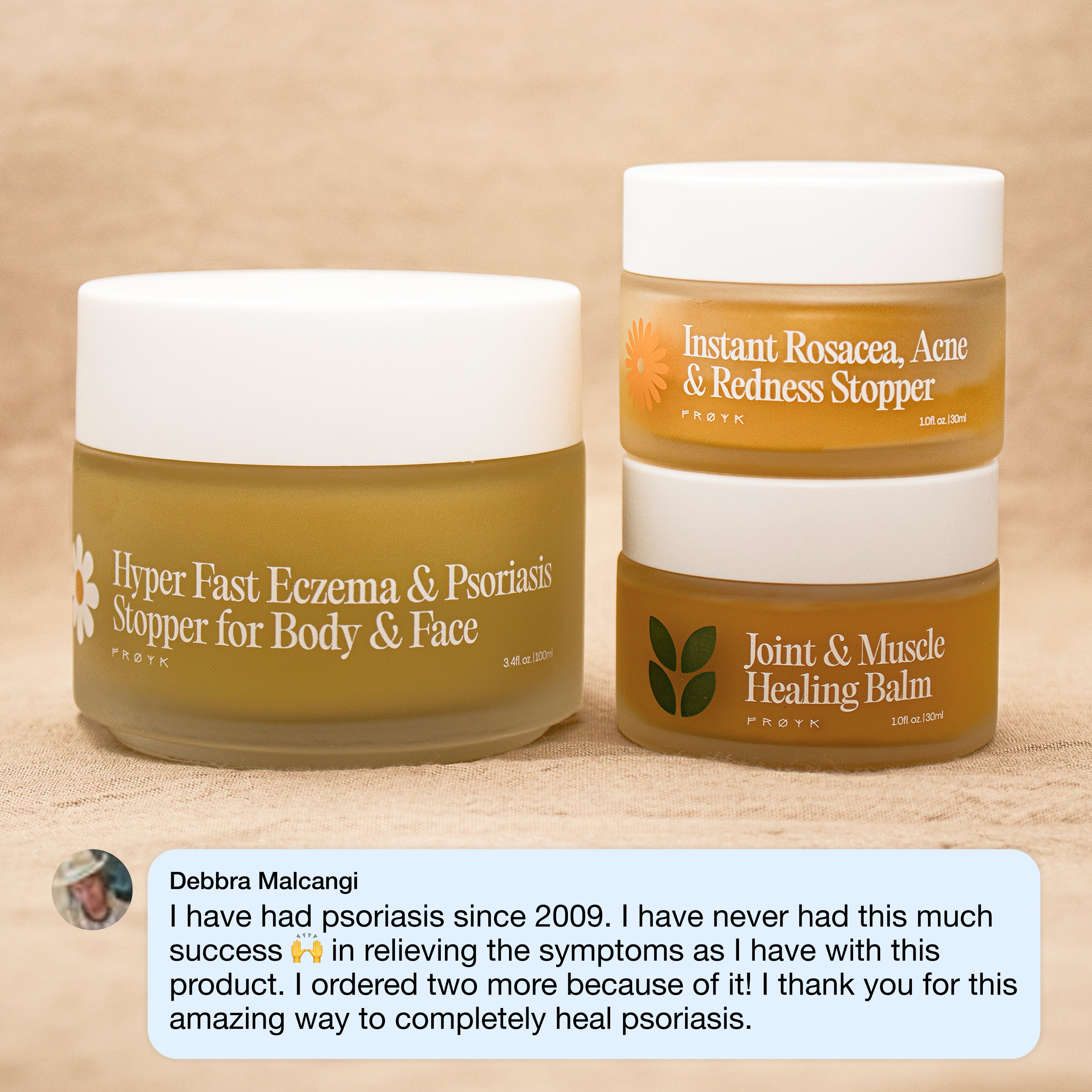
Drie waterloze balsems voor psoriasis, roodheid en gewrichtspijn. Wilde arctische planten en biologische bijenwas kalmeren, verzegelen en ondersteunen huid op gezicht en lichaam, ondersteund door een niet-goed-geld-terug-garantie van 60 dagen.
Shop het Systeem VandaagVeelgestelde Vragen
Wat is de grootste trigger voor psoriasis?+
Wat mag je niet op psoriasis aanbrengen?+
Kun je psoriasis kalmeren zonder steroïden?+
Is er een genezing voor psoriasis?+


